
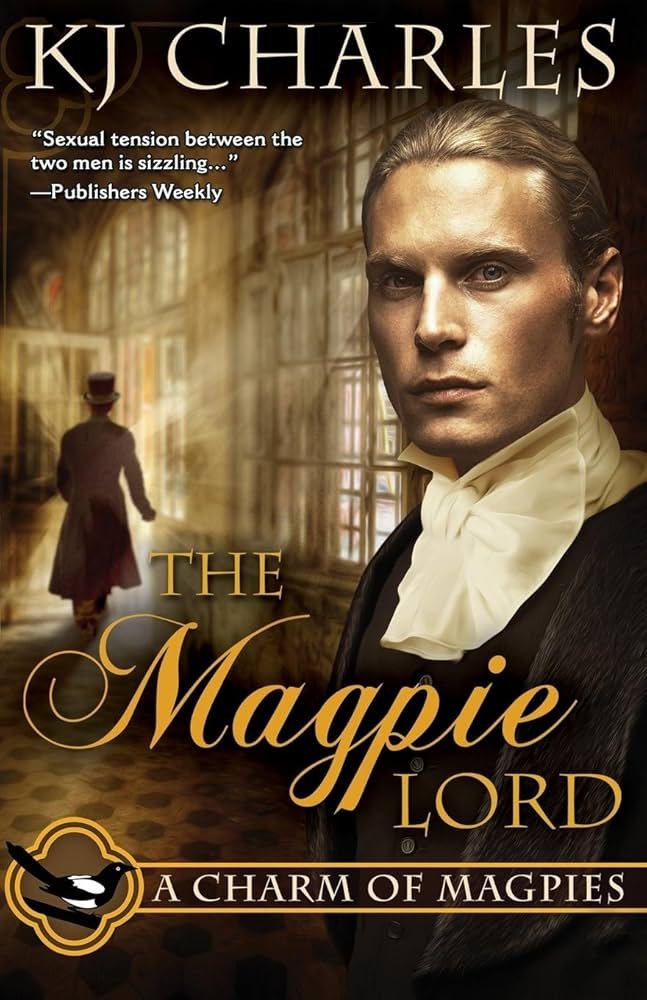
S08.13 KJ Charles’s The Magpie Lord: We’re Gonna Get to the Tattoos
We’re so excited for our deep dive of KJ Charles’s The Magpie Lord, first in her magical, gothic series, A Charm of Magpies. We talk about the clear chops displayed in this romance --strong plotting, complex characterization, and a beautiful understanding of what happily ever after looks like. And yes, we get to the tattoos. Obviously.

Notes
This is our second KJ Charles deep dive. The first was Band Sinister.
We were lucky enough to speak to KJ Charles about her work and her pathway through romance as part of our Trailblazers series. Listen to that interview here.
It’s been the snowiest start to winter in Chicago since 1978! The Great Lakes can freeze, kind of. Here’s what the Great Lakes ice prediction for this year.
The Ice Fishing town hall meeting, as promised.
Heated Rivalry is great and Jen (and everyone else) thinks you should watch it.
The Magpie Lord was published in 2013 by Samhain Publishing, which shut down in 2016.
You can find all of our 80+ deep dive episodes in the Fated Mates Book Club.
Sponsors
Zara Doyle, author of Bianca and Her Wolf, available in print, ebook, audio or with your monthly subscription to Kindle Unlimited.
Lumi Gummies. Go to lumigummies.com and use code FATEDMATES for 30% off your order.
Alexandra Cait, author of Storm of Fire, available in ebook or with your monthly subscription to Kindle Unlimited.
1001 Dark Nights, publishers of years of delicious romance novellas and collections. The imprint will shutter in 2026, so head over and load up on print versions of all your favorites right now.

S05.35: Trailblazer Loretta Chase
The Trailblazers conversations continue this week with the brilliantly talented Loretta Chase, who we adore, and not only because she wrote one of our favorite romances of all time. We obviously talk about Lord of Scoundrels and Jessica and Dain, but we also talk about writing, about the challenges of writer’s block, about the glorious rabbit holes of research, and yes…we ask hard hitting questions about The Mummy. We are so grateful to Loretta for making time for us, and for writing such glorious books.
If you are in New England, you can meet Loretta and Sarah at the Ashland Public Library Romance Festival this Saturday, May 20th in Ashland, MA. Attendance is free! Learn more and register at Eventbrite.
We have a Patreon now, and it comes with an extremely busy and fun Discord community! Join other magnificent firebirds to hang out, talk romance, and be cool together in a private group full of excellent people. Learn more at patreon.com.
Show Notes
Welcome author Loretta Chase, author of over 20 historical romance novels. We did a deep dive on Lord of Scoundrels back in season 2.
Authors mentioned: Jayne Ann Krentz writing as Amanda Quick, Susan Holloway Scott, Mary Jo Putney, and Caroline Linden.
Publishing Professionals: Gail Fortune at Berkley, Walker & Co. Publishers and editor Ellen Edwards
Books Mentioned This Episode


Sponsors
Desirée Niccoli, author of Called to the Deep and Song of Lorelei,
both available for $0.99 this week in celebration of MerMay
and
Avery Maxwell, author of Your Last First Kiss,
available now from Amazon, or with a monthly subscription to Kindle Unlimited.


Loretta Chase 00:00:00 / #: The main thing about that book was that it was in me. I did not have to find it. It was there and it was demanding to be written. The characters were in my mind very clearly from the beginning, and that never happens. I'm always struggling. I'm always fumbling. It takes me a while to get to know who they are and what do they want and what's the goal, et cetera, et cetera. In this case, it was all very clear to me. The main thing I saw in the beginning was this child who had had this horrible, horrible childhood, badly traumatized, that turned him into this person who's a sort of monstrous. And I thought, what do you do for this person, or what's needed here for some kind of a balance?
00:01:02 / #: And the heroine was there instantly. It was like, okay, she's someone who just gets it. She gets the thinking, she gets the guy thinking, she gets whatever it is. And why is she that way? Because she grew up with boys all the time, and she's just smart and paying attention. I needed someone who could see through him, and Jessica just came to my mind. So they really formed in themselves on the stage, and the rest of it, the rest of that book, I know it sounds mystical and it's like writers shouldn't wait for this to happen because it doesn't usually, but it just wrote itself. It was like a movie and all I had to do was write it.
Sarah MacLean 00:01:47 / #: That was the voice of Loretta Chase, author of Regency Romances single title Historical Romances, and as everyone knows, Lord Of Scoundrels. This is Fated Mates. I'm Sarah McLean. I read romance novels and I write them.
Jennifer Prokop 00:02:08 / #: And I'm Jennifer Prokop, a romance reader and editor. You are about to hear our trailblazer episode with Loretta, where she talks about how she came to writing romance, her research process, and why she believes in historical research and folding it so well into her books and her life in romance.
Sarah MacLean 00:02:32 / #: And how it is that Lord of Sundress came to be. Without further ado, let's get into it.
Jennifer Prokop 00:02:44 / #: Here we are with the Loretta Chase. I'm just going to make words now, just they're going to flow out of me in a rush, because I'm so overwhelmed.
Sarah MacLean 00:02:52 / #: Loretta, we are so thrilled to have you.
Loretta Chase 00:02:56 / #: Oh, thank you for having me.
Sarah MacLean 00:02:58 / #: It's a delight. I don't know that you know this, but we are avowed Loretta Chase fans here at the podcast. We reference your characters all the time.
Loretta Chase 00:03:09 / #: Oh, thank you.
Sarah MacLean 00:03:11 / #: And of course, we've talked a lot about Lord of Scoundrels, so I'm sure we'll get into that as well. But in general, I'm just so thrilled to have you here. Thank you.
Loretta Chase 00:03:20 / #: I feel honored to be here, because I know about your podcast and I think it's just very cool.
Sarah MacLean 00:03:26 / #: Thank you. So we start all of these conversations the same way, and that is to say, how did you come to this genre?
Loretta Chase 00:03:36 / #: I came in a very weird way because I was never a romance reader. My mind was poisoned by my English professors, so I thought very scornfully of romance. And the way I came to it was after I had been writing professionally, and my husband said to me, "Do you want to write video scripts for the rest of your life? What do you really want to do?" And eventually, after much weeping, I admitted that I wanted to write a novel, but I had never been able to. I would write and write and write, and it just went on forever and it didn't have a story, and it didn't make any sense.
00:04:23 / #: And I realized just in that conversation, I made the connection with what I was doing in video and what could be done in a novel. And I realized all I needed was structure. So when you're writing scripts for video, you have a specific structure, you have a message that you want to get across. And I would always ask the clients, "What's the message? Can you tell me in one sentence what you want the audience to come away with?" And I realized the genre fiction does that.
Jennifer Prokop 00:04:54 / #: It sure does, bless.
Loretta Chase 00:04:55 / #: Yes. So I'm looking at mystery. I'm looking at science fiction. I'm looking at various genres, but it was like, oh, wait a minute, love stories. That's the part of the books that I really like, and maybe that's where I should be working. And yeah, love conquers all. Yes, please. Because it doesn't, in so many of the classic novels, the women are victimized. They die if they have sex. And so, I thought, oh, well, this is a great way to correct that. And I have a structure. I have a structure. I have something I like, which is a love story. And that gave me my start, and it worked nicely.
Sarah MacLean 00:05:47 / #: When you talk about the books or the parts of the books that you always love, the love story, what were you reading before you came to the genre?
Loretta Chase 00:05:59 / #: Well, a good example would be like Charles Dickens, Bleak House. All right. So there's Lady Dedlock and she's had an illegitimate child, and there's no forgiveness for her, she has to die. Anna Karenina, she has an affair, she has to die. Women who follow their sexual inclinations or fall in love outside of the norms of the time, they're punished. And I wanted to rewrite those stories. So actually, I did that with one of mine, not quite a lady, I took Lady Dedlock story as a starting point and said, "Okay, here's a person who had a child out of wedlock. It was kept a big secret, but she's going to have a happy ending."
Jennifer Prokop 00:06:52 / #: So at some point, did you read romance as research, or did you just-
Loretta Chase 00:06:57 / #: Oh, yes.
Jennifer Prokop 00:06:58 / #: Okay. So I mean, once you decided, wait, I might want to write this, did that happen concurrently or did you stop and think, okay, I'm going to give myself permission to read these books now?
Loretta Chase 00:07:09 / #: I approached it the way I would've approached a project in an English class. I started doing the research.
Sarah MacLean 00:07:15 / #: Do the reading, Loretta.
Loretta Chase 00:07:19 / #: Yes, exactly. So I read maybe hundreds of romances because I was also looking to find where would I fit. So at that time, there was Kathleen Woodiwiss and Johanna Lindsey, and they wrote those big sprawling romances, and I didn't think that was me. And then, I encountered the traditional regencies and I thought, oh, this is perfect. This is a time period I'm very interested in. I love the witty banter. And it was like there were smaller books, so I felt like I could handle that for my first thing. So that was how I ended up there. But there was a lot of research before I actually started trying to write a book.
Sarah MacLean 00:08:14 / #: Your first books are traditional regencies and they're category regencies, right?
Loretta Chase 00:08:20 / #: Right. I wrote for Walker & Company.
Sarah MacLean 00:08:24 / #: Now, wait, that's a name we haven't talked about at all.
Jennifer Prokop 00:08:27 / #: I know. I don't don't think we've ever talked about that.
Sarah MacLean 00:08:28 / #: What is that?
Loretta Chase 00:08:30 / #: Wow. When I started writing, there were so many places that were publishing regencies. There were so many lines. I made a big list and I went with Walker because they published hard cover, and I thought that was cool, but I was not expecting to be accepted. That was my thing. And they accepted the book.
Jennifer Prokop 00:08:53 / #: So this is Isabella?
Loretta Chase 00:08:55 / #: Yes, yes. And then, I later discovered it was primarily they were publishing for libraries. And that worked out fine because my agent ended up selling the paperback rights to Avon. And it was through Avon that I met my editor, Ellen Edwards, and she was the person who got me to write historical romance, longer books.
Sarah MacLean 00:09:21 / #: How many books did you do with Walker?
Loretta Chase 00:09:24 / #: Six.
Sarah MacLean 00:09:25 / #: Okay. Walker was publishing the hardcovers, and Avon was publishing the paperbacks?
Loretta Chase 00:09:29 / #: Mostly, except for one book. I think Fawcett had published one book. The rest of it were Avon.
Sarah MacLean 00:09:35 / #: And Ellen was always your editor at Avon?
Loretta Chase 00:09:39 / #: Yes, yes.
Sarah MacLean 00:09:40 / #: So obviously Ellen Edwards is a name that we have talked about before and heard many people talk about. Can you give us a sense of what that editorial relationship was like with Ellen? Because it does feel like she had a really special eye.
Loretta Chase 00:09:57 / #: Oh, my gosh. She was amazing. I loved her so much. She would write a little note, three words in the margins, and a whole idea would open up for me, or I would see how I had gone astray. But she wouldn't say, "You've gone astray." She would just ask a little question. And she was so perceptive. When she invited me to write historical romance, I said, I don't think I can do that. I don't think I can write those big books. And she said, "It's just like what you're doing only bigger." And then she said, "Read Laura Kinsale."
Jennifer Prokop 00:10:41 / #: Oh, sure.
Sarah MacLean 00:10:44 / #: A perfect beginning for you, yeah.
Loretta Chase 00:10:46 / #: Yes. So she knew that I would connect with what Laura Kinsale was writing, and she was absolutely right. She was just so insightful. I can't say enough about her. I think she was a fabulous editor.
Sarah MacLean 00:11:02 / #: So you moved from Walker over to Avon for single titles, and that's the early '90s?
Loretta Chase 00:11:11 / #: Yes.
Sarah MacLean 00:11:11 / #: Yeah. And that's sort of what we always clock here as the heyday of there was a really, or maybe not the heyday, but there was a really remarkable sea change in historical right then in the early '90s. And it was led largely by, it seems like Ellen there. And I wonder if you could talk a little bit about what was going on during that time period. Did it feel like readers were just drawn to historicals? Now, we look back and we say, "Okay, well, Ellen, she'd acquired you and you put out Lord of Scoundrels," which we'll get to. And then she acquired Beverly Jenkins, who was doing what Bev does over there. And Lisa Kleypas' books from the early '90s really were changing the game. And was there something?
Jennifer Prokop 00:12:06 / #: Was there in the water?
Loretta Chase 00:12:10 / #: I'm not sure, but there was something else. I mean, Avon wasn't the only place. This is the interesting thing. A lot of the friends that I made early on were writing regencies for Signet, and then Signet started doing what they were calling Super Regencies, so it was like the traditional Regency, but a bigger story, more sex. And that's a lot similar to what was going on at Avon, although Avon's weren't quite so much in that Regency, not precisely in that Regency mode. So there was definitely something going on in other places. It was just that-
Sarah MacLean 00:12:45 / #: Across the board?
Loretta Chase 00:12:46 / #: Yes, yes. And that Regency sensibility, I think was, for some reason, it ebbs and flows. I've been around for so long because I'm so ancient that I see these ebbs and flows of what people are reading and what they're not reading. I really can't account for it. It's hard to account for what happens with tastes. And I'm not that analytical to begin with. I write what I write and cross my fingers. That's okay.
Jennifer Prokop 00:13:20 / #: If you had six books before, oh my God, I've already spaced on the name of that-
Loretta Chase 00:13:25 / #: Walker.
Jennifer Prokop 00:13:26 / #: Walker.
Loretta Chase 00:13:27 / #: Yes.
Jennifer Prokop 00:13:27 / #: Does that mean Lord of Scoundrels was the first Avon book? I'm sort of looking at FictionDB, but it maybe-
Sarah MacLean 00:13:35 / #: No, it was The Lion's Daughter, right?
Loretta Chase 00:13:36 / #: The Lion's Daughter, and then Captives of the Night. And I've always forgotten to tell this story about that transition, but right around the time, I think when I had written Captives of the Night, Jayne Ann Krentz started writing as Amanda Quick, and I think she sort of triggered a sea change in the way we were approaching historical romances because she came with that contemporary romance sensibility, and she was writing romantic suspense.
00:14:15 / #: And when she turned to writing these historical sort of Regency Victorian set, they had that feel to them, and they weren't quite the sprawling books that we were working on at that time. And I'm sure that fed into my thinking when I was writing Lord of Scoundrels, because it's quite a different book from Captives of the Night and The Lion's Daughter. And I think that's part of it was that influence of, wow, this is another way to do this. And there are things that you absorbed by osmosis. And it was only, I mean, actually really, the other day when I was thinking about that, that I remembered about Jayne Ann Krentz and that Amanda Quick thing and how that seemed to have changed things.
Jennifer Prokop 00:15:09 / #: I vividly remember as a reader reading Amanda Quick and feeling like this was different. I could tell it was different. And I just was so drawn to those books. And it's not that I didn't love, I of course loved it all, but I vividly remember really feeling like everything about those books was different. And so, it doesn't surprise me to know that that was apparent to the authors at the time as well. New rules almost, for what could be done.
Loretta Chase 00:15:40 / #: Yes.
Sarah MacLean 00:15:42 / #: It felt like heroines especially were shifting at the time.
Loretta Chase 00:15:46 / #: Yes.
Sarah MacLean 00:15:47 / #: Amanda Quick brought a very different kind of heroine to the Regency.
Loretta Chase 00:15:51 / #: Yes, absolutely. And it was more clearly feminist and more clearly aware of differences in communication between women and men, and addressed some really interesting aspects of male-female relationships that I did not feel as though we had or I was dealing with anyway, in my earlier books necessarily. And then, I started reading some other things. One of the books that was very influential was You Just Don't Understand.
Jennifer Prokop 00:16:28 / #: Oh yeah, I remember that. Sure.
Sarah MacLean 00:16:30 / #: I don't remember that.
Jennifer Prokop 00:16:34 / #: It was like a pop culture kind of psychology book.
Sarah MacLean 00:16:38 / #: I see. Women and men in conversation.
Jennifer Prokop 00:16:39 / #: About women and men in conversation. And it was like the first time I was ever, and this was when I was in college. I was in college from 1991 to 1995, and it was this take, I remember about topping people when you're talking and someone comes along and just talks over you, which I feel like I'm kind of doing now. Sorry, everybody. And it was really a real take at this is how people communicate differently based on how essentially they were raised in their gender identity.
Loretta Chase 00:17:12 / #: So that was very enlightening. And then, that also led to my having conversations with my husband about that, about communication styles. So I think that also influenced the way I dealt with the relationships in my stories.
Jennifer Prokop 00:17:27 / #: This week's episode of Faded Mates is sponsored by Desirée Niccoli, author of the Haven Cove duology, Called to the Deep, book one, and the Song of Lorelei, book two.
Sarah MacLean 00:17:39 / #: Jen, did you know that in many circles, it is not in fact the month of May. It's the month of Mermay.
Jennifer Prokop 00:17:47 / #: Amazing. I feel better for knowing this.
Sarah MacLean 00:17:50 / #: Listen, if you're out there and you are enjoying all the drawings of mermaids that are being posted on social media and all the talk about mermaids that's happening, and you're just cannot wait for this new live action Disney movie, we have the series for you. This one is pretty delicious. And I use that word intentionally because it features Killian Quinn, the captain of an offshore fishing boat that receives a distress call from a sailing ship in a terrible storm early in the book in the Duology. He and his crew head out. They make a big save, they save the crew. And a woman who does not know who she is and has no knowledge of how she got on the boat, turns out this is Lorelei Roth who is not just a normal woman, she is actually a mermaid. And in the world building of this series, mermaids eat people.
Jennifer Prokop 00:18:49 / #: I'm not even mad about it.
Sarah MacLean 00:18:50 / #: Listen, at one point in the blurb it says, "The handsome captain begins to look like a tasty snack in more ways than one."
Jennifer Prokop 00:18:59 / #: Perfect. No notes.
Sarah MacLean 00:19:00 / #: Are they going to get together? What happens when he finds out she's a flesh eating mermaid? Does she eat him and not, I mean, I'm sure-
Jennifer Prokop 00:19:09 / #: Sure. We all know what you're about to say. Here's the thing, everybody, in celebration of Mermay, you can get both books in the Haven Cove duology between May 15th and May 22nd for only 99 cents wherever you buy your eBooks. It's also available in print. Thanks to Desiree for sponsoring this week's episode.
Sarah MacLean 00:19:29 / #: And happy Mermay to all who celebrate. So Ellen brings you over to do these kind of single titles for Avon. You write two, and then you write Lord of Scoundrels, and let's get into it. I mean, because we have to. Tell us about the writing of it, the conception of it, and then because you say, "Well, they weren't like these big sprawling books from before," but Lord of Scoundrels is a epic store. I mean, it covers a lot of ground. So I wonder if you could talk a little bit about how it came to be.
Loretta Chase 00:20:15 / #: Okay, I had to make myself some notes about this because-
Jennifer Prokop 00:20:19 / #: Long time ago.
Loretta Chase 00:20:22 / #: Well, yes, long time ago, and I write intuitively, so I'm not quite sure what I'm doing most of the time. There were some things that fed into that, but the main thing about that book was that it was in me. I did not have to find it. It was there and it was demanding to be written. The characters were in my mind very clearly from the beginning, and that never happens. I'm always struggling. I'm always fumbling. It takes me a while to get to know who they are and what do they want and what's the goal, et cetera, et cetera. In this case, it was all very clear to me.
00:21:08 / #: The main thing I saw in the beginning was this child who had had this horrible, horrible childhood, badly traumatized, that turned him into this person who's sort of monstrous. And I thought, what do you do for this person or what's needed here for some kind of a balance? And the heroine was there instantly. It was like, okay, she's someone who just gets it. She gets the thinking, she gets the guy thinking, she gets whatever it is, and why is she that way? Because she grew up with boys all the time, and she's just smart and paying attention. So I needed someone who could see through him, and Jessica just came to my mind as... So they really formed in themselves on the stage. And the rest of that book, I know it sounds mystical, and it's like writers shouldn't wait for this to happen because it doesn't usually, but it just wrote itself. It was like a movie, and all I had to do was write it.
Sarah MacLean 00:22:22 / #: That's how it feels.
Jennifer Prokop 00:22:24 / #: It is how it feels reading it.
Sarah MacLean 00:22:25 / #: When you read it, you just feel like it's just perfection.
Loretta Chase 00:22:29 / #: Thank you. But I consider it a gift. I got a gift from the writing gods with that book.
Jennifer Prokop 00:22:38 / #: You were talking about Dain's like trauma, right?
Loretta Chase 00:22:41 / #: Right.
Jennifer Prokop 00:22:41 / #: So what's interesting to me about that is I think a lot of people kind of, I don't know, write about trauma without doing a lot of research on trauma. And at one point, we have a friend who is an expert on trauma, and she was like, "This book does it so perfectly." I mean, was that part also intuitive, or was that something where you really did think like how can I write about his trauma? I mean, I don't know, maybe it all was mystical, but it's hard, I think, to write about traumatized characters without feeling like you're taking advantage of traumatized people. I don't know if that makes sense.
Loretta Chase 00:23:22 / #: It's an empathetic thing, and it's also, if you look back at your own childhood and the way children treat one another, that wasn't so hard for me. I knew quite a bit, I had done quite a bit of research, so I understood about the bullying at Eton, and it wasn't that hard to imagine a child who's been rejected by his family and has dealt with abandonment. I think it was just, I don't know, this is something that writers do. You try to put yourself in the other person's shoes, or you think back to your own childhood and maybe your friends, what happened to them or things you saw in the playground. You're drawing on all of that. So it wasn't as though I studied trauma, I was just imagining, trying to imagine what kind of torturous childhood would make a person just shut everything off.
Sarah MacLean 00:24:32 / #: So obviously, this book struck a chord across romance. I mean, it is a book that was talked about then, it continues to be talked about. It is on every list. It is a book that is held up by so many of us, including us as the best of it, the best of the genre. And I wonder if you could speak to the reception at the time, and it sounds like it was electric for you in the writing, but what happened after?
Loretta Chase 00:25:08 / #: Well, that's what's so funny, it's like when I wrote it, I felt, and I said this to Ellen, I said, "I think this is a pretty strong book."
Sarah MacLean 00:25:19 / #: Sure. That sounds exactly right. I mean, writers are always like, "I think it's okay."
Loretta Chase 00:25:25 / #: And the thing about Ellen-
Sarah MacLean 00:25:27 / #: Oh God, I loved her so much.
Loretta Chase 00:25:29 / #: She used to write 40-page notes on your books, which no one has time to do anymore.
Sarah MacLean 00:25:37 / #: Whoa.
Loretta Chase 00:25:37 / #: But they were so wonderful. Well, she had two little notes on this book. That was it. For Ellen, that never happened, that never happened. So I felt like, okay, this book really holds together, so that was great. But in terms of reception, they sent it out for blurbs, and I got really nice blurbs from various writers, but the book didn't take off or anything. It was just, it did okay. And then, it did win an RWA RITA, but that book took 12 years to earn out its advance.
Jennifer Prokop 00:26:19 / #: Oh, wow.
Sarah MacLean 00:26:19 / #: Wow. Really?
Loretta Chase 00:26:21 / #: Yes.
Sarah MacLean 00:26:23 / #: And it just was the little engine that could, or did something happen that-
Loretta Chase 00:26:28 / #: I don't know. It started appearing on that All About Romance List as a top book. And then, I think that it might've been really, a lot of word of mouth started so more and more people started reading the book and then it built up momentum. But initially, it was no big deal.
Sarah MacLean 00:26:51 / #: It was just a very good book.
Loretta Chase 00:26:55 / #: Right.
Jennifer Prokop 00:26:56 / #: I'm not surprised by it, because I think one of the fascinating things about romance readers, and we've talked about this before, is there are books I love when I read them, but I never want to revisit them. And then, there are books that grow on me over time, and I think that maybe there's something special about romance in that way. And so, it doesn't necessarily surprise me because there are books that when I first read them, I'm like, "It was okay." And then I'm like, "Wait, why have I reread that book now seven times?"
00:27:29 / #: So it surprises me the way things have a hold. I don't know, like a romance, the keeper shelf is no joke. And I think that the cumulative effect of it being on the keeper shelf for so many people, that word of mouth is really powerful. I mean, when I first started talking to people openly about liking romance, I would say to them, they would ask for recommendations. And I'll be like, "I have two for you. And one's historical, one's contemporary. And if you don't like either of them, then you don't like romance." Which you guys, that seems dramatic, but that's what I would tell people. And it was Lord of Scoundrels and Bet Me by Jenny Crusie.
Loretta Chase 00:28:11 / #: Oh, that book. Yes, yes.
Sarah MacLean 00:28:14 / #: Just like terrific.
Jennifer Prokop 00:28:15 / #: These books are what romance is all about. And if you don't like them, then you don't like romance. And that's okay, more for me.
Sarah MacLean 00:28:23 / #: But I also think there's something too, Jessica, I mean, not to keep coming back to the heroines, but I feel like Jessica Trent holds up however many years later, we don't need to count them, Loretta, but I feel like we read Lord of Scoundrels for one of our deep dive episodes a couple of years ago, and did a big episode on it. And if Jessica walked off the page of Lord of Scoundrels right now and walked into a modern historical written this year, she remains as relevant, as amazing, as aspirational as any heroine ever. And I think that is a hallmark of a book that just will forever be one that we hold up. But I'm fascinated to hear that it took 12 years to earn out. Wow.
Loretta Chase 00:29:32 / #: Yep.
Sarah MacLean 00:29:32 / #: Okay. So you've written what is arguably, I mean, not here arguably, but arguably the greatest romance of all time, but we still have to, it hasn't earned out, so you still have to make a living. And I want to talk a little bit here. I think this is a good place to talk about it, because one of the things that we have loved, or that I have loved about your books over the years forever is how much research goes into them, how much love and care you give the worlds that you create. You used to have a blog that I loved very much called Two Nerdy History Girls, which you had with your friend, whose name is now escaping me.
Loretta Chase 00:30:14 / #: Susan Holloway Scott.
Sarah MacLean 00:30:16 / #: Yes. And in that blog, you used to tell these great stories about how dark the ballrooms would actually be in romance novels, or the legendary scene from Lord of Scoundrels is that is the glove scene with the button hook. There's so much discussion where a fan, right, or remember the dueling book with the bird pistols?
Loretta Chase 00:30:45 / #: Yes. Yeah, the bird pistols.
Jennifer Prokop 00:30:47 / #: Right. Which has like, wait, this is a real thing. This is fascinating.
Sarah MacLean 00:30:51 / #: And then, my other favorite, Mr. Impossible, all the Egypt stuff. And I do want to know if that came from The Mummy or not, because that is a discussion that comes.
Loretta Chase 00:31:01 / #: Yes. No, it did.
Sarah MacLean 00:31:04 / #: You heard it here.
Loretta Chase 00:31:05 / #: The Mummy absolutely inspired that book, yes.
Sarah MacLean 00:31:09 / #: You just made a lot of people really happy.
Jennifer Prokop 00:31:11 / #: Exactly. This has been speculation for a long time, and now we have confirmation. Amazing.
Loretta Chase 00:31:18 / #: Oh, yeah. I was like, oh, wait, I can do this. And I always wanted to write about Egypt. I had been so fascinated by that, particularly what happened in the early 19th century and the discoveries that were made then. But I mean, there were these intrepid women who were involved in that discovery. So yeah, I loved doing the research for that. I have way more books than I ever needed to write that book, something like 50 books on Egypt. And no, having them in the library wasn't enough. I had to own them.
Jennifer Prokop 00:31:55 / #: We support you. Everyone just buy the books they want.
Sarah MacLean 00:31:59 / #: So talk about the research, because I do think that that is one thing that often historical romance novelists get. People don't realize quite how much research goes into the books because it does feel so invisible a lot of the time.
Loretta Chase 00:32:14 / #: Well, the goal is to make it invisible. You read books and books and make tons and tons of notes and look at all these images, and you're digging into historical newspapers and two lines appear on the page that have to do with that topic. But as Susan and I have often said, we really have to understand it. We have to be able to visualize. We have to feel like we're there in order to make the reader feel as though she's there.
00:32:45 / #: And I love it. I love reading the old newspapers, and it's like, this has been one of the fascinating and positive aspects of technology from the time when I first started writing, when we had no access to anything, and trying to find information on the Regency. We're so dependent on what Georgette Heyer wrote and a limited selection of books and memoirs that were not very accurate. And now, we can get primary sources. And I just love that. I love reading the newspaper and finding an event that happened, say, "Oh, wait a minute, I'm going to use that in a story." It's like, I did that in the last book, Ten Things I Hate About The Duke. I read about this fancy fair that was so crowded with people, and people were fainting because it was crowded. I said, "Oh, I have to set a scene there."
Sarah MacLean 00:33:48 / #: So tell us about the research process. As you said, you're an intuitive writer. Are you researching as you go? Do you sort of have a sense of what you're going to tackle in the book? Do you have a file? How does it work?
Loretta Chase 00:34:04 / #: Initially, what I was doing, I was taking, I think it was Stephen King's advice, and I was, or maybe it was Lawrence Block, somebody. I was researching what I needed to know for the scene. But now, and over the last maybe 20 years, I feel as though I need to get some sense of where I'm going to be with the story, what's the location? And then, I sort of build from there. And I kind of like that method better. I like going through the newspapers and looking at what's happening, say in May of 1832, and thinking about what can I do with that, because there are tons of ideas there for me. So now, it's a little more of a little bit some of the work in advance, but then most of the work as I'm writing.
Sarah MacLean 00:35:04 / #: At some point, Mr. Impossible, that series is not with Avon, that is with Berkeley.
Loretta Chase 00:35:12 / #: Right.
Sarah MacLean 00:35:12 / #: Right. So what happens in that world? How does the shift happen?
Loretta Chase 00:35:21 / #: Well, what happened was I finished The Last Hellion, and I had writer's block. My father had died, and I didn't realize that that was what was going on. It was grief. And I had very bad writer's block, and I couldn't write. And I bought back my contract, and I did not think I was going to write another novel.
Sarah MacLean 00:35:48 / #: Oh, my gosh.
Loretta Chase 00:35:50 / #: And then, what I did, I went back to writing video scripts and that sort of thing for a few years. And then, things change in our personal circumstances, and it became necessary for me to actually get a real job. And I've got myself a new agent, and she put me in with Berkeley. There had been an editor there who had been courting me all during my mental block period, because I was still going to conferences, Gail... Oh, I can't remember her name. Anyway, she had been courting me. She said, "Whatever you write, just can I look at it." And so, she ended up being the editor. So I was at Berkeley for a few years, but then she left Berkeley and my agent wasn't really thrilled with how the books were being sold. And so she-
Sarah MacLean 00:36:46 / #: When was that? That had to have been-
Jennifer Prokop 00:36:49 / #: Early 2000s, yeah?
Loretta Chase 00:36:52 / #: It was early 2000s when I went to Berkeley. And then, let's see, so I wrote Miss Wonderful, Mr. Impossible, and Lord Perfect. Oh, and then I had breast cancer.
Jennifer Prokop 00:37:05 / #: Oh, it's a small other thing.
Loretta Chase 00:37:09 / #: Oh, yeah. So I was finishing that book. I was finishing Lord Perfect when I had breast cancer, and I had to take a little time off from writing. And then, by that time I was getting ready to go back to work, that was when my agent was saying, "I think we can do better at Avon." And Avon welcomed me back. And the last couple of books in that series were through Avon. Some of these things, it's like your personal life messes things up for you or makes them better or whatever, but that's what happened.
Sarah MacLean 00:37:46 / #: Yeah. I want to go back to this intuitive writing piece too, because it feels like we've known each other for a while, and it feels like one of the magical things about your books is that you write them and you write until you're done, and then the book comes out. It feels like you really do honor the text and the story in a way that many of us, because of the way romance works, don't do. So I wonder when you sort of come to a new series or to a new book, are you waiting for inspiration to strike before you start?
Loretta Chase 00:38:31 / #: No. I start writing, and this has to do with my training in art, which my art professor always said, "If you wait for your inspiration to start, you might be waiting forever. Just start doing the work." So I start doing the work, and I find my way in the course of doing the work. So sometimes, I've been able to write a nice long outline, and that works beautifully, and that did work beautifully for me for a number of books. Other times, I just have to do it by the seat of my pants, because that's the way the book wants to be written, so I have to do whatever. It's hard to say, again, intuitive. I'm doing whatever is working at the time.
00:39:21 / #: And lately, it seems to be sit down, start writing, see where it goes, figure out the things as you go along, and then it's like go back and make it come together. So it's a construction process. It's not linear at all. And I don't think my mind really is linear. And I don't think even my earlier books were all that linear, but I was able to work out plots in advance in a way that made my life much easier. But I just can't do that lately.
Jennifer Prokop 00:39:54 / #: No. I mean-
Loretta Chase 00:39:55 / #: I wish I could.
Jennifer Prokop 00:39:55 / #: I'm the same way.
Loretta Chase 00:39:56 / #: But I can't.
Jennifer Prokop 00:39:57 / #: Have to.
Loretta Chase 00:39:59 / #: Yeah, you have a vague idea of what you want to do. It was like when I did The Dressmaker Series, for instance, I thought, all right, I'd like to have three sisters. I have some idea of what they're trying to accomplish. I know what they want to do. They want to rule the world. And then, it would be a matter of figuring out, okay, who are they? What are the differences between them? And then, the plots start coming together, but they arise very much out of the characters. So if I don't know the characters, I can't get a story. I would love to be able to write a plot and have the story go with it. Never.
Sarah MacLean 00:40:44 / #: Does that happen for anyone?
Loretta Chase 00:40:46 / #: Never.
Sarah MacLean 00:40:46 / #: I don't believe it.
Jennifer Prokop 00:40:49 / #: I think character is really king in romance. I think that's, for me, at least as a reader, I feel like when people start with a plot, sometimes I'm like, yeah, but why are these characters here? Right. Wait, yeah, that's not enough. I need to really believe that how they got there.
Loretta Chase 00:41:10 / #: Yeah, they're not puppets.
Sarah MacLean 00:41:13 / #: This week's episode of Fated Mates is sponsored by Avery Maxwell, author of Your Last First Kiss.
Jennifer Prokop 00:41:20 / #: Penny Mulligan is a mess. She has had a disastrous first marriage. She's basically the single mother to three perfect but rowdy boys and an ex-husband who is a bunch of trouble. The only thing she has going for her is the perfect eye candy who shows up bringing coffee to her boss every Wednesday, Dillon Henry. He is just perfect fantasy material, handsome, charming, thoughtful. But she's just not in a place for this.
Sarah MacLean 00:41:51 / #: No. She has three boys and an ex-husband. Nobody has time for new people.
Jennifer Prokop 00:41:55 / #: So she is just like, "I'm going to have fantasies about Mr. Wednesday." But then Dillon freaking Henry shows up at her doorstep, and he's totally into her, and he is ready to just figure out a way to take the perfect chaos of her life and turn it into HEA.
Sarah MacLean 00:42:16 / #: Oh, I love it. This is great for anybody who loves a small town romance, for people who are interested in single moms as heroines, friends to lovers, second chance, found family. If you want to read Your Last First Kiss, what a title, you can find it in print or in eBook, or with a monthly subscription to Kindle Unlimited. Thanks as always to Avery Maxwell for sponsoring the episode.
Jennifer Prokop 00:42:49 / #: We talk a lot. I think I know Sarah experiences at a deep level that romance readers connect with the books in such a way that almost everyone we've had on talks about letters they've received from readers. So what do readers tell you about your books?
Loretta Chase 00:43:13 / #: Oh, my gosh. Particularly during COVID, but before, I have had so many messages from people telling me the books help them get through cancer. The books help them get through grief. The books help them get through COVID. And I mean, from the time I started writing romance, I really understood the value. But I think it's had much more of an impact in the last few years of what we do when we write romance. What we're doing for other people when we write romance is we're giving them a place to be where things are, okay, you know it's going to come out right in the end.
00:44:08 / #: And the more difficult the world around you is, the more important it is to have this place where you can go. And I'm all for escapism, and I'm never going to hesitate to say that my books are escapist because they are. And I feel like they should be. Yeah, I've had messages that just made me cry. And I think the last couple of years have been so hard on people that it makes, in my view, romance more important than ever because we're giving them that safe place to be for the time of reading the book.
Sarah MacLean 00:44:52 / #: So you have people who have inspired you over the years, and it sounds like you've had a group of other writers who you've connected with and who love research as much as you. But I wonder if you could talk about who are the people who you have spent who have really kept you going? Because I know that this isn't always an easy job, right?
Loretta Chase 00:45:23 / #: Yeah. Well, Susan Holloway Scott and I have been friends for a million years now, and we talk on the phone a lot. We go to Colonial Williamsburg. We meet up at Colonial Williamsburg almost every year, and she's really important part. She's just been, well, a really good friend, and we can talk. And that's part of the thing too. It was one of the great things I discovered when I started writing romance and I started going to conferences. It's like, oh, wow, I found my tribe. We're talking to other women mostly who are writers, and we're living in that same environment and we're having the same struggles. And that's not something I'm going to be finding in my everyday life. I love my husband, I love my sisters, and I can talk to them about stuff, but not the way you can talk to other writers. So Susan's important.
00:46:27 / #: There have been a lot of people over the years. When I was first starting out, Mary Jo Putney was very, very encouraging to me. She reached out to me, sent me a letter early in my career with my first or second book. There was a little cabal of writers sign, Regency Writers with whom I was friends, and we would get together at conferences. And then, over the years, I've met more people. It's like now I chit-chat with Caroline Linden, so it's evolving. But yeah, that's one of the great things that the great discoveries for me, when I started writing romance, it was finding all these women and they were feminists like me, and we had similar goals, and same kind of fights and the same kinds of... People don't understand what I'm doing, that sort of thing.
Sarah MacLean 00:47:30 / #: Do you feel like that's thing shifting now, or do you feel like we're still getting the same kind of response?
Loretta Chase 00:47:41 / #: I'll tell you, I missed the conferences.
Jennifer Prokop 00:47:43 / #: Yeah, me too.
Loretta Chase 00:47:48 / #: It's like, yeah, Zoom is nice, but it's not person to person sitting in the bar or outside a meeting place and hanging out with your friends and talking or meeting new people that way. The personal direct conversations are something I miss very much. I mean, my local writers group, it's like they haven't been able to have a conference because well, once COVID simmered down, and it was possible, it's like, well, we need volunteers and people don't have time and people are overworked. So that's something I... I miss that community, in other words. And with the crash and burn of RWA, that was bad, and romantic times for all the craziness, that was a great way to connect, wasn't it?
Sarah MacLean 00:49:00 / #: It really was. Jen never experienced it. It was a whole ride.
Loretta Chase 00:49:07 / #: So I only did it once, but it was such a trip. I was exhausted afterwards. But it was really wonderful. It was fun.
Sarah MacLean 00:49:15 / #: So this is one of the hard questions, I think, but what do you think is the mark that your books have left on the genre or are continuing to leave on the genre?
Loretta Chase 00:49:35 / #: I don't know.
Sarah MacLean 00:49:36 / #: Maybe.
Loretta Chase 00:49:38 / #: I don't know. Someone else would have to tell me what mark they're leaving, because I-
Sarah MacLean 00:49:43 / #: Well, maybe we can try it this way. What do you think is the hallmark of a Loretta Chase novel?
Loretta Chase 00:49:52 / #: Okay. When I first started writing, the one thing that was very, very clear in my mind was that my heroines were going to be strong. They were not going to be victims, so there was that. The second thing was I was never going to write down to my readers. I was always going to assume everyone was smarter than I was. So that's informed what I've done. And then, the other thing is, but the other thing has evolved, which is the research. And I feel as though it's possible for historical romance to get closer to that historical novel approach to research and ground people in the world that you're writing about. But that doesn't mean that it has to be, but that's what I need to do.
00:50:56 / #: So I think it's that the three things is the very strong heroin, the not talking down to people, and the world, trying to create a historical world as close to accurate as I can, but still without violating the trust my readers have that I'm going to keep them in a safe place where things are going to come out right. So I might touch on some ugly aspects of history, but I'm not going to force my readers to live in that because things are crappy enough around them for most people, and that's not what they come to my books for. It's the escape. I want them to have a lovely escape, feel like they're time traveling and dig the heroine the most.
Jennifer Prokop 00:52:01 / #: I mean, Sarah and I have both been readers. She's been writing now for-
Sarah MacLean 00:52:05 / #: We don't have to count them.
Jennifer Prokop 00:52:05 / #: ... however, 20 years, whatever it is. Okay, sorry. We've been reading for a long time. One of our questions is sort of about the ebb and flow of the genre. So how do you think you've seen romance change over time, or do you have thoughts about where you see romance going in the future?
Loretta Chase 00:52:27 / #: There has been ebb and flow for sure, starting out in a world where traditional Regency romances were a big thing, and there are dozens and dozens of lines, and then they kind of lose their popularity. And then, every few years we hear historical romance is dead. So I've heard that a bunch of times, and in fact, I'm hearing it lately.
Sarah MacLean 00:52:53 / #: Me too. But it doesn't die, right?
Loretta Chase 00:52:59 / #: Yeah. It doesn't seem to die. And the readers say they like going there. They want to go there. They want to be transported. They want that time travel aspect. They want to be taken farther away from current reality, and that's what historical romance does. I mean, contemporary romance also takes you away, but there's still that element of the real world's there, and there's some real world things we have to deal with. Whereas my people are going around in their little carriages and they don't know anything about cell phones and YouTube or Facebook or TikTok or any of those things. So it feels like it's an escape to a quieter time.
00:53:49 / #: And I think that, I believe that will continue to be something that people like, people have always read historical books for hundreds of years. They don't always read books that are set in their own time period. So I think that's a continuing interest, but I really am not sure what's going to happen. Things are in an uproar right now. There's a lot of upheaval in the publishing industry, so it's a little puzzling.
00:54:24 / #: In terms of other changes that I have seen, well, there's definitely been one big change for the better, which is when I started out almost pretty much like 99% of the books were by white authors and they were about white people. And now, we have books that have different cultural slants, and we have books that are dealing with different kinds of sexuality. Early in my career, one of my gay friends said to me, "Are there any gay romances?" And I said, "I don't know about any." But now, that's there. So I think those things are great that we have evolved to that point.
Sarah MacLean 00:55:12 / #: So we always like to ask two questions to wrap up. And the first is, which of your books do you hear the most about? Which is the book that readers come to you the most to discuss? And the second is, which is the book that you as the writer feel the most connection to, whatever way that means?
Loretta Chase 00:55:46 / #: Obviously the one I hear the most about is Lord of Scoundrels.
Sarah MacLean 00:55:48 / #: That was an easy, that's a softball.
Loretta Chase 00:55:54 / #: Right. So if we do an in-person thing, and we have a bookstore there and they want to order books, I always have to have Lord of Scoundrels there because people want it. Which is, I mean, that's a gift that people still want to read my book that I wrote a long time ago, particularly in a genre that seems to have such a short shelf life. And in terms of what books I feel the best about or strongest about or love the most or whatever, incredibly proud of Lord of Scoundrels. How can I not be? On the other hand, my favorite book is always the latest book, the one I most recently finished, because I like to feel that I'm getting better as a writer. So I felt very proud of the last two books. I especially felt very proud of Ten Things I Hate About the Duke, and I hope I'm going to feel even better about this next book if I ever get it finished. So my favorite-
Jennifer Prokop 00:57:08 / #: Would you care to talk about that one at all? No pressure.
Loretta Chase 00:57:11 / #: I'm happy to talk about. No, no, it's good.
Sarah MacLean 00:57:13 / #: Jen knows already.
Loretta Chase 00:57:14 / #: People ask.
Sarah MacLean 00:57:15 / #: She's been around me long enough, Loretta. I know I'm like, she knows that these are sticky questions.
Jennifer Prokop 00:57:23 / #: I know, exactly. I would never have brought it up if you had not mentioned it first. I just want to put that-
Loretta Chase 00:57:28 / #: Thank you. I appreciate that. But I've done a couple of blog posts because I just get so many. "When's the third book coming out? Is there a third book? What happened to the Blackwoods?" So I had writer's block again. And it started, let's just say there was a political situation going on in the world.
Sarah MacLean 00:57:54 / #: Gosh.
Loretta Chase 00:57:55 / #: That just depressed the daylights out of me and made me crazy, and it was just so incomprehensible, so there was that. And then, in the middle of that comes COVID. And you're thinking, oh wow, this is such a great opportunity. I'm isolated, I can't go anywhere.
Jennifer Prokop 00:58:17 / #: No, seems wrong.
Loretta Chase 00:58:17 / #: I'll write a book. Nothing, blank. So I'm sitting in front of the computer every day dutifully, because you don't wait for inspiration, you start writing. And I'm writing every single day, and I'm writing complete garbage, just boring crap day after day after day after day after day. So yeah, that's what happened. And I had to tell my publisher and my agent, I thought, "I'm sorry, I can't deliver. The book's way over." It's like over a year overdue. And I'm just now starting to make it get together, but it's still a struggle. I feel like I'm emerging from the writer's block, but it's not coming the way it should be. So it's been hard. This has been a really tough time. It's not any comfort to know I'm not the only one either. That's no comfort.
Sarah MacLean 00:59:16 / #: I mean, one of the questions, this is a question we get so often, I mean, we writers, and I'm sure you've gotten it a million times, but this question of writer's block, what do you do? How do you come out from underneath it? And now, because you sort of feel like maybe the shroud is being lifted, is there some piece of advice that you have for those of us out here who are also feeling weighted down by the world?
Loretta Chase 00:59:54 / #: I've done a couple of approaches. So the first time I had writer's block, I just walked away and did something completely different, which was writing video scripts. It wasn't all that satisfying, but boy, it pays really well.
Sarah MacLean 01:00:13 / #: Sure, good.
Loretta Chase 01:00:15 / #: But this time, I just felt like I had to keep writing because then I felt like if I didn't keep writing, I would succumb to despair, and I didn't want to go there. So I kept writing. A couple of times, I said, "Okay, I'm going to just stop for two weeks and see if that refreshes my brain. I'm going to go do this. I'm going to go do that." And we have traveled, so refresh the brain. But this time, I've just kept at it. I just keep writing it in the hopes that things will start becoming clear and it's actually working.
01:01:01 / #: The hero and the heroine have very gradually and reluctantly started letting me know who they are and what they want. And so, that's incredibly encouraging to me. And also, it helps if you have someone to talk to that's a trusted professional. And I am very fortunate in my agent and editor, so I can talk to them about things and bounce ideas off them, show the material, and have them come back and give me little bits of inspiration here and there. I think we each have to find our own way out of this. I've heard of people say, "Well, I just walk away for a couple of days and it comes back."
Sarah MacLean 01:01:47 / #: Days?
Loretta Chase 01:01:48 / #: It's like, oh, I'm [inaudible 01:01:50 / #] what happened.
Jennifer Prokop 01:01:51 / #: Is that writer's block or is that just like a writer's burp? I mean.
Loretta Chase 01:01:54 / #: Exactly. That's a good analogy. So I think for me right now, what's been working is to just keep writing, just keep writing because I'm a writer. Even if it's crap, it's something, and you never know what's going to come out of it. And that's happened a few times. It was like, I'm writing crap, I'm writing crap, I'm writing... Oh, okay, I can work with this. So that's been the approach. I would not wish this on anybody. It sucks, but there is going to be a book.
Sarah MacLean 01:02:28 / #: Great, we're ready when you are.
Loretta Chase 01:02:30 / #: It's like a terminate. No. I told my agent, I said, "I'm going to write this book. I have to write this book. I need to write this book. I want to write this book." It's going to get written one way or another.
Jennifer Prokop 01:02:44 / #: I just want to say this was amazing because I tried to keep my cool the entire time. I want everyone to appreciate that.
Sarah MacLean 01:02:54 / #: If you live in New England or feel like coming to New England, Loretta is going to be at the Ashland Public Library in Massachusetts on Saturday, May 20, 2023, for the RomCon up there. The Ashland Public Library has a great romantic romance novelist event, and it's outdoors, and it's a whole day long, and I'll be there too, and so will Megan Frampton and Caroline Linden, so historical writers. And Sandra Kitt will be there too, who was also a trailblazer. So you can join us there. We'll put ticket information in show notes for everyone, but you can get your copies of all your favorite Loretta Chase books signed.
Loretta Chase 01:03:40 / #: Yes, I'm looking forward to that. I did it last fall and it was so fabulous.
Sarah MacLean 01:03:44 / #: I'm looking forward to it too.
Loretta Chase 01:03:46 / #: So Sarah, you're going to have a great time. You're going to have a great time.
Sarah MacLean 01:03:50 / #: I will hopefully not have COVID this year.
Loretta Chase 01:03:51 / #: Don't have that again.
Sarah MacLean 01:03:53 / #: I'm going to try my best. Loretta, this was amazing. You are always amazing. I love hearing you talk.
Loretta Chase 01:04:03 / #: It's wonderful talking to you both. It really is. You have just such a great sensibility and sensitivity about the genre and about the authors. It's really a pleasure. Thank you.
Sarah MacLean 01:04:20 / #: Listen, it was special. It just came to her fully formed like Athena.
Jennifer Prokop 01:04:27 / #: Or like J.R. Ward. I'm also fascinated by the dichotomy between the way Lord of Scoundrels came to her, and then she didn't say it, but I would imagine that then struggling with writer's block would be all that more painful if you'd had that kind of experience, right?
Sarah MacLean 01:04:45 / #: Yeah, presumably. I mean, I was really grateful to hear her talk about writer's block, actually. I mean, a lot of this, for those of you listening, you probably got the sense that this was more about the writing this conversation than really I think any of them have been, which was obviously really wonderful for me and for probably every writer out there who's listening. But listening to somebody talk about how they struggle with writer's block is really interesting because as I said in the conversation, we get a lot of questions as writers about writer's block, and the instinct is always to just sort of wave it away and say, "Oh, I don't believe in writer's block. Writer's block isn't real. Just keep pushing." It's not a fun job. It's not that you're blocked, it's just that you have to sit your ass in the chair. And so, it was really good to hear her say, "No, it is real". And for those of us who have gone through serious issues, serious grief, anxiety about the world, it can be debilitating.
Jennifer Prokop 01:05:54 / #: Yeah. Well, and I was also really fascinated to hear that she's essentially grappled with it twice and that it presented in a different way both times, because I think that's the other, what I feel like is sort of that writer's block is just its own thing. It's a thing, and it's like, no, just like anything, it can manifest itself in lots of different ways. And so, one time she just kind of put everything down and walked away from it and just did something totally different. And then, this time, she really is taking the put your butt in the chair and move through it. And I think that that is also probably really great to, because how you have to be able to say to yourself, "This is what I'm struggling with." It's that it looks different than someone else's block, for example, or it looks different the last time I struggled with this. And I think that's got to be really powerful.
Sarah MacLean 01:06:50 / #: Think about the kind of bravery it takes to say, "I am experiencing this thing. It is related to my, in the original case, grief, and to solve this problem, I'm going to walk away, and buy my contract back." I mean, we haven't talked about that. Nobody has talked to us about that, but that does happen. You can't finish. And so, to get out from under it, you pay the publisher back.
Jennifer Prokop 01:07:21 / #: Right, your advance. Right.
Sarah MacLean 01:07:22 / #: And take the book away. But what also just brilliant person she is, I mean, just somebody who clearly thinks so much about the writing. I was not at all surprised when Ellen Edwards said, "Go read Kinsale."
Jennifer Prokop 01:07:44 / #: Of course, we've all, many of us have experienced the way the genre is sort of shamed and the way that people allow themselves to say like, "Oh, I like this." I have a friend who's a reader who mostly read fantasy, and then when she finally said to me, "I like romance too," it came in a very similar way, which was like, I always like those subplots in books, the love story part. So what would it be like to just allow myself to read that part, or write that part.
Sarah MacLean 01:08:23 / #: In Loretta's case, to rewrite those stories and provide them with happily ever afters. Also, what a cool way of coming to it and thinking, I want to write a novel, but I know my brain requires limitations and scope and a strategy, and therefore I'm going to turn to genre.
Jennifer Prokop 01:08:50 / #: Because it's going to give me that structure. Yeah. I thought that was fascinating.
Sarah MacLean 01:08:53 / #: We are releasing this episode much later in time than when we recorded it, but it made me think about what, there was a sort of silly article that floated by and social media yesterday about a person who decided they going to write romance, because clearly that's where the money was. Spoiler alert, there was no money for this particular person because they weren't very good at the job. But what's fascinating is the difference between those two avenues. This was Loretta saying, "I have creativity in me. I have the chops to write a novel, but I just need guidelines because if I don't, I'll never tell a story." And what a cool way of coming to romance, and then dominating it. I mean, also what was wrong with readers in 1995, the Lord of Scoundrels was amazing.
Jennifer Prokop 01:09:57 / #: That also was a year where there were not, I mean now with the rise of self-publishing, literally thousands of books being released a year more than that. Thousands a week, it feels like, a month. So I'm fascinated to think too, what are the books that are coming out now that it's going to take everybody 10 or 12 years to discover? I mean, that's also what I think of as being the best part about romance is things... Don't get me wrong, I think we all know that things can be dated, or you can read an older book that feels dated in a way. But there is something magical about picking up a book from 25 years ago in romance and having it be just as sort of powerfully moving as it was what the year was published.
01:10:49 / #: And I think that could be true of all of genre fiction. People have heard me talk about Jack Reacher. I've been re-listening to Jack Reacher when I drive, and the biggest change is about technology. And so, it's really fascinating to sort of think, well, what are the things that date a book, and when it's historical, especially when it's rooted in historical research, that doesn't get triggered the same way often.
Sarah MacLean 01:11:19 / #: You're absolutely right. I loved a lot of this conversation. I love that she clocked Jayne Ann Krentz's powerful impact on historicals, which we talked a little bit about in the Jayne Ann Krentz Trailblazer episode. But hearing it from the mouth of Loretta Chase, Jayne Ann Krentz became Amanda Quick and gave us all a blueprint for how to write these books differently. It just makes me smile. It makes me really happy that it was all interconnected in such a powerful way.
Jennifer Prokop 01:12:00 / #: Those first Amanda Quicks were late '80s, '88 or '89 maybe.
Sarah MacLean 01:12:07 / #: Yeah, sounds right.
Jennifer Prokop 01:12:08 / #: And Dangerous Men and Adventurous Women was 1992.
Sarah MacLean 01:12:15 / #: Yeah.
Jennifer Prokop 01:12:16 / #: It was both the books and the explicit naming of what romance was trying to achieve.
Sarah MacLean 01:12:25 / #: Yes.
Jennifer Prokop 01:12:26 / #: And I was also really fascinated here to talk about that kind of pop culture book. I can't remember the name of it now, but talking, like the way people talk to each other. I remember reading that book. I remember it wasn't quite like Men Are From Mars, Women or from Venus, like that old dumb thing. And it was really fascinating I think also to think too just about, and we say this all the time, romance is so responsive to what is going on in society, and it was really interesting to hear Loretta name some of those things really explicitly.
Sarah MacLean 01:13:01 / #: She's remarkable. If you have not read a Loretta Chase book, now is your chance. You should read Lord of Scoundrels and then go back and listen to the Deep dive episode that we did. We'll put links in show notes, or go off and read Mr. Impossible set in Egypt. And then, do yourself a favor, give yourself a treat, and watch Brendan Frazier's Mummy and know why romance Twitter.
Jennifer Prokop 01:13:28 / #: Sarah, can I confess something?
Sarah MacLean 01:13:31 / #: Yeah.
Jennifer Prokop 01:13:31 / #: I've never seen that movie.
Sarah MacLean 01:13:34 / #: Jennifer.
Jennifer Prokop 01:13:36 / #: Wait, what year did it come out? Could someone-
Sarah MacLean 01:13:38 / #: 1999.
Jennifer Prokop 01:13:41 / #: Okay.
Sarah MacLean 01:13:41 / #: I know you and I have a little thing coming, a little thing that actually might have already been announced, but if it has not already been announced, we have this little thing happening and maybe a rewatch of The Mummy is a thing that we can do.
Jennifer Prokop 01:13:54 / #: A rewatch for you, a watch-watch for me.
Sarah MacLean 01:13:56 / #: A watch-watch for you. Maybe we should have B and her books join us.
Jennifer Prokop 01:14:02 / #: I'm writing this down on my... Look, I have a little pad of paper everybody, and it says bad ideas. And I write things down that are good ideas.
Sarah MacLean 01:14:10 / #: Oh, it's ironic.
Jennifer Prokop 01:14:11 / #: It is. This note paper does not boss me around. The Mummy. That's a great idea.
Sarah MacLean 01:14:19 / #: You will delight in it because it is part of our mutual favorite genre, beautiful people blowing things up.
Jennifer Prokop 01:14:28 / #: I mean, yeah, hello. I mean, I'm sorry, we should be talking about Loretta Chase, but she wouldn't mind. Loretta would understand, I think.
Sarah MacLean 01:14:36 / #: I mean, she wrote a whole book based on it. So I think she's okay.
Jennifer Prokop 01:14:39 / #: God, I love those Brennan Frazier movies. I love the one where he's trapped underground with his fusty parents because they think nuclear war is coming.
Sarah MacLean 01:14:48 / #: I know that one.
Jennifer Prokop 01:14:49 / #: And then he pops out onto the surface in modern times and it is hilarious. It's so good.
Sarah MacLean 01:14:56 / #: I mean, he was a treat.
Jennifer Prokop 01:14:59 / #: Yeah. And he's like a great swing dancer, but you know what I mean? And that was like when swing was really popular.
Sarah MacLean 01:15:04 / #: Cutie pie.
Jennifer Prokop 01:15:06 / #: It was, oh my God, I can't remember the title. It's great.
Sarah MacLean 01:15:08 / #: The way I wept when he won the Oscar this year and gave a speech that was just about still being here, just still being here along with the guy from Everything Everywhere All At Once, who was also in Indiana Jones and Goonies. These are, look, our childhood.
Jennifer Prokop 01:15:27 / #: Yeah, I think I loved listening to Loretta Chase. I especially really like one of my favorite questions is what is the hallmark of your books. And I loved her answer. In particular, the answer about, I always assume my readers are smarter than me. I pledge to never write down to them. And I think romance readers know. I think we know when that's the case because we are so fine-tuned, so calibrated to hear that those discordant notes of when someone is trying, as you said at the beginning, right to market, I can make money here. These people I can make money off of versus these people have a similar interest in the same stories as me, and I want to write books for them.
Sarah MacLean 01:16:18 / #: And also, when she said that it made me realize that, I mean, and this is not just a hallmark of historicals, but it is a hallmark of historicals that often historical writer, that is something that happens in historicals, where we sort of trust the reader to come along with us on this ride, and we're going to show you the world, and you're going to know the history, and you're going to know what's happening. And if you don't, it's going to be okay. God, she just made me, every time I talk to Loretta, I just feel good about writing historicals. I feel like it's nice to be sort of even remotely in the room breathing the air of someone like her.
Jennifer Prokop 01:17:01 / #: Yeah. Well, it sounds like you guys are going to have a great time.
Sarah MacLean 01:17:04 / #: Oh, yeah. So come see us in... Oh, gosh. We have to make sure this gets out before then.
Jennifer Prokop 01:17:10 / #: It's on my bad ideas list, don't you worry.
Sarah MacLean 01:17:12 / #: Oh, all right. Good. So this will be out, it will probably be in the next couple of weeks, this event in Boston. And we hope that you'll join us.
Jennifer Prokop 01:17:24 / #: Thanks for having us, everybody. Thanks for having us in your ear holes. And thanks to Loretta Chase for just being... That was a really inspiring conversation. I loved it.
Sarah MacLean 01:17:33 / #: God, for making me just want to put on a murder dress every day.
S05.22: Trailblazer K.J. Charles
Today, we’re welcoming KJ Charles to Fated Mates for our next Trailblazer episode! Known for her work helping to bring queer historical romance to the modern genre, KJ joins us to discuss historical romance, how it remains relevant in the modern world, her work centering queer characters and communities in romance, and the start of her romance career as an editor of Mills & Boon medical romances. We also talk about the arc of her career through early small press publishing, indie publishing, and now, as a traditionally published author.
We hope you enjoy this conversation as much as we did, and we are so grateful to KJ Charles for joining us.
Thanks to Kylie Scott, author of End of Story, and Lumi Labs, creators of Microdose Gummies, for sponsoring the episode. Visit microdose.com and use the code FATEDMATES for 30% off and free shipping on your first order.
Notes
K.J. Charles is a RITA nominated author of over 25 historical romance novels. You can preorder her upcoming novel, The Secret Lives of Country Gentlemen, which will be released on March 7, 2023. KJ worked as an editor at Mills and Boon, and her blog is an excellent source for romance readers and writers.
If you're looking for the "romance with a body count" infographics, click here.
Authors mentioned: Mills & Boon author Alison Roberts, Mills & Boon author Marion Lennox, author Jordan L. Hawk, author Alexis Hall, author Talia Hibbert, author May Peterson, author Jackie Lau, author EE Ottoman, author Penny Aimes, author Kris Ripper, author Therese Beharrie, author Jeannie Lin, editor Anne Scott.
Don’t miss our Band Sinister episode from last December.
Books Mentioned


Sponsors
Kylie Scott, author of End of Story
Get it at Amazon, Barnes & Noble, Apple Books,
Kobo or at your local indie bookstore
visit Kylie Scott at kyliescott.com
and
Lumi Labs, creators of Microdose Gummies
Visit microdose.com and use the code FATEDMATES
for 30% off and free shipping on your order


KJ Charles 00:00:00 / #:
There's historical romance that just have only the vaguest relationship to the actual history of Britain. There's historical romance that gets really down and dirty, intimate, and where the author has really delved into it. And although I prefer the second kind, but I don't think the first kind should be dismissed, because it is doing something else. I don't think every historical romance needs to go, "But there was only 28 Dukes, and most of them had syphilis and no teeth, and everyone's got lice." I don't want to read books where everyone's got lice. If I want lice, I'll have young children again.
00:00:34 / #:
I would rather read a book where they just sort of throw their hands up and just go, okay, we're Heyer-ing the hell out of this. Because actually, Georgette Heyer, although she did loads of research and everything, when she actually did the bits that are really historically grounded, which is to say An Infamous Army and the other... But they're awful. They're so boring. They're dreadful. Nobody reads them. Nobody wants to read them.
00:00:54 / #:
The sort of glittery, ball-y, wonderful, romance-y ones, we love them. And it is good that people do that. And I think there is space for both. This is actually something I'm struggling with at the moment, because, like a fool, I've been trying to write a duke book. Fundamentally, my problem is, and this really does cut quite deep into the fact that I write historical romance, is that I sort of feel like the entire aristocracy should have been executed.
Sarah MacLean 00:01:22 / #:
That was the voice of KJ Charles, an author who helped establish a place for queer historical romance in the modern genre. Writing, as she describes her work, "Heyer, but gayer." In this trailblazer episode, we talk about KJ's writing, about the way she views the historical romance genre, about building communities of queer people on page, and about her work as a romance editor back in the day for Mills & Boon.
00:01:49 / #:
You are listening to Fated Mates. I'm Sarah MacLean. I read romance novels and I write them.
Jennifer Prokop 00:01:54 / #:
And I'm Jennifer Prokop, a romance reader and editor. Although I might not want to call myself that today because KJ Charles was a real romance editor, and I'm just going to be like, okay, well, I-
Sarah MacLean 00:02:04 / #:
Listen, you just have 19 more years to go.
Jennifer Prokop 00:02:09 / #:
Hire me, Mills & Boon, so I can feel real.
Sarah MacLean 00:02:11 / #:
Oh, my God, imagine. What a good job. What a fun job.
Jennifer Prokop 00:02:16 / #:
Just editing presents all the time.
Sarah MacLean 00:02:18 / #:
The dream.
Jennifer Prokop 00:02:20 / #:
The literal dream. Yes.
Sarah MacLean 00:02:21 / #:
Anyway, but before we get there, we have something else. We have a little housekeeping for everyone. In case you didn't download our quick six-minute episode last week, Fated Mates Live is happening in person in Brooklyn, New York.
Jennifer Prokop 00:02:37 / #:
The best borough of New York City, obviously.
Sarah MacLean 00:02:41 / #:
March 24th at 7:00 PM. We suggest you call up all your romance loving friends and make a weekend of it. The 24th is a Friday. March is a great time to come to New York City because it's maybe a little gray but not super cold, and it'll be very fun. You can go to a museum, you can go to a show, you can come see us. The tickets include a gift certificate to the romance book table sponsored by WORD bookstores in Brooklyn. There will be a bar, there will be lots of other Fated Mates listeners to make friends with. And Jen, and me, and a really delightful spate of special guests, many of whom you all know already.
Jennifer Prokop 00:03:25 / #:
It's been really exciting to see people on Instagram and Twitter talking about getting their friends together and buying tickets, and arranging to come into the city for the weekend.
Sarah MacLean 00:03:35 / #:
Put on a mask, get on an airplane or a train, and come see us. Fatedmates.net/live
Jennifer Prokop 00:03:42 / #:
And now that, that's off the table. Without further ado, here is our conversation with KJ Charles.
Sarah MacLean 00:03:51 / #:
Well, thank you so much for joining us. I'm so excited. I don't think we've ever met.
KJ Charles 00:03:56 / #:
Not in person. I think we've been on panels, but this is a proper face to face, so that's nice.
Sarah MacLean 00:04:02 / #:
It's great. It's nice to meet you. It's nice to see your face.
KJ Charles 00:04:06 / #:
Yes, you too.
Jennifer Prokop 00:04:07 / #:
So everybody, as we've mentioned, I'm really excited about our conversation today because I have also hosted a few panels with KJ, and I love listening to you talk about romance. And I'm really excited because you were also an editor, which is a personal interest to me. Not that it's about me, everybody. So we are really excited to have you today on as a trailblazer. And really, one of our first questions, just because we love hearing about it, is, what was your journey to romance?
KJ Charles 00:04:38 / #:
Well, my mother had a complete set of Georgette Heyer's, which is basically, you know-
Sarah MacLean 00:04:43 / #:
That'll do it.
KJ Charles 00:04:44 / #:
Yeah, I'm an immensely fast reader and a voracious one, and I always have been. One of those kids who just sat in the library all summer, and I read extremely quickly. So I was planning to read all of my parents books. They had to remove all the inappropriate ones from the shelves, kind of thing. And so yes, I'd read through the entirety of Georgette Heyer, and obviously formative. I was thinking about it and, basically, Cotillion and These Old Shades pretty much sum up the two strands of my writing. In Cotillion, you've got Freddy, who is this wonderfully... Yeah, not too bright, wonderful, generous hearts, immensely kind, and also the superpower of really, really good manners to be deployed accurately. And then you've got Avon in These Old Shades, who's basically just a completing amoral son of a so-and-so. So yeah. And those two basically sum up most of my writing. Although, I was also reflecting that Georgette Heyer, or her era, and with the proviso of the kind of person she was and the many prejudices she had. But there's an awful lot of queerness in Georgette Heyer's historical romances.
00:05:56 / #:
In The Reluctant Widow, the actual hero, who isn't the guy who marries the heroine, is very, very heavily queer-coded. In the Corinthian, you've got the heroine who is masquerading as a boy, and the fact that the bad guy effectively hints that he's going to blackmail the hero for having taken off the boy in private, et cetera, et cetera. So there's very strong awareness of non-conventional sexuality. And then The Masquerades is just the most ridiculous cross-dressing, gender-bending. So there's a lot of that in Heyer. So yeah, it's [inaudible 00:06:31 / #], definitely. And then I kind of didn't follow up my intro. I was more of a fantasy reader, to be honest. But when I was, gosh, about 28 or so, I got a job at Mills & Boon. Which to be honest, I took because I was working at an absolute disastrous company for a lunatic, and I needed to get out of there, and Mills & Boon happened to be advertising.
Sarah MacLean 00:06:55 / #:
Take the rope that comes.
KJ Charles 00:06:57 / #:
It was very much take the rope that comes. I wanted a job that would mean not having to go into that snake pit, and they wanted an editor. And I stayed there for years. And everything I learned about editing really came from there.
Sarah MacLean 00:07:11 / #:
When you started at Mills & Boon, aside from Heyer, did you have any frame of reference for what was going on in romance?
KJ Charles 00:07:19 / #:
Not really, no. I hadn't been reading any romance at all. Well, the thing is, because of being an editor, I actually mostly concentrated on reading what I was working on. So when I worked at a travel guide company, I would be reading non-fiction, or fiction, but set in the country for the travel guide I was working on. And then I moved to a house that was doing politics and history, which I read an awful thought of that. So I wasn't actually reading romance at that time. So Mills & Boon came as a complete change of track, but it was just so much more fun. So much more fun.
Sarah MacLean 00:07:58 / #:
What did you begin with at Mills & Boon?
KJ Charles 00:08:00 / #:
They plunge you right into it. Basically, I was on the medical team, the medical romance team.
Sarah MacLean 00:08:06 / #:
And we haven't talked a ton about medical romances on the podcast.
KJ Charles 00:08:10 / #:
Oh see, I love that.
Sarah MacLean 00:08:12 / #:
It's a very English world, the medical romance.
KJ Charles 00:08:15 / #:
A lot of our top authors were Australians.
Jennifer Prokop 00:08:18 / #:
They seem Australian to me more than-
KJ Charles 00:08:19 / #:
Yeah. Well no, it pretty much divided English, Australia. I can't, offhand, think of an American, in fact.
Sarah MacLean 00:08:24 / #:
I did not grow up with medical Romances. And, I mean, I read all of them.
KJ Charles 00:08:29 / #:
They were not the big one, but it was a good team. I like working on it.
Jennifer Prokop 00:08:35 / #:
Listen, Sarah, we grew up with George Clooney on ER though.
Sarah MacLean 00:08:38 / #:
I know.
KJ Charles 00:08:38 / #:
Well, yeah.
Sarah MacLean 00:08:40 / #:
I mean, that's not to say that I don't love a doctor romance, and that's a separate episode.
KJ Charles 00:08:44 / #:
But we had some fabulous... So we had Alison Roberts, who was actually a paramedic, who wrote such exciting story, really exciting. She did one, which is set, there was a big earthquake and then there were full stories set round. It was a wonderful sort of linked series, all starting from the earthquake. Terrific. So good to work on. And she did another trilogy that basically tracked over the progress of one person's pregnancy, for which I had to do the worst Excel spreadsheet in the world. We had to make sure, these three books, every single incident all tracked this one pregnancy. Ah, well, shoot me. But it had Marion Lennox as well, who is a wonderful one. She divided between what we called, we called it tender romance then, which I think is just... What do you call it? harlequin romance?
Jennifer Prokop 00:09:26 / #:
Heartwarming?
KJ Charles 00:09:27 / #:
Yeah, it was just harlequin romance.
Jennifer Prokop 00:09:28 / #:
Just harlequin romance.
KJ Charles 00:09:29 / #:
Yeah. Opposed to harlequin presents. They've probably changed the name about 15 times since then. But Marion Lennox, she was one of my favorite authors to work with. But she wrote the... And this has become kind of quite formative for me because it was a book of hers, I actually looked it up yesterday, it's called Bushfire Bride. And it's one of those, the heroine's got a husband who is in a coma, and has been in a coma for eight years. And there's a sequence where she basically says goodbye to him. And yeah, I'm literally editing this manuscript-
Jennifer Prokop 00:09:58 / #:
I'm crying already.
KJ Charles 00:09:59 / #:
Well, this is back in the day when you edited by hand. You literally had a printout and you made the edits by hand to be input by the copy editor, because that's how old I am.
Sarah MacLean 00:10:09 / #:
Me too.
KJ Charles 00:10:10 / #:
I was literally crying so hard while I was reading this, that the copy editor was like, "You're going to have to redo this page."
Jennifer Prokop 00:10:19 / #:
Your tear stained pages.
KJ Charles 00:10:20 / #:
Literally tear stained. I mean, God, she absolutely [inaudible 00:10:23 / #]. I can't. In fact, I didn't have to look it up too much. I was thinking, what was that book called? And Bushfire Bride came into my head. And that was 20 years ago, easy 20 years ago. Amazing. So yeah, that was it. But it was formative because I delved a lot. We did a lot of books. The turnover there was absolutely crazy. Although I was mainly on medical team, everyone worked across all four. So this historical, harlequin presents, medical, and tender. That's right. So you worked across them and you got given... And if an editor or author got absolutely sick of one another, you might get them switched in.
00:11:06 / #:
Plus, I was very fast. So people tended to give me an extra manuscript when there was a panic on, which there almost always was.
Jennifer Prokop 00:11:12 / #:
Sure.
KJ Charles 00:11:12 / #:
Well, you couldn't have a book come in late, because of the nature of the publishing. And then if everything did fall apart, you had to delve into the slush pile and actually pull out a finished manuscript, and find out a way to make it publishable within the next week.
Sarah MacLean 00:11:26 / #:
Amazing.
KJ Charles 00:11:28 / #:
Well, you learn to edit. I tell you what, you learn to edit like that, it's the most fantastic grounding and structural editing. Because you have to be able to pretty much look at the slush pot manuscript and say, "Okay, it's got totally good bones, the writing's a bit junky, but if the author will agree to basically let me do a really massive edit on it, this will work." Or alternatively, "This isn't working at all, but here is a thing that I can tell the author to do. And if they do it, that will work." But you've got to be able to pretty much x-ray the book, and look at the structure, and identify what will work and what won't.
Sarah MacLean 00:12:02 / #:
Well, especially because in category there's no flab. I mean, you don't have any space to mess up.
Jennifer Prokop 00:12:10 / #:
It's all bones and muscle. Yeah.
KJ Charles 00:12:11 / #:
Yeah. It's really something. There was weeks when I did six manuscripts in a week, kind of thing, which is insane. But like I said, if you were publishing eight presents in a month, you can't publish seven presents. It doesn't work like that.
Sarah MacLean 00:12:27 / #:
Right.
KJ Charles 00:12:28 / #:
You have to deliver eight presents.
Sarah MacLean 00:12:30 / #:
People have signed up for their box. Right.
KJ Charles 00:12:32 / #:
Well, yeah, exactly. It's completely nonnegotiable. So I honestly think I couldn't have had a better training in fiction editorial. Because it was so fast and so relentless, and you had to be really super practical.
Sarah MacLean 00:12:47 / #:
So at what point during that process did you think, "I'm going to start doing this myself?" Is that how it went?
KJ Charles 00:12:57 / #:
So when I was there... Well, see, I didn't really. I've always had it vaguely in mind that it would be nice to write, or indeed to have written a book. When I was there, they very kindly let me go off for four months and work from home in Japan. And this is, as I said, 20 odd years ago. So that was a really pretty advanced thing for them to do. My husband, my then boyfriend, was doing stuff in Japan, and we lived there for four months. So I did use some of my free time to start writing then, but it wasn't a romance. I wrote a fantasy novel, which has never been published, nor should it be. And then I wrote a thriller, which was picked up by Samhian, and sold about 12 copies, properly, deservedly. But it didn't occur to me to write a romance at all. I mean, it just never... Partly, I think, actually trying to write romance while you are working at Mills & Boon might actually be a really, you really bad idea.
00:13:54 / #:
Your head might explode. Yeah, I couldn't recommend that, I don't think. So it was quite a long time, actually, after I had left. And then I got married about a year later. And then about a year after that I had a baby. And I started writing when the baby was quite small, because you're trying to stay sane. It was supposed to be a fantasy novel. But at that point, with all the years I'd worked with Mills & Boon, basically, romance had coded... My neural pathways are like valleys. My neural pathways are carved so deeply into my brain. But it just turned into a romance. And that was The Magpie Lord, which was my first published book, my first romance. And once I just leaned into it, it just felt like the most natural thing in the world to do it. So there we are.
Jennifer Prokop 00:14:51 / #:
It sounds like you mostly edited contemporary romance. So what was the draw for you to historical romance or queer romance? Did one of those come first in your brain in terms of the kind of story you wanted to write?
KJ Charles 00:15:04 / #:
I'm always more interested in historical. The thriller that I wrote was an attempt at contemporary, and I hated everything about it. Because I'd live under a rock, I don't like modern technology, and it dates so badly, so quickly. And mobile phones ruin everything, because you set up this whole drama, and all [inaudible 00:15:26 / #] just phone up and go, "Oh yeah, this is what's going on." And you've ruined everything. And then you've got to find a reason for them not to have a mobile. So yeah, historical, obviously where it's at. And also, I like the differences. I like doing the research, and I like writing about different times and different people in different places. The similarities and differences are just much more interesting to me. So although I didn't read many, I didn't edit, rather, many historicals at Mills & Boon, because we only did four a month, and they had a historicals team. So I had one or two authors. But no, it's always been what I wanted to write. And the other thing is I'm very pulp focused. A lot of what I write is sort of riffing off the pulp of the Victorian, and Edwardian, and sort of 1920s period, because I just really enjoy that. And I enjoy picking that up, and running with this, and messing about with it. And often, queering it, because as anyone who plays with Victorian to 20th century pulp will tell you, it's just absolutely ripe for that. There's a fun, it's fun. Yeah.
Jennifer Prokop 00:16:37 / #:
Gosh, it's so fun. I feel like that's the thing I really love about your books. There was one, and I'm terrible with titles, where he was a taxidermist. Is that right?
KJ Charles 00:16:50 / #:
Yes. An Unseen Attraction.
Jennifer Prokop 00:16:52 / #:
Yes. And I was seriously like, "Why am I really interested in this right now? Why is this such a great time?"
KJ Charles 00:16:58 / #:
I loved doing that though. It wasn't actually what it was meant to be. I pitched the publisher something completely different, but then I couldn't write the thing I pitched to the publisher, it turned out to be a terrible idea. And I can't even remember now why taxidermist struck me as a good idea. It's one of the most fun books I've ever read. I did this deep dive into Victorian taxidermy. I've got the most extraordinary books on my bookshelf. But I had a whole sequence where he actually taxidermy's a canary just because it was so fascinating to me. I was about inches, literally inches, from going and finding someone who would teach me to do it myself.
Sarah MacLean 00:17:33 / #:
Well, that's the best part, that you can convince yourself. I always feel like writing historical also gives you... It's really best for procrastinators, because then we can sort of go off and convince ourselves that learning how to taxiderm is actually work.
KJ Charles 00:17:47 / #:
It's totally what you should be doing.
Jennifer Prokop 00:17:49 / #:
You had to learn to pick a lock to write that book, Sarah.
Sarah MacLean 00:17:51 / #:
I learned to pick a lock to write a lock pick.
KJ Charles 00:17:53 / #:
That's so cool.
Sarah MacLean 00:17:53 / #:
I mean, it did become very useful when I had to open my mother's cheap safe.
KJ Charles 00:17:58 / #:
Okay, that's fantastic.
Sarah MacLean 00:17:59 / #:
And I'd never felt more powerful.
00:18:05 / #:
This week's episode of Fated Mates is sponsored by Kylie Scott, author of End of Story, a new book out this week.
Jennifer Prokop 00:18:12 / #:
We love Kylie Scott here at Fated Mates, and this one sounds like a banger.
Sarah MacLean 00:18:17 / #:
Ugh. She's so great.
Jennifer Prokop 00:18:19 / #:
So here's the story. Susie Bowen inherits a charming fixer up from her aunt. And so she is really excited. She's going to do the whole HGTV scene and revamp the whole thing.
Sarah MacLean 00:18:30 / #:
Perfect.
Jennifer Prokop 00:18:31 / #:
The book starts with a knock on her door. Her contractor has arrived and-
Sarah MacLean 00:18:35 / #:
Is he hot?
Jennifer Prokop 00:18:37 / #:
He's hot. His name's Lars. That's real hot. Unfortunately, Lars is her ex's best friend. And her ex is a real dirt bag. And Lars saw their whole humiliating, public breakup. And Susie just is like, oh God.
Sarah MacLean 00:18:53 / #:
No. What am I going to do?
Jennifer Prokop 00:18:55 / #:
This is awful.
Sarah MacLean 00:18:55 / #:
But she needs a contractor.
Jennifer Prokop 00:18:57 / #:
She does. And Lars is available, thank goodness. So I think she's just going to have to lean into it.
Sarah MacLean 00:19:02 / #:
Even if it's pity contracting.
Jennifer Prokop 00:19:04 / #:
It's fine, whatever. Here's the part that's great. He is tearing down some wall, and they find a divorce certificate hidden in the wall that is dated 10 years in the future and has both of their names.
Sarah MacLean 00:19:19 / #:
What?
Jennifer Prokop 00:19:20 / #:
Right. What's going to happen?
Sarah MacLean 00:19:21 / #:
Wait, why? What?
Jennifer Prokop 00:19:23 / #:
You, and Lars, and Susie are going to have to discover it all together by downloading and reading this book.
Sarah MacLean 00:19:29 / #:
I mean, as though I wasn't going to download and read this book anyway.
Jennifer Prokop 00:19:32 / #:
Of course.
Sarah MacLean 00:19:33 / #:
No matter what it was about. Because Kylie's amazing. But this is such a cool idea. I'm going to read it immediately.
Jennifer Prokop 00:19:39 / #:
Exactly. Have a great time, everybody. You can find End of Story anywhere eBooks are sold, in audio or in print.
Sarah MacLean 00:19:46 / #:
Thanks to Kylie for sponsoring the episode.
00:19:51 / #:
One of the things that Jen and I have been talking about a lot recently, there's a woman who is on TikTok and also Twitter, and her handle is baskinsuns. And she's been talking a lot about how, in her mind, historical is really more like speculative fiction than it is...
Jennifer Prokop 00:20:11 / #:
Historical fiction.
Sarah MacLean 00:20:12 / #:
Historical fiction. Historical romance is more like speculative fiction than historical romance is like historical fiction. And I think this is a really fascinating way of thinking about the genre. And I wonder how that strikes you.
KJ Charles 00:20:25 / #:
I think there's very definitely strands of it. I mean, you've got the Bridgerton, the TV series, for example.
Sarah MacLean 00:20:33 / #:
Right.
KJ Charles 00:20:35 / #:
But I mean, why not? Well, okay, actually, we could debate this one for hours, and people already have. So I'm not going to go into that. But on the face of it, you could look at that and literally just go, okay, this is a fantasy version where a large number of the aristocracy are people with color, and why should you not do that? Why is that not a good thing to do? Then there's historical romance that just does have only the vaguest relationship to the actual history of Britain. And there's historical romance that gets really down and dirty, intimate, and where the author has really delved into it.
00:21:16 / #:
And although I prefer the second kind, but I don't think the first kind should be dismissed, because it is doing something else. But maybe looking at the historical fantasy without magic would almost resolve that argument. If you see what I mean. Because it is trying to do something else. I don't think every historical romance needs to go, "But there was only 28 Dukes, and most of them had syphilis and no teeth, and everyone's got lice." I don't want to read books where everyone's got lice. If I want lice, I'll have young children again.
Jennifer Prokop 00:21:49 / #:
Yeah, I don't want to read any books where there's any lice, actually.
KJ Charles 00:21:52 / #:
Exactly. I would rather read a book where they just sort of throw their hands up and just go, okay, we're Heyer-ing the hell out of this. Because actually, Georgette Heyer, although she did loads of research and everything, when she actually did the bits that are really historically grounded, which is to say An Infamous Army and the other... They're awful. They're so boring. They're dreadful. Nobody reads them. Nobody wants to read them.
Sarah MacLean 00:22:13 / #:
No. It's much more fun to read her making things up.
KJ Charles 00:22:15 / #:
Yeah. Well, the sort of glittery, ball-y, wonderful, romanc-y ones, we love them. And it is good that people do that. I suspect that's kind of what that person might have been getting at, or at least, that's how I feel about it. And I think there is space for both, very definitely. But this is actually something I'm struggling with at the moment, because, like fool, I've been trying to write a duke book. And my problem with the duke book... I mean, fundamentally, my problem is, and this really does cut quite deep into the fact that I write historical romance, is that I sort of feel like the entire aristocracy should have been executed. Usually, I sort of hand wave this one. And then I started writing a duke, and I've got 60,000 words, and I'm just sitting there going, "You haven't got any problems that cannot be solved by your money, which you have."
Sarah MacLean 00:23:11 / #:
Exactly.
KJ Charles 00:23:11 / #:
I hate it.
Sarah MacLean 00:23:12 / #:
Money, power, title. Exactly.
KJ Charles 00:23:14 / #:
Yeah. I mean, seriously, you don't have any problems. So I have not in fact squared that circle yet. And if I've wasted 60,000 words, I'm going to be banging my head against a wall. But currently, I feel like I've wasted 60,000 words, because I cannot, for the life of me...
Sarah MacLean 00:23:29 / #:
It's poor little rich boy, right?
KJ Charles 00:23:31 / #:
It is. And that's not...
Sarah MacLean 00:23:32 / #:
[inaudible 00:23:32 / #].
KJ Charles 00:23:32 / #:
It's something I struggle with. No.
Jennifer Prokop 00:23:35 / #:
And that's not your brand.
Sarah MacLean 00:23:36 / #:
He didn't like his dad, KJ.
KJ Charles 00:23:40 / #:
Yeah. And the things that could be a problem... Oh, anyway, I won't bore you with my struggles, because I'm boring myself with my struggles. But it's a real problem for me.
Sarah MacLean 00:23:48 / #:
It's interesting that you bring this up, because I actually think this is a push-pull that's happening. This did not happen in historical romance 20 years ago. Nobody worried about this.
Jennifer Prokop 00:23:58 / #:
Even 10 years ago.
Sarah MacLean 00:23:59 / #:
Or even 10 years ago. But now, those of us... I mean, I've written a thousand dukes. And you can see it in my writing, that I've gone from poor little rich boy to now it's time to burn down the dukedom entirely. Right? Let's set it on fire.
KJ Charles 00:24:14 / #:
It's really hard not to, isn't it?
Sarah MacLean 00:24:16 / #:
Yeah, I don't do it anymore.
KJ Charles 00:24:18 / #:
Exactly. And because apart from [inaudible 00:24:21 / #], I don't know about you, but how often do you just sit there and think, "So where does this guy's money come from?"
Sarah MacLean 00:24:25 / #:
Oh, well, yeah. And what's interesting is in the eighties or nineties, you could wave it away. He has plantations, but he pays his workers.
KJ Charles 00:24:34 / #:
Or you don't even mention the plantation, he's just rich.
Sarah MacLean 00:24:37 / #:
Right.
KJ Charles 00:24:37 / #:
Okay. It's fine. He's rich, he's got land. We don't talk about the English people working for him, still less, anyone outside... Make it Victorian, and how much of his money is coming from empire, which is say colonialism, say theft.
Sarah MacLean 00:24:51 / #:
Yeah. And there are only so many times that you can sort of accept, well, this one got his title when he was 35 because he did something good.
KJ Charles 00:25:04 / #:
And if they do that, and steal money, where does that come from?
Sarah MacLean 00:25:07 / #:
It's probably in a war. There's a lot. It's hard.
KJ Charles 00:25:11 / #:
There is a lot. Yeah. No, there is a lot.
Sarah MacLean 00:25:14 / #:
Which is why there's something to this. Like you said, historical fantasy, but no magic. Because it does feel like, in a lot of ways, the work that these books are doing, the social work that these books are doing is not about... Obviously, it's very difficult to handle where did the power come from, where did the money come from. But in many cases, in your books especially, the work of your books is very important, currently. For the world that we live in now, for 2023. And I wonder if you could talk a little bit about that, about how you think about the job, the work of the books in a world where, right now, queer people and books about queer people are under attack across the United States and around...
00:26:03 / #:
... and books about queer people are under attack across the United States and around the world. So how do you reconcile the work with the world, I guess, is the question?
KJ Charles 00:26:10 / #:
Oh, Lordy.
Sarah MacLean 00:26:13 / #:
I'm asking for a friend who is me.
KJ Charles 00:26:18 / #:
Do you mean in the sense of the guiding principles, as it were?
Sarah MacLean 00:26:24 / #:
Yeah.
KJ Charles 00:26:24 / #:
I mean I feel like fundamentally the purpose of romance, I mean it's twofold, isn't it? You want to give hope and you want to give connection. So the hope is ... romance gives us a portrayal of a better world where people are loyal and people are loving and someone stands up for you and you've got family. And it's not just hope. It's fulfilled hope because you pick up a book thinking, "I hope this ends well," and it does because it's a romance novel. And then I think you've got connection in the sense of you're writing a book that depicts people connecting in a real way, but also there's a romance community and there's a fact that people see a romance novel with someone who looks like them and behaves like a queer person and black person or whoever on the cover, and that romance novel is being sold and it's on the shelves of the bookshop, that's really, really important. And it's all the more important if they're taking the books out of the schools and the libraries, which I have to say is [inaudible 00:27:34 / #] terrifying. I don't know what your policy on swearing is, but-
Jennifer Prokop 00:27:40 / #:
No, please go for it. We're-
KJ Charles 00:27:43 / #:
I mean when it comes down to it, I want my books to be ones that people ... that they're a place of safety where things work out, even if things don't look like they're going to work out. Which I think is important because there is absolutely a place of very, very low angst romance where everything is totally okay. And I don't write that. I'm really glad it exists because people sometimes need to go there. But I think people also sometimes need to have the drama or the angst or whatever but still with the guarantee of everything being okay. We use fiction to tell ourselves that the world could be a better place fundamentally. That is what fiction is for. It's to try things out and explore them and say, "Look, here's this thing, this is the way the world could be." And I write the books how the world should have been and how I would like it to be.
Sarah MacLean 00:28:47 / #:
I keep thinking about what we were talking about about the Dukes situation and I think part of the reason class is so hard to deal with in romance is we all know that many people have found happiness even in the throes of financial instability like of course, right?
00:29:08 / #:
But at the same time, we all also know that financial instability does make so many problems go away. And I think romance really hasn't quite figured out how to grapple with some of that. I know that's, I'm sorry, I'm bringing that back but I was thinking as you were talking too about how the world should be. And I think so much of what romance is trying to do when it's found family and this is the way the world should be, is we shouldn't have people that are like, "Well, I can't really have the life I want to live right now because I have to work 800 hours a week," or whatever. Or, "I can't have the life I want to live because I live in Florida and these books are being banned and what's that like for my family or my children?" And I think so much of what romance is about is saying we don't have to live like that.
KJ Charles 00:30:01 / #:
Yeah. And I think addressing problems through a fictional lens is a great way of helping people deal with them. I mean I remember one absolutely lovely bit of mail I got that was from a reader who was going through something like quite rubbish, I think it might have even been chemo, but she basically said that ... And this is going to sound, actually, it's going to ring a bell because you all could have done it, but she basically was reading this book of mine where the hero is kidnapped and he's basically trapped in this room and he's just doggedly doing sit-ups with a chain on his leg because he's not going to sit there and do nothing. So he does a thousand sit-ups and she pretty much said, "I was just going through it thinking, well, I'm like Darling, I'm like Will darling doing his sit-ups and if he can do a thousand sit-ups, then I can do this thing kind of thing. And actually that's-
Sarah MacLean 00:30:53 / #:
Nice. It is.
KJ Charles 00:30:56 / #:
So it's not just about romance providing an escape. Well, it does provide an escape. I think we can all use this, we can all think of characters and almost model ourselves.
Sarah MacLean 00:31:06 / #:
Yes.
KJ Charles 00:31:07 / #:
This is why sex positivity is important or depicting sexual relationships at work, I'm not going to necessarily say healthy because another thing romance does which is a big matter of discussion. But you can show people starting from quite an unhealthy place, but you can actually show them starting from an unhealthy place and improving. You can model all sorts of behavior and people can try them out and apply those ideas to their own situation while they're also reading a highly entertaining book that doesn't feel didactic.
Jennifer Prokop 00:31:39 / #:
Well, and I think for me it's always been love is worth it. Even when you've been hurt. We've all been hurt. I know it's very old school, but those old '90s romance heroes who were like, "I've been hurt once, I can never love again," that means something to me because we all have, right? I don't think there's anything more brave than putting your heart on the line again. And I think romance every single time is really saying you might not be called to some big act of bravery in your life, regular people of the world, but you will be called upon to make these small commitments to the people in your lives in my community or the people ... I mean I don't know. I know that's really cheesy maybe, but that really means something to me.
KJ Charles 00:32:25 / #:
But I mean it does. This is the thing. I get quite a few letters and people discover the most ... If they really see themselves in a character, if they see a dyspraxic character and they've not read one before and it means something to them to be seen, or people who read an absolute shedload of queer romance and then they go, "Actually, it turns out I might not be a success after all," which happens. Yeah, it happens. And some people who've never been aware that there was an option discover that. I think that is the power of romance. It's the power of showing how things could be and they work out, they guarantee work out. They don't do the little life on you.
Sarah MacLean 00:33:18 / #:
And I think that, to that point, we've really been very lucky as romance readers and people in the community for the last however long decade because it feels like there was so much less of that representation before. And obviously we've tried really hard for these particular episodes to bring people in who have been working on representation of all forms from the beginnings of the modern genre. But I think about it was so rare to see characters who were anything other than cis white, thin, rich-
Jennifer Prokop 00:34:05 / #:
Rich people.
Sarah MacLean 00:34:05 / #:
... et cetera, before. But now it feels like part of the reason why we asked you to join us is because it does feel like when you came onto the scene there was a shift, not that you brought the shift-
KJ Charles 00:34:21 / #:
No, it's [inaudible 00:34:23 / #] but yeah.
Sarah MacLean 00:34:22 / #:
... but you were a part of something that was happening. It was firing on all cylinders, right?
KJ Charles 00:34:28 / #:
Zeitgeist.
Sarah MacLean 00:34:31 / #:
Yeah. So I wonder if you could talk, was there an awareness of that for you as somebody who had come up through ... I mean one of the most classic romance avenues was the sort of Harlequin Mills & Boon pathway, right? So what you were working on when you were there was almost like the purest of romance.
KJ Charles 00:34:53 / #:
Very much the old school.
Sarah MacLean 00:34:54 / #:
Yeah. So did you have an awareness at the time that you started writing or you started being published that something was shifting?
KJ Charles 00:35:05 / #:
It's actually quite interesting because I sold The Magpie Lord to Samhain.
Sarah MacLean 00:35:10 / #:
And Samhain was doing so much of that too.
KJ Charles 00:35:14 / #:
They were doing a shedload, but even they basically went, "Look, this is Victorian queer fantasy and Victorian queer fantasy romance. And they pretty much said expected to sell 12 copies because it's not even regency. People don't like historical that much. It's got fantasy which can put a bunch of people off. They were doing quite a lot of queer romance, but you were really very much looking at contemporaries mostly with two [inaudible 00:35:42 / #] on the cover kind of thing.
00:35:45 / #:
And I did actually go out looking. The only other one I could find was Widdershins by Jordan L. Hawk who was also 19th century queer so same area, fantasy, and I go, "That's exactly the right ... Well, how dare you say there isn't one of them? Of course there is." There's one of them. Well, that's always the way, isn't it? There can be only one but Jordan's self published, so my expectations were extraordinarily low basically. They didn't expect it to sell a lot, but they still wanted to do it. And although it didn't end well, I really respect what they were doing. And then it did sell well. I mean it sold extremely well.
Sarah MacLean 00:36:29 / #:
Yeah. Do you know why? I mean obviously it's fantastic and that's why, but was there something that happened? Was there somebody who-
KJ Charles 00:36:36 / #:
There was a good reader who I've always ... I don't know if I'm right, but I've always attributed it to this one personal good ... You know how some people, good readers, some of them just seem to have 40 zillion connections? Well, one of them got an ARC and just left this absolutely phenomenal review and then it just went boom.
Sarah MacLean 00:36:54 / #:
Because it also feels like fantasy. You scooped up a world of readers who were not being served by romance at all.
KJ Charles 00:37:03 / #:
Yeah. People love ... I mean, yeah, look at how much historical fantasy and even queer historical fantasy there is now. It's just this wonderful, wonderful cornucopia because I think everyone's always loved this. I don't know why people ... One of the most depressing things for me about working with publishers, and I've really experienced this as an editor, is they just sit there going, "That won't sell. Oh no, that won't sell." "Well, how do you know it won't sell? We haven't published one." Well, somebody else did one and it didn't sell."
Jennifer Prokop 00:37:35 / #:
We've tried nothing, KJ.
KJ Charles 00:37:36 / #:
We've tried nothing and we're out of ideas and it's actually along the lines of I've heard people say variants on, "If it sold, we'd have already published something like it."
Jennifer Prokop 00:37:47 / #:
Sure. Nobody has new ideas.
KJ Charles 00:37:50 / #:
Yeah, no. We'd already know if this kind of thing would sell. There isn't loads of this on the market already, therefore it doesn't sell. And you go, "Well, why don't we start it?" It is genuinely infuriating.
00:38:03 / #:
And then you get through that and then you go through there can be only one phase, which we have lived through in which they will absolutely publish a Black author but one Black author. Or we can have one Indian, or we can have one queer person on our books but, goodness me, not more. Because one is plenty and then, oh my God, if it doesn't sell, [inaudible 00:38:26 / #].
Sarah MacLean 00:38:28 / #:
Beverly Jenkins, Forever.
KJ Charles 00:38:31 / #:
Well, I mean Beverly Jenkins is like this amazing ... I really hope someone's done a PhD because she sold so much. And then you look back and you think, "Why weren't they scooping up other Black historical romance authors when she was selling and selling and selling?" And why wouldn't they be going, "This is a trend, this is a trend that we can cash in on?" And they don't. They highlander it, they say, "There can be only one Beverly Jenkins."
00:39:02 / #:
And then, of course, it tips and then suddenly they go, "Oh my God, gold rush." But then they're scooping up everyone they possibly can because finally they have worked out they can make some money on it. Which obviously, as we know, is a publisher's sole reason for being, and it's maddening to observe. So my experience with especially queer fantasy historical romance was pretty much that all my [inaudible 00:39:32 / #] out there is there's a whole bunch of people writing it and a whole bunch of publishers just going, "No, that's not going to sell. That's not going to sell." Samhein told me it wasn't going to sell even while they published it so it was presumably an act of charity or something. And then, oh my God, now they'll [inaudible 00:39:46 / #] all the manuscripts that I will absolutely bet you people have been sending in for years and years.
Jennifer Prokop 00:39:51 / #:
Sure.
Sarah MacLean 00:39:51 / #:
Right. And what's fascinating about that is Samhain is one of those publishers. So let's talk about that piece of romance history because it was so fleeting, it feels like, and it was so important at the same time because there was this moment, this crest of a moment where eBooks had just hit, people had just started accepting eReaders into their lives. There were so many of these small presses that were taking on authors who larger publishers were saying, "Nobody buys that. There's no market for it." Samhain was one. Elora's Cave was doing it in erotica. There were a number of other queer presses. And I wonder if you could talk a little bit ... We've never had anybody on who published with Samhain, so I wonder if you could talk a little about that world, who it was there, what was going on in the Samhain world and then that didn't last for very long.
KJ Charles 00:40:58 / #:
It didn't last for very long. It was very, very unstable. If you look at it, they've all imploded, haven't they?
Sarah MacLean 00:41:03 / #:
All of them.
KJ Charles 00:41:05 / #:
[inaudible 00:41:06 / #], that's gone.
Sarah MacLean 00:41:06 / #:
Except for Radclyffe's. But it's different because Bold Strokes is like Radclyffe running the show, right?
KJ Charles 00:41:12 / #:
No, well, Bold Strokes, I think there's a couple of ones where it's basically people who publish themselves and possibly their friends and it's very, very specific. But also lesbian romance kind of is differently siloed. But for the sort of more general thing that was going on that I was part of, so you had [inaudible 00:41:33 / #] that was I mean they were doing some really weird things with covers that were very difficult and I think it ended poorly. And then Samhain who they did a lot of exciting stuff and they really put a lot of heart into it ended poorly. And then you've got Dreamspinner who are still going but-
Sarah MacLean 00:41:54 / #:
But don't pay their authors.
KJ Charles 00:41:56 / #:
But don't pay their authors and I have very strong views on that.
Sarah MacLean 00:41:59 / #:
My constant asterisk about Dreamspinner. They don't pay their authors, don't publish with them.
KJ Charles 00:42:04 / #:
But do not publish with them because they still owe large amounts of back royalties they should never have touched. And then you have Riptide who imploded in such a spectacular way that there was a whole page article about it in The Guardian, which is a UK newspaper, about a small American press going under because of the spectacular nature of their inflation.
Sarah MacLean 00:42:23 / #:
Well, it was so horrifying that.
KJ Charles 00:42:26 / #:
Well, it was horrifying and I was one of the people who ... I had a book coming out with them literally at that time and it was one of those ones where it was so close to publishing and I didn't want to publish with them, but it was like a couple of days before and there was an audio book. So I basically wrote to them and said, "I'm very dubious about this." And they literally reversed my rights without asking because I think they were just automatically [inaudible 00:42:51 / #].
Jennifer Prokop 00:42:51 / #:
They were just doing it. Yeah, they were just doing it.
Sarah MacLean 00:42:53 / #:
For everybody listening, we'll put a link in show notes to the Riptide story, but essentially sort of very broad strokes, there were allegations and screenshots of an editor sexually harassing authors.
KJ Charles 00:43:08 / #:
Yeah, and there was a bunch more to it. There was another scandal. Anyway, the whole ... Without delving any further into that because, to be honest-
Jennifer Prokop 00:43:17 / #:
We'll never get back out.
KJ Charles 00:43:17 / #:
No and-
Sarah MacLean 00:43:18 / #:
And it's not what today is about.
KJ Charles 00:43:20 / #:
But pulling my hair out. But that was actually quite a large part of it. It was a very [inaudible 00:43:27 / #] time. There was a great deal of hope and a great deal of people who were in some ways throwing everything at the wall to see what would stick because nobody knew, because nobody had been doing it before.
Sarah MacLean 00:43:38 / #:
Right. It literally hadn't existed.
KJ Charles 00:43:41 / #:
Yeah, suddenly, yeah, queer presses had been these very tiny outfits probably operating out of New York and doing a paperback for like $20 or something because of the cost. And suddenly you can back it out there and get it on ebook. And the numbers were pretty startling because so many people who were around the whole world who had been unable to get these books were able to get these books.
00:44:05 / #:
But of course what happened, and which happened with much of romance, is the realization that you could then self publish on Amazon and get 70% instead of 25%. And people started questioning what a lot of those presses ... [inaudible 00:44:21 / #] and they put an absolutely shocking generic cover on it and didn't give you any editorial support or you get your mates to knock up a cover and put it on Amazon and it wasn't really a debate. So I think that very heavily lies behind why so many of them didn't survive.
Jennifer Prokop 00:44:39 / #:
I just was doing a library thing and I was talking about a lot of people who self-publish will trade services with each other as a way to get books to market. As you said, I have a friend who can do a cover and I can do a copy edit. I mean it feels like people are recreating the work of the publisher in smaller groups in order to put out good products.
KJ Charles 00:45:03 / #:
That does exist. I definitely know of people who do it and there's lots of sort of horse trading with newsletters and mutual supports and so on and so forth, which I think, yeah, can be great. I'm always a bit dubious about putting the words community and authors in the same sentence because like cats in a sack and also ... but there are clearly people who do work together to help one another and recommend and lots of people who will just email me or DM me and sort of say, "Can you help with this? Can you tell me somebody who might ... Who did you use for?" And I think that is important. Well, for any marginalized community, but especially when you're trying to build it.
Sarah MacLean 00:45:53 / #:
This week's episode of Fated Mates is sponsored by Lumi Labs, creators of Microdose Gummies. So you've all heard us talking about microdosing and the concept of microdosing, which is commonly associated with psychedelics, wellness, performance enhancement and creativity. And we've been talking about Microdose Gummies for a while on the podcast and we've talked a lot about how we use them ourselves. Jen uses them for sleep. I have used them in the last few months as sort of a way to just take the edge off and calm down off of a rough time or a stressful time over the holidays. People use them for creative boosts. We've heard about people who listen using them for pain and anxiety. It's a great product that's going to fit into your lifestyle. So I really love ... I was like the whole idea of just chilling out in this really stressful time of year has been one way lately than I have found them helping me.
00:46:55 / #:
So if you search around the internet, have a Google search on microdosing, you'll learn more and you'll learn about all the ways that people are using them out there in the world. Our show today is sponsored by Microdose Gummies, which deliver the perfect entry level doses of THC that help you feel just the right amount of good. And you can find Microdose available nationwide. It'll be shipped directly to your doors at microdose.com. You can use the code Fated Mates for 30% off your first order and free shipping. Thanks as always to Lumi Labs and Microdose for sponsoring the episode. Did you have a community coming up, cats in your sack?
KJ Charles 00:47:39 / #:
I'm not a very good community person. I tend to be fairly ... There's a reason I work on my own in the shade, but I've had-
Sarah MacLean 00:47:49 / #:
Or editors or anybody who you felt was helping you to shape the road?
KJ Charles 00:47:55 / #:
Yeah, no, definitely. I mean resources like I talked a lot with Alexis Hall, obviously, queer romance British. That's been really, really interesting. Jordan Hawk, who I co-wrote a book with and E.E. Ottoman as well. And that's actually been really important I think. Probably I talk to Brits because it is actually a bit separate. Romance is so American dominated that it's actually nice so Talia Hibbert, for example, was great and Alexis and I've also got May Peterson who is an author of mostly trans, also non-binary romance including fantasy romance, but who's also a really good editor and a book doctor and she's like book doctored three books for me and saved them effectively. So having someone like that at your back is absolutely invaluable. Yeah, I think establishing relationships just with people who will actually give your book a read and tell you to calm down and take a deep breath if you're being given hassle is very important to anyone.
Jennifer Prokop 00:49:10 / #:
Do you think the perception of romance has changed over your career? I mean coming up from Mills & Boone to where we are now, how has it changed and do you have a crystal ball like where are we going?
KJ Charles 00:49:25 / #:
It's probably how do people seek romance and all that, it's such a massive genre that it's really hard. I see people say things about romance and I'm thinking but you're looking at Kindle Unlimited that's full of [inaudible 00:49:40 / #] books and toxic, I don't know what my God the hell people are doing in there. And then you're looking at the kind of books which are, lots of the kind of books which are getting on the shelves at the moment, which there's much more diversity and there's a much stronger sense of sex positivity and body positivity and all these great things. And then you've also got this huge strand of there's always a Fifty Shades or a Colleen Hoover, isn't there?
00:50:09 / #:
And how can we say what do people think of romance when you're simultaneously talking about Talia Hibbert and Colleen Hoover and whatever godforsaken thing is at the top of the Kindle Unlimited charts? I have different perceptions of those things.
00:50:27 / #:
That said, so the thing that actually is really striking me at the moment, so you're getting a lot more romance of the kind that I like and read is hitting the bookshelves, Boyfriend Material and Red, White and Blue and [inaudible 00:50:42 / #]. People like Jackie Lau who's set out to write romance with Chinese leads because she couldn't get them published and she just sort of doggedly said, "I'm going to self-publish these because no publisher will take them." And now she's being traditionally published because she just dug in and did it. So you're getting all those on the shelves, and I don't know if it's the same in the US, but I went into the Waterstones, the only big book chain we've got left and there's a table covered in romance novels and the label on it says new adults. It doesn't say romance anywhere. The word romance doesn't come up.
Jennifer Prokop 00:51:17 / #:
No, they don't like that word. No.
KJ Charles 00:51:22 / #:
Yeah, well [inaudible 00:51:24 / #], those are not new adult books. That's complete rubbish. But they don't ... and this is why the cartoon covers bothers me, not because I don't like them excessively but because it seems to me part of the big branding effort to go, "This isn't romance." It looks like chick lit or it looks like lit fic. I mean there's a book that's come out recently whose name I probably shouldn't say but it's okay because I can't remember it, but the blurb is one of those that looks like it belongs on Kindle Unlimited. It's one of those ones of he looks at me with his dark eyes and I see myself falling into the prison of his yada yada yada like black verse. There's black verse-
Sarah MacLean 00:52:00 / #:
And there's no name and it's so frustrating when you're trying-
Jennifer Prokop 00:52:03 / #:
And there's no names, and it's so frustrating when you're trying to get information.
KJ Charles 00:52:06 / #:
There's no names and it's just all this sort of vague, "she is my doom, she is my destiny" et cetera. So, the blurb is all that. But the cover really is this absolutely beautiful thing, where it looks like it belongs on a book about a Hungarian countess in the 1940s whose family is slowly decaying during the war.
Sarah MacLean 00:52:28 / #:
She's trying to keep that castle together. It's hard work.
KJ Charles 00:52:30 / #:
But it's the most lit-bit cover you've ever seen. And the blurb is the most horrible KU thing you've ever seen. And the book, I have no idea what the book is. I completely [inaudible 00:52:41 / #]
Jennifer Prokop 00:52:40 / #:
What is in there?
KJ Charles 00:52:43 / #:
Actually clashing... I don't know.
Jennifer Prokop 00:52:47 / #:
Maybe that's the strategy.
KJ Charles 00:52:49 / #:
Well, if the strategy is to confuse anyone who knows anything about romance, then they have absolutely nailed it.
Sarah MacLean 00:52:56 / #:
I saw a book the other day that is absolutely not romance, just contemporary fiction and it had a very generically vector art cover. And I just thought, this is not a romance-only problem now. This is a publishing problem.
KJ Charles 00:53:11 / #:
It is a massive publishing problem.
Sarah MacLean 00:53:12 / #:
It's just all one big bin to them, I guess. It's a book.
KJ Charles 00:53:16 / #:
The last two romantic comedies I have bought, both of which had cartoon covers or drawn covers-
Sarah MacLean 00:53:22 / #:
Were they funny?
KJ Charles 00:53:23 / #:
Both of which said rom-com on the blurb, neither of them has been romance. And actually, neither of them was a comedy. One of them was all about the heroine was being stalked by her toxic, abusive ex. It's not comedy. Why is that funny?
Sarah MacLean 00:53:36 / #:
No.
KJ Charles 00:53:36 / #:
What's going on here? And there's no romance. The other one, it's a very good book, but it's literally a book about this woman having this really difficult relationship with her family, and her faith, or whatever, and she gets engaged to this other guy. Then at the end, she thinks she might start dating the other guy who's really nice. "I think I might start dating him in a couple of months" is not a happy ending. You can't call that a romantic comedy, but they are.
Sarah MacLean 00:54:02 / #:
Right.
Jennifer Prokop 00:54:03 / #:
Yeah.
KJ Charles 00:54:03 / #:
So, where do I think romance is going? If the publishers are in charge-
Jennifer Prokop 00:54:08 / #:
Down the drain!
Sarah MacLean 00:54:09 / #:
Yeah, exactly.
00:54:11 / #:
Well, I feel that way, right? They're like, "Well, it would be great if this would just go away. Can we just make money off of you without giving you what you want? That's what we would like."
KJ Charles 00:54:21 / #:
Yeah, it is kind of baffling to me because my experience as an editor was very much simply that publishers will do basically anything for money. And I don't understand why it's the asterisk exception romance.
00:54:40 / #:
Especially the Mills have been, they were such a good publisher to work for in a lot of ways and they were completely led into what they were doing. We had an internet forum that where readers were encouraged to come on and talk to editors. We were literally so encouraged at work to sit there and chat with readers on the forums. That was a part of my job. I got paid for that and it's amazing. But they were groundbreaking and things like that.
Sarah MacLean 00:55:06 / #:
Well, it is interesting that you bring that up because it feels like those publishers, again, so you were editing for Mills & Boon in the 90's? No.
KJ Charles 00:55:17 / #:
Yeah, got to have been 20 years ago. Yeah.
Sarah MacLean 00:55:20 / #:
So at that time there were so few places for readers to find authors and publishers. Romance has always felt to me, the community of romance readers is so active and so eager to find each other because, I think, of the perception from the outside world that we're all like 'cat ladies' or sex-crazed. It's one or the other and there's both ends, the "listen, stop judging me". And so the idea being that because the outside world has this really negative perception of us as readers, when we find each other, we are so grateful to find each other. And the interaction, I think, speaking to my friends and colleagues who write, not right outside of romance, their relationship with readers is incredibly different than my relationship with readers. And I think that is something that's very special to romance. And so I'm sort of curious about how that world has shifted in your perception.
00:56:35 / #:
Because I remember before I was writing, Avon was doing similar things. Like there were boards, Tessa Dare and Courtney Milan and others came up through the Avon boards as they were writing Bridgerton fanfic essentially on the Avon boards. And then Avon had a fan-lit contest where Julia Quinn judged the finals.
Jennifer Prokop 00:57:02 / #:
Yeah.
KJ Charles 00:57:02 / #:
I mean that kind of thing was amazing. It was wonderful. I basically, I would be talking to people that I remember giving the call to somebody who was a regular on the Nelson Boone boards. And when we announced, it was wonderful because I got to do it in person, it was one of the best days of my life. I told that in person, she burst into tears. We were at a conference, she burst in into tears and she cried so hard that people were rushing up thinking she'd had news of her family's death.
Jennifer Prokop 00:57:27 / #:
I love it when they cry.
KJ Charles 00:57:30 / #:
Oh, it's great when they cry. Then we announced it on the Harlequin boards and they just exploded, the sheer joy. But it was also, and I had done it because it was a great book and she was a great writer and I loved doing it. But somebody described it as the best piece of PR Nelson Boone ever had. And it was because all of those people literally saw in real time that one of them, it could happen to you.
00:57:52 / #:
Because it did happen to her.
Sarah MacLean 00:57:55 / #:
Exactly.
KJ Charles 00:57:55 / #:
And it was joyous. It was absolutely joyous.
Sarah MacLean 00:57:59 / #:
And now I feel like the readership is binding us in so many different ways there, there's a constant sense of them being able to touch us on Twitter, on Goodreads, in all these different places. And I wonder if that's changed the way you think about writing.
00:58:20 / #:
I often wonder that about myself. Do I write differently because I'm interacting so much with readers? And this is a different question from the one that's going around on Twitter right now, which is, "What the purpose of reviews?" I don't want to talk about that.
KJ Charles 00:58:37 / #:
No, no.
Sarah MacLean 00:58:39 / #:
But I'm, I think a lot do think a lot about readers when I write.
KJ Charles 00:58:43 / #:
Well, you can't not.
Sarah MacLean 00:58:45 / #:
But I think a lot of writers don't at all. Jen and I have talked to however many and there is so many who are like "I don't think about them at all. I write for myself." I want to say for everyone out there, that's not me being, I'm not judging that, that's a way.
KJ Charles 00:58:59 / #:
No, it's an approach.
Sarah MacLean 00:59:02 / #:
Yeah.
KJ Charles 00:59:03 / #:
I totally get it. Because I know people who just, they don't want anything to do with social media, it's a time suck.
Sarah MacLean 00:59:08 / #:
Heads down.
KJ Charles 00:59:09 / #:
And I get people who say I couldn't write, I don't write, I don't write like messy, I don't have, it's one of the reasons I'm so firm on the reviews of readers. I'm not sitting here finding out what Blob 27 wants to say about, I don't care.
Sarah MacLean 00:59:24 / #:
Your mental health. I don't know how people survive that. Yeah.
KJ Charles 00:59:28 / #:
But yeah, no, I have absolutely. It's not a committee. Okay. Yeah. It's a benevolent dictatorship.
Sarah MacLean 00:59:36 / #:
Sometimes not even benevolent.
KJ Charles 00:59:37 / #:
It's [inaudible 00:59:39 / #] dictatorship, let's be real.
00:59:44 / #:
And yet, I have learned so much from readers' comments and really insightful things, which are not for me, but they are things I have seen because they scroll past on my timeline. And when you see someone who is really putting the work in to say, okay, here's this historical romance and this is why this was a misstep and this hit really badly and this hurt really badly. And you think, yeah, that is a misstep and it's potentially a misstep I could very easily have made and I'm really glad I didn't make it and I don't want to make it. And the world is full of missteps I could make. I feel like it's, on the one hand you could paralyze yourself. And on the other hand, I would rather not hurt somebody than hurt them. I don't want to hurt anyone. I don't want to say something stupid and crass if I can avoid it. I can say stupid crass things, but I'd rather not. So I think, I guess it's a fine line, isn't it?
Jennifer Prokop 01:00:43 / #:
I think strictly from a reader point of view, one of the ways I think romance has changed is that I grew up in a time of, I hid my romance novels. I think a lot of us did. Or I didn't have a community of romance readers because I grew up in a time where there was like, how was I going to find those people?
01:01:01 / #:
And so I do think one of the ways that romance has changed is that romance readers are no longer buying into the narrative of "this is something we should be ashamed of". And I often wonder if that doesn't trickle out in ways that say, as you've said, this hurt me and I don't come to romance to be hurt. There is an avenue for that to be heard. Not in a personal way like "this book isn't good", but in a right? And I do think that maybe that's what Sarah's talking about, writ large. You're more in touch with readers in a way. We didn't have that. I mean if you've been around long enough, you knew that this was a secret shame. You sulked down the library aisle or the bookstore aisle and got your books or you've got them sent to your house, there's a reason there's not send the thrillers to your house package.
01:01:57 / #:
Nobody needs that. Right. And I just think a lot about-
KJ Charles 01:01:59 / #:
Like a secret political science book.
Jennifer Prokop 01:02:02 / #:
The reader is more, we're more aware of the reader because readers are more aware of ourselves. I don't know.
Sarah MacLean 01:02:08 / #:
Yeah, I think that's true.
KJ Charles 01:02:10 / #:
But I also think people in general have just developed a much stronger idea that they can talk to creators and be talked back. I mean, you just look at that sort of powerful genre of memes. Where you've got some absolute idiots explaining to the creator of a TV show, what the TV show is about. I, so I think Twitter has almost given people this world idea possibility that you know, you can talk to your favorite author and they might interact with you and you say anything to, and yeah, quite often people are at me and I will reply and then they'll go, "I didn't think you'd reply!" It's like, but you literally talked to me!
Jennifer Prokop 01:02:50 / #:
I'm not rude.
KJ Charles 01:02:51 / #:
I'm British!
Sarah MacLean 01:02:54 / #:
Yeah. I mean one day you might talk to that person and then have a podcast with them. It's crazy.
KJ Charles 01:02:59 / #:
But I mean, this is not a binding guarantee that I will reply if someone at's me on Twitter.
Sarah MacLean 01:03:06 / #:
Oh my God.
KJ Charles 01:03:06 / #:
But I think the possibility of being sucked into the worlds of that is immensely strong. And especially if you don't have a fairly strong sense of self and a fairly, you need a tough hide for that kind of thing. I think if you are the kind of person who's always looking for feedback and who's devastated by a three star review or whatever, my only recommendation will be, stay the hell off social media altogether because it'll kill you. That's unfortunately just the way it is.
Jennifer Prokop 01:03:39 / #:
Are there books of yours that are fan favorites? Are there books that you hear about from your readers more than others?
Sarah MacLean 01:03:47 / #:
I mean, we obviously have our favorites here at Fated Mates, but.
KJ Charles 01:03:51 / #:
Yeah, there are. I mean the Magpie trilogy, which is my first ones, obviously they've been out the longest, but they also seem to have a place in library hearts that nothing will match.
Jennifer Prokop 01:04:03 / #:
It's always those first ones. And you're like, "I've written so many others!"
KJ Charles 01:04:07 / #:
I've got so many. Yeah, I've got more translations in those than anything else, it's now in 8 languages, which is nice. And tattoos, when people get tattoos, it's usually Magpie Lord. Tattoos. The first tattoo was really Terrifying. Yeah, it's amazing. It's just-
Sarah MacLean 01:04:24 / #:
See all the more reason for you to be worried about Twitter because then you're afraid, oh God, I'm going to say something someday.
Jennifer Prokop 01:04:29 / #:
And then these people have tattoos of my books.
Sarah MacLean 01:04:31 / #:
My only tattoo is of a James Joyce quote and he is not alive to really appreciate that about me.
KJ Charles 01:04:37 / #:
Yeah, but you know, he's also not going to get canceled then he'll feel dreadful. You have to strike it out and get canceled up wrong.
Sarah MacLean 01:04:44 / #:
I'd be like, god dammit.
KJ Charles 01:04:45 / #:
No, I think it's incredible. I see that and I still just sit there in white jaw, gob-smacked awe that this thing could possibly be happening.
Sarah MacLean 01:04:54 / #:
Amazing.
KJ Charles 01:04:55 / #:
Someone could react like that. Yeah. I think those are the ones that strike. Although, well, in fairness, there's three books in the tragedy and then there's two books in the extended world. So also I think people have a real opportunity to take a deep dive and roll around in the world, which is nice.
Jennifer Prokop 01:05:13 / #:
So to the same extent or a similar question, but from the other side, is there a book that you've written that you feel is the one, this is the one that 50 years from now, this is the KJ Charles book I wish everyone would read.
Sarah MacLean 01:05:29 / #:
When we talk about you, the way people talk about Georgette Heyer, like "this was the good one"-
KJ Charles 01:05:33 / #:
Oh, gosh, that's such a hard one, isn't it? Most of them have different things that I'm proud of. I mean, look, if you're asking me sort of which book am I proudest of? It's probably book three of my Will Darling series, solely because there was literally no way I was able to write that book because I published book one just at the start of the pandemic. And I had just finished writing book two when I was publishing one because it was it's self-pub and you can do that. And book three, I'm trying to write it in the pandemic, plus it's a book three of the same couple trilogy, and I put all that work in and I couldn't do the plot at all. It was really plotty. And there was another, and they couldn't decide on the, I mean you know what it was like writing in the pandemic - flipping mad.
01:06:20 / #:
But it had a murder mystery. And I wrote to the beginning with the same character. First he was the victim and then he was the murderer, and then he was the key witness and I had to write this over and I forget and I just couldn't write this bloody book.
Sarah MacLean 01:06:35 / #:
Plot is the worst.
KJ Charles 01:06:37 / #:
It took me 10 months. I cannot, I normally write a book in four months. It took me 10 months to write this. I had to stop and write a different book in the middle just to take my mind off things. So the fact that I finished it and the fact that lots of people, some people would, it's been reviewed as "her best book" kind of thing. I think, yeah, I will eternally be proud I did that.
01:06:59 / #:
I'm also actually incredibly proud of the Secret Lives as Country Gentleman, which is one that is coming out in March with Sourcebooks because that-
Sarah MacLean 01:07:08 / #:
It is tremendous. I was very lucky to be able to read it early.
KJ Charles 01:07:14 / #:
Well, I'm proud of it as a book. But I'm also immensely proud because I've published with Samhain and then I had six books with Love Swept, which were only published in E, which is an experience. [inaudible 01:07:31 / #] 2017 I basically switched to self-publishing and decided I didn't want anything to do with publishers ever again as long as I lived. And while, started looking to change that a few years later, so Secret Lives of Country Gentleman is now my first book that is coming out, coming primarily in print, this is obviously coming out in E, but Sourcebooks is print-led. Yeah, it's going to be on bookshelves, it's being promoted, it's had reviews in all the big journals, which is not something you'd get when you are self-published as a rule. And it is actually out there going, look, there is queer historical is on the shelves to buy being promoted by a publisher and being part of a tiny part, but a part of that wave of actually getting some representation out there. So I'm just hugely proud of that.
Sarah MacLean 01:08:23 / #:
Everyone, you can pre-order it now.
01:08:25 / #:
So one last question that we really like, because we feel like the history of romance is so unwritten. And we sort of mentioned this earlier, but when you think about the people that you've worked with that maybe are not, the unsung heroes of romance, are there people you worked with at Mills & Boon or people that you've worked with even as you self-published or at Samhain? We like to put the names in show notes just so that they show up in Google searches. These are people that we can sort of say, "hey, these people were an important part of making romance happen."
KJ Charles 01:09:05 / #:
Oh, it's hard isn't it, to sort of define.
Jennifer Prokop 01:09:10 / #:
It's giving an Oscar speech. Just get in the mood.
KJ Charles 01:09:15 / #:
So some of the authors I would think of, I named some of them before, but the people who have just dug in and written the books about, written the books that publishers weren't taking. So again, Jordan L Hawk and E.E. Ottoman, who were writing Trans Romance, and Jackie Lau and Talia Hibbert, who are writing diverse romance and who have driven through and become really successful.
01:09:46 / #:
And then you've got the authors of Trans Romance who are getting published now because that's happening in Karina. So you've got Penny Aimes and Kris Ripper and May Peterson and who are just leading the charge and pushing forwards. And I want them to explode, not literally I want them.
01:10:06 / #:
And actually also the people, because I mean Mills & Boon for a long time, Harlequin certainly when I came into romance, very white basically. It was pretty much very, very heavily white when I was there as an editor.
01:10:24 / #:
And then you've got people like Therese Beharrie and Jadesola James, Jeannie Lin was with them. People who were actually getting in there and changing things and being very visibly, writing books about, the price is an actual Nigerian prince, not the kind who sends emails, but your actual Nigerian price. And Teresa Harris writes, she's black, South African, and she writes books and yeah, she's also moving to traditional publishing out of category. But all those people, they fought so hard to be seen. And I want them all to be huge successes because they're also all wonderful writers. So that matters.
01:11:05 / #:
And then in terms of editors, the one who actually really leaps to mind, I wish I knew what she was doing now, is Anne Scott who was my editor at Samhain, and I say this because she gave me the single best piece of editorial advice I had ever received in my life. And one which I still think about and still becomes relevant every time I write a book. Cause I keep doing the same thing over and over again. But she basically just highlighted this passage and said, this reads like you are explaining the plot to yourself. And I've never been so seen in my life. Now I can see your face there. Yeah, exactly.
Jennifer Prokop 01:11:41 / #:
Oww.
KJ Charles 01:11:42 / #:
Yeah, but actually-
Jennifer Prokop 01:11:44 / #:
Also, yes, absolutely.
Sarah MacLean 01:11:46 / #:
Yeah. I'm going to write that down. That's a good thing to tell people.
Jennifer Prokop 01:11:49 / #:
Man, that happens in every book.
KJ Charles 01:11:52 / #:
But have an editor who will actually just sit there and say that to you and it as genuinely, every manuscript. And why is this so, period. Yeah. Why is this whole passage so slow and boring? Oh right, I'm doing it again.
Jennifer Prokop 01:12:05 / #:
I'm just recapping for myself because I took a little break.
KJ Charles 01:12:11 / #:
Yeah, exactly. It's shockingly easy to do, but when you get that kind of [inaudible 01:12:16 / #], you will never forget it. And I actually, I did a book called The Secret Casebook of Simon Feximal, which is framed as, the hero is a kind of Watson who writes stories about his lover, who he works with and is framed as letter to the editor. And I actually named the editor Henry Scott after Anne Scott because she just deserved to be immortalized.
01:12:37 / #:
But yeah, no, that kind of thing you just can't forget.
Sarah MacLean 01:12:41 / #:
That's a great piece of advice. Great advice.
Jennifer Prokop 01:12:44 / #:
We did a deep dive read along of Band Sinister so hopefully all of our readers have read a KJ Charles book, but if they haven't, I wonder if you could talk a little bit about what makes a KJ Charles book? Because you've written, so you've written all over the place in terms of, there's magic sometimes, there isn't magic, sometimes there's more, sometimes there's more romance, sometimes there's a murder, sometimes there's three books with the same couple. So I wonder, is there something that when you think about yourself and the way you write that you always get from KJ Charles?
KJ Charles 01:13:22 / #:
I have basically two taglines or taglines which have been bestowed on me. And one of them is romance with body counts, which is completely fair. Somebody did an infographic of deaths in my book and it's just horrifying.
Sarah MacLean 01:13:37 / #:
I'm going to find that.
KJ Charles 01:13:38 / #:
[inaudible 01:13:38 / #] and the different animals that people have been killed by and that kind of thing. So yeah, romance with body count, high murder levels, definitely. And the other one is HEA [inaudible 01:13:50 / #].
Jennifer Prokop 01:13:49 / #:
[inaudible 01:13:50 / #]
KJ Charles 01:13:49 / #:
It sums up everything I aspire to.
Jennifer Prokop 01:13:57 / #:
Oh my gosh. Put it on your tombstone.
KJ Charles 01:14:00 / #:
Oh totally.
Sarah MacLean 01:14:01 / #:
Tattoo worthy, I'll say it.
KJ Charles 01:14:02 / #:
Band Sinister is absolutely HEA BGA and the Will Darling Adventures is romance with body counts kind of thing. So those sort of sum up the kind of things I write, albeit over different time periods. But if I had to identify one element that was most present, it is probably the theme of a lonely person finding an alliance, friendships, loyalty, not just from their loved one, but in a larger group.
Jennifer Prokop 01:14:31 / #:
That's the right answer.
KJ Charles 01:14:32 / #:
And I toted it up because when I looked at your thing before, and as far as I can tell out of approximately 27 books, so far, 23 have [inaudible 01:14:45 / #]. So that's quite a lot. But it's so important because you've got, especially I'm A), I'm writing historicals about a time where there was no social safety net whatsoever. And if you didn't have a supportive family or a supportive community, you know, you were in so much trouble. And B), I'm writing about queer people who are, take that what I just said and multiply it by a factor of about 50. And it seems to me that a happy ending very often requires, you know, it takes a village fundamentally. So I seem to have a drive to give people their best friends and the new best friends and their group and the place where they feel at home. And it's not just with one person. Its got to be bigger than that. So I think that would be me.
Jennifer Prokop 01:15:34 / #:
We'll think about how to make that into something catchy like HEA BGA, not sure I'm up to the task, but that then you'd have three romance with a body count, HEA BGA and I'll keep working on it.
KJ Charles 01:15:46 / #:
I actually, one of, I did a series called Society of Gentlemen set in, it's a very realistic type regency world in that it's politics like cats in the sack and people like, being informed on and sent prison for their political views and revolution and so on. And one of the heroes who's a seditionist, and one of the things he repeats throughout the book is, "I don't inform". Its his catchphrase. He does not inform, it doesn't matter what he do to him, he's going to be absolutely loyal to his friends.
Jennifer Prokop 01:16:20 / #:
That's A Seditious Affair, right?
KJ Charles 01:16:22 / #:
That's A Seditious Affair. Yes.
Jennifer Prokop 01:16:23 / #:
That's my favorite of that series.
KJ Charles 01:16:25 / #:
Yeah, I enjoyed writing that so much.
Jennifer Prokop 01:16:27 / #:
Silas and Dominic, and they're perfect in all ways.
KJ Charles 01:16:32 / #:
I really enjoyed writing that one because it's got a lot of the things that I write about a lot, like class difference, which is absolutely huge there and money difference. But also what to do when you've got genuinely opposing points of view. Because I really feel that most of the time a conflict isn't one person who's right and one person who's wrong. There's people who came at it from a completely different point of view and have to reconcile those points of view. And one of them going, I'm sorry, I was totally wrong. It's easier. But it's not how it works. Yeah. So I'm very proud of that one.
Sarah MacLean 01:17:09 / #:
We are pro-conflict here at Fated Mates. So on the record.
01:17:14 / #:
KJ, this was wonderful. Thank you so much.
KJ Charles 01:17:17 / #:
Pleasure. Thank you for asking me.
Jennifer Prokop 01:17:18 / #:
And talking about your life in romance and your thoughts. We, I'm, I love every time you write along a long form piece about what's wrong with writing in romance. Well, and I will say mean, we didn't mention it, but KJ's blog is, if you want to write romance and you are not reading it, you are doing it wrong. And as an editor, if you are an editor and not giving people, I'm often read this, read this because it's so great. I mean that's the thing I feel like your editor's eye, you can see in the things that you write yourself, but also in the way that you talk about books you've read. I just, we're lucky to have you.
KJ Charles 01:18:00 / #:
Well I'm, I've really scratched my itch I missed being an editor. I loved being an editor.
01:18:03 / #:
Well, I really scratched my itch because I miss being an editor. I loved being an editor. And if they would only pay me enough, I would still be an editor. But it's the way I scratch my itch to talk authoritatively about books these days is in large part by blogging. And plus, I also find that if I blog on a subject that I'm sort of noodling about in my own writing, I often find... My granddad used to say it, say, how do I know what I think 'til I hear what I say? And I feel that may be what I'm doing.
Jennifer Prokop 01:18:29 / #:
That's perfect. No, we do that too. I feel like whenever I'm in deep in a book, I'm like, "Jen, can we do an interstitial about this thing that I'm working on?"
KJ Charles 01:18:37 / #:
Yeah, exactly.
Jennifer Prokop 01:18:38 / #:
So that I can read a bunch of books and then noodle it.
KJ Charles 01:18:41 / #:
Yeah. And you talk about it, but you're not talking about yourself. You're just talking about the problem abstractly. And lo and behold, it turns out that, you know?
Jennifer Prokop 01:18:48 / #:
Yeah, right. That's when the solution appears.
KJ Charles 01:18:50 / #:
That's what I think. Thank God, I knew it was something.
Jennifer Prokop 01:18:56 / #:
Well, thank you so much for being with us. What an amazing conversation. And we wish you the best of luck with the Secret Lives of Country Gentlemen, which is, as I said, tremendous.
KJ Charles 01:19:07 / #:
Thank you.
Jennifer Prokop 01:19:08 / #:
And you should all go read it immediately. I had a whole lot of joy reading it. March 7th.
Sarah MacLean 01:19:14 / #:
March 7th. Thanks, KJ.
KJ Charles 01:19:16 / #:
Excellent. Well, thank you very much for having me. That was lovely.
Sarah MacLean 01:19:21 / #:
What a delight.
Jennifer Prokop 01:19:23 / #:
Oh, she's the greatest.
Sarah MacLean 01:19:24 / #:
She's so fun.
Jennifer Prokop 01:19:26 / #:
Yeah, yeah. So during the pandemic, Joanna Shupe has a Facebook group. If you love historical romance, the League of Extraordinary Historical Romance Writers, and readers can be in that space too. And so it's a really fun group. And during the pandemic, I hosted a bunch of Zoom chats. Remember how desperate we were to just talk about things? And KJ was on once and I was like, "Oh, wow, this is great." And so, one of the things, can we talk about her working at Mills and Boon Stories? So awesome.
Sarah MacLean 01:20:04 / #:
I know. And so, one of the things that I just realized before we started recording the intro and the outro for this episode is we didn't say this, but I'm sure most of that Mills and Boone is Harlequin.
Jennifer Prokop 01:20:20 / #:
Right.
Sarah MacLean 01:20:20 / #:
It's just called Mills and Boon in the UK, Australia, Canada. Although I think now in Canada it's Harlequin. I don't know. Don't quote me on that. But Mills and Boon and Harlequin are crossover publishers. So presents that are published by Mills and Boon can be published by Harlequin, et cetera. I wish I'd thought to push her more on talking more about medicals because I would really like to know why medicals aren't an American thing. Don't really sell over here because I love a doctor, as you know.
Jennifer Prokop 01:20:54 / #:
I really honestly do feel like it maybe... I joked about ER, but I do think that maybe it's a different... I think maybe American TV has trained us to expect a different kind of medical thing happening.
Sarah MacLean 01:21:07 / #:
Interesting. See, what I immediately thought of was does this have something to do with insurance?
Jennifer Prokop 01:21:13 / #:
Well, sure. Nothing... Yeah.
Sarah MacLean 01:21:15 / #:
Because medical issues are so much more stressful for Americans than they are for people in all the rest of the world because we have to worry about costs.
Jennifer Prokop 01:21:23 / #:
Yeah, maybe. Maybe.
Sarah MacLean 01:21:25 / #:
But I don't know that. That just went to a bleak place. Anyway, I get universal healthcare, everybody. Vote for politicians who want to give you healthcare.
Jennifer Prokop 01:21:35 / #:
A whole new romance world will open up to us.
Sarah MacLean 01:21:37 / #:
Imagine. Imagine if that happened, if we go universal healthcare and an entire new world of contemporary romance.
Jennifer Prokop 01:21:44 / #:
What a world.
Sarah MacLean 01:21:45 / #:
Listen, that's what they should do. They should put out commercials like that in election season.
Jennifer Prokop 01:21:50 / #:
Yeah. I think the thing that also, when I think of if, look, I love KJ Charles's books. Obviously we've talked about Band Sinister's my favorite, but there are writers who have different strengths. And one of the things about KJ Charles's books is they are impeccably plotted and the pacing is perfect and all of the emotional beats. KJ Charles, as we like to say, really knows the job. And so it was really fascinating to hear her talk about learning the neural pathways literally being retrained, right?
Sarah MacLean 01:22:26 / #:
Yeah. Spending years writing, spending years editing category has to hone that skill better than really anything else, I would think.
Jennifer Prokop 01:22:37 / #:
Absolutely.
Sarah MacLean 01:22:39 / #:
I talked about this when we did the Band Sinister episode, but there's just no, there's nothing extra in those books. Every word is placed intentionally. Every plot point is intentional. I was really fascinated, I was truly incredibly fascinated by her talking about Heyer and how Heyer has really influenced her work. And that, of course, is because when we think about Heyer now, when we look back on it, Heyer's sort of a problematic antecedent, right?
Jennifer Prokop 01:23:10 / #:
Yeah.
Sarah MacLean 01:23:10 / #:
And for all of us, and I think what was really interesting to me when she talks about Heyer is how much she acknowledged queer coding in hair.
Jennifer Prokop 01:23:19 / #:
Yes.
Sarah MacLean 01:23:20 / #:
Which is not a thing I have ever thought about. Obviously when we talk about cross-dressing heroines and a lot of those things that were so essential to romance and continue to be really constant in historicals, it's never really given... I've never thought about them... I've thought about them coming from Heyer, but I've never thought about them coming from Heyer and being possibly intentionally coded in Heyer. And it made me think, gosh, I wish KJ would write the introductions to a bunch of these Heyers. So if you're a publisher out there, now You know who to talk to.
01:24:05 / #:
Planning to republish Heyers.
Jennifer Prokop 01:24:09 / #:
Yeah.
Sarah MacLean 01:24:10 / #:
Hit up KJ to write some of them, the introductions.
Jennifer Prokop 01:24:12 / #:
I think that this is something, and again, we are two straight ladies talking about this, so I don't want to-
Sarah MacLean 01:24:18 / #:
Yeah, of course.
Jennifer Prokop 01:24:19 / #:
-misstep, but I have thought a lot about what she was talking about. These books have existed for a long time, but in small press runs, and with Vincent Avera in specific bookstores, knowing, so how to get those books into your life was charged. And so I think a lot about how angry I am that people are realizing, oh, this is dangerous. And these movements to remove queer coded... Not queer coded books, queer books. Doesn't have to be coded anymore.
Sarah MacLean 01:24:56 / #:
We don't have to queer code anymore, although I think we are going to start seeing it.
Jennifer Prokop 01:25:00 / #:
I just can't get over... I don't know, I'm so upset about us going backwards and I'm so upset about the kids who had to look for queer coding because queerness explicitly didn't exist. And it's just so wrong to be taking that back from young readers, from any readers.
Sarah MacLean 01:25:21 / #:
Absolutely. I want to pause in our KJ discussion to just say to everyone, if you have not listened to our book banning episode, and I know there were lots of reasons why people maybe skipped that episode, but it is so important to hear the voices of those people who are being impacted directly by book banning. And so we have it, we'll put links and show notes to it. It sits now on the main page of fatedmates.net so that everybody can access it, but I encourage you to go listen to that episode so that you can get more informed about what is actually happening in the world right now, in the United States especially.
01:26:05 / #:
I thought that was really interesting. I really thought, I was interested in the way that, in the way she talks about historicals. We talked about this too, that there are two schools of historicals, the historicals that are maybe more historical fantasy without magic, as she said. And then what she writes, which is more historical romance purely. And I think that she threaded a really interesting needle there. And I do think there are really interesting things happening on both sides of that line.
Jennifer Prokop 01:26:42 / #:
Right. And I think I love historical, God, I love historical so much, and I feel like there's such refuge for me, and it sounds like for KJ too, in thinking about who we are now through the lens of who we were then, that's such a powerful way to think about the differences. And also what I really loved is I think one of the things you and I is romance is fun. Romance is fun.
Sarah MacLean 01:27:09 / #:
It should be fun, yeah.
Jennifer Prokop 01:27:11 / #:
It should be fun. And it doesn't always have to be fun. That's not the only mood that romance kind of can be in, but I really loved, because that's one of the things I think about KJ's books, is you are in for a good time reading those books.
Sarah MacLean 01:27:26 / #:
Yeah, they rollick.
Jennifer Prokop 01:27:27 / #:
Yes, exactly. And I think that that's part of the... It's nice to hear a author who is so committed to romance being fun, talk about what that means and what that looks like and how you get there. And then to hear that readers respond to it is so powerful. Right?
Sarah MacLean 01:27:47 / #:
I think she wasn't giving herself enough credit when she talked about how readers interact with her texts because I think reading KJ's remarkable books with her communities of supportive communities of characters, and the way love is just so beautifully represented in all of these books. She just does it so, so well. She's one of the best of us undeniably. And I think for readers, there is such power in that.
01:28:26 / #:
And I imagine back in the day when Samhain was producing some of the only eBooks that you could find that were romance KJ must have been incredibly transformational for a lot of readers.
Jennifer Prokop 01:28:46 / #:
Yeah. I think a lot about it because one of the things I feel is sometimes romance authors develop secondary characters only as bait for later books. And look, God, trust me, I love it. But that is not what KJ Charles is doing. And I think it's really important in terms of from a writing standpoint to really state that. Every single character in her books is there to be themself, not there to just be like, "I'm here to support the other characters," or, " I'm here to be background," or, "I'm here for a future book." And I really think that that's a hallmark of her style to me, is how well-developed it all is. No one's there just for a reason. And I think if you're interested as a writer yourself about how to do good secondary character work, you should be reading KJ Charles.
Sarah MacLean 01:29:53 / #:
Oh, a thousand percent. You should be reading KJ Charles for a lot of reasons. Her incredible plotting.
Jennifer Prokop 01:30:04 / #:
Yes.
Sarah MacLean 01:30:05 / #:
And this sounds like you're explaining the plot to yourself, is like, oh, yes, I felt harmed by that, but the truth is that her plotting is so clean. And I don't know if it happens on the first draft or if it happens later, but the way her plots come together is so tidy. And we talked about this, we're sort of rehashing the deep dive that we did, but hearing her talk about process in that way was really valuable.
01:30:37 / #:
And I think also one of the things that she seemed to be able to do, she seems to have been able to do with her career, is really write all around. You really get the sense from her that as difficult as it has been in terms of it sounds like her publishing journey has been not great all the time, and certainly losing your publisher, your publisher closing, having a terrible relationship with your publishers can really impact what you end up writing. It sounds like for her, it has also been really, it allowed her to really explore.
Jennifer Prokop 01:31:18 / #:
Is this the first predominantly self-published author we've had on?
Sarah MacLean 01:31:22 / #:
Well, we had E.E. on.
Jennifer Prokop 01:31:23 / #:
As a trailblazer? Oh, and E.E. Ottoman. And that's probably not a mistake, right?
Sarah MacLean 01:31:30 / #:
And Radcliffe. If you think about our queer-
Jennifer Prokop 01:31:32 / #:
Oh, yeah. Right.
Sarah MacLean 01:31:33 / #:
-guests. With the exception of Vincent, but that's just because it didn't exist probably when-
Jennifer Prokop 01:31:38 / #:
Sure.
Sarah MacLean 01:31:39 / #:
It definitely did not exist when Vincent was writing.
Jennifer Prokop 01:31:42 / #:
And I think that this is the thing where we haven't really... I think we are agnostic. When we talk about books, we're just like, "This is a good book." We're not really talking about necessarily the pipeline that brought it to your Kindle or to your door. I think that when we think about this time in romance, the ability to self-publish, the gatekeeping that exists that then people can circumvent is going to bring us books like KJ Charles, like E.E. Ottoman, like May Peterson. These are books that... And then because of the success of these authors, then we can see how traditional publishing is like, "Oh, there is a market for this." That whole discussion of the ways publishing is like, "Well, if this sold already, we'd already be selling it."
01:32:32 / #:
And I think that the only, in that way, self-publishing has been such a gift, not just to the romance community, but just to all readers. I can read books now that I didn't know I would love because publishing didn't think I would buy it. And I think that that part, talking about the journey from traditional, a kind of traditional independent publisher Samhain, down to the Riptide dream spinner, this has been a circuitous route. And it's hard to see, I don't know how to say this, the whole story until it's later, but I think that we're going to really look back on self-publishing as it gives and it takes.
Sarah MacLean 01:33:25 / #:
You and I come at romance with a very keen sense of we have to know the past in order to understand what's going on. I don't think everybody comes to romance that way, and I don't think everybody has to. But I think for you and me, there is a very real sense of the history informing the present. Right?
Jennifer Prokop 01:33:44 / #:
Right.
Sarah MacLean 01:33:46 / #:
And I think people like KJ teach us that... I just don't believe that indie publishing would be where it is if not for those small presses at the beginning. And I think that that is because those small presses, they rode that line between traditional publishing and the structure of traditional publishing and the timeline of traditional publishing and where we are now. And so I think that we are very lucky to have had authors like KJ come up through those publishers because I don't think that if we'd sort of immediately gone into what we are, where we are now with a giant pool and everybody just throws their stuff into it, we would have the kind of discoverability that we do.
Jennifer Prokop 01:34:45 / #:
Well, and I think that this is also, I'm thinking a lot about what she was talking about in terms of her readers, the letter she gets from readers, and everyone, you couldn't see her, right? But it was like this is clearly something that moved her deeply. It moved me to hear her talk about it. And I think that this is the part where what has in many seasons of Faded Mates, I hope what people really understand is reading has made me who I am. If you're a reader, the things you read are changing, are making you who you are, realizing who you are at all kinds of levels. And I just found it really beautiful to think that self-publishing, cutting out those gatekeepers has just made room in the world for people who in romance, in the readership in the world, who they are.
01:35:43 / #:
I don't know. I just get on my high horse about romance, how beautiful it is, how much it means to me to know that, I don't know, there's nothing more important about who you are in the world than how you feel about yourself and who you are allowed to love. Right?
Sarah MacLean 01:35:59 / #:
I don't know.
Jennifer Prokop 01:36:01 / #:
Yeah. And I just was very moved by the idea that people who have, we've talked about letters, people, authors get from readers who are like, "I don't like it when you swear." But you know what? Maybe that's worth it. Who cares about those letters in comparison to...
Sarah MacLean 01:36:19 / #:
Yeah. And I do think we are living in a really fascinating age of romance, and you and I talk about all the different ways that that is true, and it's not all good, but the thing that is good is how easy it is to find yourself in the books now.
01:36:43 / #:
I also think we didn't say this with her, and I wish we had, because I do believe that she herself may be responsible for a lot of how historical romance is tackling queerness.
Jennifer Prokop 01:37:00 / #:
Oh, yeah.
Sarah MacLean 01:37:02 / #:
And I mean that as the difference, the sheer difference between even the nineties and early thousands and the way historicals would use queerness as a weapon versus now you do see characters in romance in historical more. You don't see them as protagonists all the time, but you see them as secondary characters more, tertiary characters more. And I think KJ is a big, big reason why, I think so many of us have looked to her books as remarkable texts and also a brilliant model for how to try to do this right.
Jennifer Prokop 01:37:51 / #:
Yeah.
Sarah MacLean 01:37:52 / #:
And I think that's why we wanted her on. Well, we're rethinking the way we think about trailblazers. We want very much to be collected. The theory of this batch of episodes, the series, is that we wanted to make sure we had a lot of these voices. And of course, for us, we want to make sure we get the older voices as quickly as we can for lots of reasons. But that doesn't mean that... But KJ is a perfect example as of somebody who has transformed the genre.
Jennifer Prokop 01:38:29 / #:
Yes, right. As a reader. It's funny because we've been talking, this is not related necessarily to exactly to KJ Charles, but I had this moment this week where I was kind of like, "What is it I value as a romance reader, a longtime romance reader?" We see so many new readers. It's really exciting in so many ways. But I had this moment where I just realized what I really value is people who have a lot of interesting ideas. I just want to read your books if you have interesting ideas. And I joked about the book about the taxidermist, because if you had told me that I would love a book about taxidermy, I don't think I would've believed you. And yet, obviously it's just a set piece in some ways.
01:39:15 / #:
But her interests, I'm kind of glad I brought up to her talking about how interested she became in it. And I think that that's the thing about KJ. When she said, "I have 27 books," or whatever it is, they're not all the same. Not even close, none of them to them. And I think that that's one of the reasons I think of her as one of my favorite authors, is obviously she just does romance so well, but also she is always doing something interesting herself. I can see her challenging herself, and that is challenging and exciting to me.
Sarah MacLean 01:39:49 / #:
And what's fascinating is when she listed the authors who she thought were important for us to name, almost all of those authors also do different things every time.
Jennifer Prokop 01:40:02 / #:
Yes, right.
Sarah MacLean 01:40:03 / #:
Right?
Jennifer Prokop 01:40:04 / #:
Right.
Sarah MacLean 01:40:04 / #:
Alexis Hall has never written the same book twice. So there's a fascinating... She is drawn to other authors who are doing, who exploring.
Jennifer Prokop 01:40:16 / #:
Yeah.
01:40:18 / #:
And that's the thing I feel like when I think about trailblazers, to me, I think when we first started, it was kind of you were the first, obviously these are the people who are the first to do something or riding the wave of being the first to do something. But I also think as our thinking has changed, it's kind of like, who has figured out a way to write 27 books and keep it fresh? Who has figured out the way? And that is valuable to me because I think that's how we talk about, as she said, it's a huge big tent, right? Romance is huge. So who are the people that are out there pushing on the corners? I'm interested in how they just think about their work and what they do.
Sarah MacLean 01:41:04 / #:
All right, well, another trailblazer in the can, as they say. Everyone, this is Faded Mates. Don't forget Faded Mates Live is March 24th in New York City. We would love to see you, bring your friends. Tickets and more information at fadedmates.net/live. Next week, we've got an interstitial for you.
Jennifer Prokop 01:41:28 / #:
Yeah. And I would like to just say quick shout out and thank you to Lumi Labs and Kylie Scott for sponsoring this week's episode.
Sarah MacLean 01:41:37 / #:
We're thrilled to have you all. I'm Sarah MacLean I'm here with my friend Jen Prokop. You can find us every week at fadedmates.net, on Twitter @fadedmates, on Instagram @fadedmatespod. We will see you next week.
S04.35: Butterfly Swords by Jeannie Lin: Some Real Hero Sh*t
This week, we’re talking about one of our favorite historical romances, Jeannie Lin’s Butterfly Swords. This is one we’ve mentioned on previous episodes, and discussed at length during Jeannie’s Trailblazer episode, as it is the first own voices Asian-set historical romance.
Aside from setting the standard for adventure romance, it’s also a near-perfect road trip romance with one of the hottest slow burns you’ll ever read. We talk about all of it, including the absolutely devastating first kiss—one that should go down in romance history. TL;DR: We love this book hard.
Notes
This week, we’re reading the debut novel Butterfly Swords by romance trailblazer Jeannie Lin. This is the first book in her Tang Dynasty series.
It’s not too late to see Sarah with Christina and Lauren in Connecticut on May 18th, 2022, or Jen with Christina, Lauren, and Sonali Dev in Naperville on May 19th, 2022.
We’re looking for an artist to draw us a magnificent firebird. Maybe it’s you?
So, it’s classic Jen to get titles wrong. Farewell, my Concubine is a movie, and the third book in the Tang Dynasty series is called My Fair Concubine. But, that’s not Li Tao’s book, either–it’s The Dragon and the Pearl.
We talked about Road Trip romance back in season 1.
Time for an interlude from The Princess Bride.
Our next read along is The Dragon and the Jewel by Virginia Henley, first published in 1991.


Sponsors
This week’s episode of Fated Mates is sponsored by:
Charlotte Howard, author of Secret Verses, available in Kindle Unlimited .
and
Mila Finelli, author of the Kings of Italy Duet
Read Mafia Mistress in Kindle Unlimited or listen wherever audiobooks are sold


S04.26: Jeannie Lin: Trailblazer
Our Trailblazer episodes continue this week with Jeannie Lin, one of the first authors to write historical romance featuring Asian characters set in Asia. Her debut romance, Butterfly Swords, is set in Tang Dynasty China.
In this episode, we talk about the craft of romance, about preparing for and resisting rejection while finding her own path to publication, about how she honed her storytelling, and about the way cultural archetypes find their way to the page. We also talk about the lightning fast changes in romance over the last twelve years. Thank you to Jeannie Lin for making time for Fated Mates.
This episode is sponsored by The Steam Box (use code FATEDMATES for 10% off) and Chirp Audiobooks.
Next week, we’re talking Sarah’s Nine Rules to Break When Romancing a Rake, which will release March 22 in a new trade paperback format. After that, our next read along is Diana Quincy’s Her Night With the Duke, which was on our Best of 2020 year-end list! Get it at Amazon, Barnes & Noble, Apple Books, Kobo, or at your local bookstore. You can also get it in audio from our partner, Chirp Books!
Show Notes
This week, we welcome romance author Jeannie Lin, whose newest book in the Lotus Palace Mysteries series, Red Blossom in Snow, comes out next week on March 21, 2022.
Hear us talk about Jeannie Lin's books on our 2020 Best of the Year episode, our Road Trip Interstitial, and our So You Want to Read a Historical episode.
The Tang Dynasty lasted from 618-907, and Empress Wu reigned from 624-705.
RWA's Golden Heart Award was phased out in 2019.
Twitter was launched in 2006 and Goodreads in 2007. Goodreads was acquired by Amazon in 2013. Borders Books closed in 2011.
People mentioned: author Jade Lee, who also writes as Kathy Lyons; author Barbara Ankrum; author Shawntell Madison; author Amanda Berry; author Bria Quinlan; author Eden Bradley of Romance Divas forum; author Kate Pearce; actor Tony Leung; Piatkus editor Anna Boatman; agent Gail Fortune.
Books Mentioned this Episode


Sponsors
This week’s episode of Fated Mates is sponsored by:
The Steam Box, a quarterly subscription book box that includes romance novels,
goodies, and toys to help you embrace your sexuality and promote self-love..
Fated Mates listeners get 10% off with code FATEDMATES.
and
Chirp Audiobooks, amazing limited-time deals on select digital audiobooks
and great everyday pricing on everything else—no subscription needed.
Visit Chirp Books to check out all their audiobook deals.


Jeannie Lin 00:00:00 / #: Romance is probably the fastest to change. It's the most reactive, I think, of all the genres. One, because we write so fast. We as a collective, I myself do not write that fast. But, people will speak negatively about writing to market. But, it's not so cut and dry. It's a conversation. Romance as a genre is more of a conversation because it moves so fast and so fluidly and so many people do it. It's hard to put your finger on it, again, that giant nebulous ball.
Sarah MacLean 00:00:32 / #: That was the voice of Jeannie Lin.
Jennifer Prokop 00:00:35 / #: Welcome to Faded Mates everyone.
Sarah MacLean 00:00:37 / #: I'm Sarah MacLean. I read romance novels and I write them.
Jennifer Prokop 00:00:41 / #: And I'm Jennifer Prokop, a romance reader and editor. Jeannie Lin is an amazing romance author and we were really excited to talk to her as a trailblazer for what we consider... Historical romance often gets really pigeonholed into being 19th century European. And obviously, I don't know when this is airing, we will be talking to some other romance authors who were blazing trails in different ways.
00:01:08 / #: But we were really excited to talk to Jeannie because she opened up the door to historical romance set in Asia, but not during the 19th century. So, her first book, Butterfly Swords, and many of her books were set during Tang Dynasty China, which is around 700, 800 AD. We asked her some questions about why she was interested in that time period. And talk about how once somebody goes down an interesting path, and readers love it, other authors can see a path for themselves. She is really fun, engaging. She has great stories.
Sarah MacLean 00:01:49 / #: Great interview.
Jennifer Prokop 00:01:51 / #: It's a great interview and we think that you are going to really enjoy hearing Jeannie's past romance.
Sarah MacLean 00:01:56 / #: One thing that didn't come up in the conversation, and I want to just say before we start is that, as much as we love Butterfly Swords and have talked about it on multiple interstitials, we put Hidden Moon, the most recent in her Lotus Palace series, on the 2020 Best of the Year list from Faded Mates. So we're renowned, devout-
Jennifer Prokop 00:02:15 / #: Jeannie Lin fans.
Sarah MacLean 00:02:16 / #: ... Jeannie Lin fans here at Faded Mates, and we can't wait for you to spend a little time with her. It was a real delight. Jeannie, welcome. We're so excited to have you.
Jeannie Lin 00:02:29 / #: I'm really excited to be here. I've been listening and so this is a geeky girl fan moment for me.
Jennifer Prokop 00:02:36 / #: Awe.
Sarah MacLean 00:02:37 / #: Well, thank you. It's a geeky girl fan moment for us because I was thinking that, I think the first time we talked about a Jeannie Lin book on Faded Mates was the third or fourth interstitial when we did road trips.
Jennifer Prokop 00:02:50 / #: Road trips, yes.
Jeannie Lin 00:02:52 / #: Oh, wow. Wow. I've never heard one where you mentioned me. So I think that's... That's probably lucky.
Sarah MacLean 00:02:58 / #: Maybe that's best. I feel like I can't listen to podcasts where people talk about my books, so... I never-
Jennifer Prokop 00:03:04 / #: Better to just-
Sarah MacLean 00:03:05 / #: No, we said nice things. But you don't have to-
Jennifer Prokop 00:03:08 / #: Exactly.
Sarah MacLean 00:03:09 / #: We almost exclusively say nice things. We don't recommend books that we don't love.
Jeannie Lin 00:03:14 / #: I actually had a funny moment when a person from my real life, a person for my real life was like, "Oh, do you listen to Faded Mates? Because they mentioned you." And I was like, "I do listen, but not... I never... Was that mentioned?"
Sarah MacLean 00:03:29 / #: Well, now we're really going to mention you because you're joining us as one of our trailblazers for the season, and we are so excited to have you.
Jeannie Lin 00:03:36 / #: Thank you. I'm excited to be here.
Sarah MacLean 00:03:40 / #: One of the reasons that we were really interested in talking to you is because we're always looking for people who are doing things that are new and different. And we've talked to people that have been around in romance for a long time. But in 2010 when you published Butterfly Swords, although there had been a book by Jade Lee that had a Chinese heroine, which was set in Shanghai, but in the 19th century. But we are really interested in talking to you because you are so... I think blew off the doors of historical romance by choosing a different time and place than that regular, what I think a lot of readers have been taught to understand about historical romance, which is, it's white characters, in London, in the 19th century.
Jeannie Lin 00:04:25 / #: People didn't fall in love before 1800. Never.
Sarah MacLean 00:04:29 / #: That's just a little backstory maybe for our audience, but we'd love to hear about your path through romance and in writing those books.
Jeannie Lin 00:04:38 / #: Yeah. And it's really good that you mentioned Jade Lee because I was a fan of that series before I ever thought of ever writing a romance at all. And I actually found Jade Lee because I was on a road trip. And this is paper book. The time of paper books. I was on a road trip and I stopped in some... I visit bookstores when I go on road trips. I stopped in a bookstore and I found her book and I was amazed. I had only read the romances that I had been introduced to by my best friend and her mom. And I was like, "Oh my gosh, there are romances set in China." And most of the books were one Caucasian character and then one Asian character, one Chinese character. And then there was actually one book in the series... Stop Me, I'm going to geek out too much, so I'll-
Sarah MacLean 00:05:31 / #: No. That why you're here.
Jennifer Prokop 00:05:32 / #: One of us.
Jeannie Lin 00:05:35 / #: There's one book in the series where it was Chinese, both characters. So it was a Chinese couple. But, it was set in Shanghai, like you said, and I was just amazed and just... I don't know, thrilled to see something different. But on top of that, I also was a big historical romance reader from the 90s era where, I think there were a lot more settings. It was sort of the, "Exotic," settings-
Sarah MacLean 00:06:06 / #: Yes.
Jeannie Lin 00:06:06 / #: ... were more popular then. So it was the idea of, "Oh, historical romances will whisk you away into a different setting, Vikings and Russia." And I know that those are European settings still. But still a little bit more exotic. And I felt that that's where I kind of got my roots of romance reading is in that era of historical romance. And so I always wanted to be whisked away. I wanted to travel somewhere when I read. And that's when I think, I almost feel like in some ways my romances are a throwback, even though people are saying like, "Oh, it's new." Nothing's new. What's old is new again, kind of thing. But that was where I was coming from, as a fan of the historical romance genre and a fan specifically of Jade Lee. And so at one point, I was teaching high school at the time. And teaching high school is probably one of the most emotionally taxing-
Jennifer Prokop 00:07:10 / #: I teach middle school, so I know what you're talking about.
Jeannie Lin 00:07:12 / #: Yeah. So it's like, you're so committed. Your head is always teaching. You're always with your students even when you're not there, even when you're not grading. And there was one point when I was working the summer to prepare for a whole new program, for at risk. I taught in South Central. So it was high risk and low performing schools, urban. And so, on the second day of school, when starting this program, all of a sudden I broke down afterwards and I cried. I was so tired, I was so done. And I was like, "Oh my gosh, it's day two." Usually I get a couple months in before I cry. And I was like, "I can't do this. This is the beginning of the school year." And my friend was like, "You need to do something for you." I had spent the whole summer teaching and preparing for this small school. And she was like, "You got to do something for you."
00:08:10 / #: And that's when I was like, "Well, I've always wanted to write. I've always wanted to write. And I've always..." You write in your notebook, all throughout my high school years and things like that, I would write little stories that I never intended to show anybody. I showed it to my little sister. And that's about it. And then, so I was like, "Okay, okay, that's the one thing I want to do. Well, I'll try doing that." So I looked for classes on... Because that's me. If you want to learn how to do something, find a class on it. I'm such a student.
Jennifer Prokop 00:08:40 / #: Well, that's the teacher thing.
Jeannie Lin 00:08:41 / #: Yeah, yeah. I laugh, because there was a time when I couldn't, I was very nervous speaking. So I went to the library and looked up like, "How to public speak?" Because that's how I do things. So I looked up how to write romance and there was a UCLA extension class taught by Barbara Ankrum.
Jennifer Prokop 00:09:02 / #: Oh, my gosh. How cool.
Jeannie Lin 00:09:03 / #: And I was like, "Okay, okay, this sounds really great. You can take it at night." So I could take it at night after teaching all day. And then I hadn't read her before. So my sister, who was actually in an MFA program. My sister was much more on the path of becoming a professional writer, a bonafide writer way before me. And then she's like, "Well, read one of her books. See if you trust her. See if you can trust her." And I went to the library. I went to the bookstore. I found a couple Barbara Ankrum books, and I was reading them and I was like, "Oh my gosh."
00:09:36 / #: I was crying. I love the books that make you feel that hitch in your chest and you're like... Rings you out. I read romance to actually cry. So good. And she gave me that feeling, I just, all the tension, the emotional tension was so good. So I was like, "Okay, I think this is who I want to learn from." But I was telling my sister, I was like, "I don't think I will ever write emotional tension this well." Because I know I had done these fun little fantasy writings and that was my thing. I didn't feel like my characters were gripping the way Barbara's characters were gripping. And my sister told me something that still sticks with me. She said, "That's not her first draft." So I was like, "Oh."
Jennifer Prokop 00:10:19 / #: That's such a good piece of advice. Oh my gosh.
Jeannie Lin 00:10:23 / #: Just to give you an idea about how-
Jennifer Prokop 00:10:25 / #: Gosh, that's transformational, that moment.
Jeannie Lin 00:10:27 / #: Further advanced my sister was and how a green writer I was, because I was like, "You write something once for fun and you just leave it. You never come back to it."
Jennifer Prokop 00:10:36 / #: Yeah.
Jeannie Lin 00:10:36 / #: It's in your notebook. And I just thought good writers stumbled upon it or were talented or just, they had something that I didn't. But I was like, "Oh, funny that." And so, I took this class. And again, never intending to ever show this book to anyone. I took the class just for fun. Because I was dying-
Jennifer Prokop 00:10:59 / #: Sure. So stressed out at work.
Jeannie Lin 00:11:02 / #: And as I was taking it... Well, right before I took it, my former brother-in-Law, her then fiance, he was also in an MFA program. And he said, "Let me give you some advice." And again, I'm totally green. He's like, "Think about what you want to write, because you're going to go in there and then the first day they're going to say, what do you want to write? And they're going to go around the room and everyone's going to say what they're working on, and then you're not going to have any idea and you're going to freak out. And that's why I ended up writing about nuns for the last two years." And I was like, "Okay."
Jennifer Prokop 00:11:33 / #: That was the first thing that came to his mind first, nuns.
Jeannie Lin 00:11:36 / #: Nuns. Well, he went to Catholic school, so he's like, "Oh, nuns." And then, so I was like, "Okay, okay." And again, I'm hearing this totally green and I think I'm like, "I'll think of some ideas. I'll think of some ideas." And I go to the class and of course, first day, what are you writing? And I was like, "Oh my God, he was right." And so I was like, "Oh, I have this idea. It's a fantasy romance." Because I'd only written fantasy. And it's Western Romance and Eastern Romance. Kind of an east meets west. These warriors, white warriors go to an Asian, Chinese based land and they meet a princess. They get involved in a war. And I'm talking through all this, and I'm sure everyone in that class was like, "This kid. This is the kitchen sink." Oh and there's sword fights.
00:12:27 / #: So I'm saying this. And they didn't laugh at me. They were very welcoming. And I also said in that same class, "Oh, I just started reading Nora Roberts. She's pretty good." Yeah, so I'm sure at that point the class was like, "This kid." But I stuck with it. And from that class, I met some people who wanted to continue after the class. And so we started meeting with Barbara as a mentorship. It was a guided critique. So she was still a teacher, guided mentor to us for the next year. And that was really what started me on the path-
Sarah MacLean 00:13:06 / #: That's amazing.
Jeannie Lin 00:13:06 / #: ... of wanting to get serious with this.
Jennifer Prokop 00:13:08 / #: How many other... So you were all writing romance at the same time? You were all romance writers?
Jeannie Lin 00:13:14 / #: Yes, yes. So it was specifically a romance class. Because I knew when I said I wanted to write, "I was like, I want to write romance. That's what I read. That's what I love."
Jennifer Prokop 00:13:21 / #: Yeah, yeah. Yeah.
Jeannie Lin 00:13:23 / #: And so we were all pre-published, I guess, or unpublished and at various levels, me probably being the most green. As in I had just discovered Nora Roberts, even though I had read romance for years. I just-
Sarah MacLean 00:13:36 / #: Sure. Everyone has that author they've just never explored.
Jeannie Lin 00:13:39 / #: My best friend's mom didn't read Nora Roberts. She was Jayne Krentz like Joanna Lindsay, but there was no Nora Roberts. So I go into this room, I'm like, "I've discovered this author."
Jennifer Prokop 00:13:51 / #: Oh my God, that's amazing. I love it.
Sarah MacLean 00:13:53 / #: So I want to talk about this group of people. Did you stick... Did you stay with them for many years or was it just the year?
Jeannie Lin 00:14:03 / #: Just a year. And most of them went to my wedding. We were really close.
Sarah MacLean 00:14:08 / #: Yeah.
Jeannie Lin 00:14:08 / #: But I ended up moving a couple years after that. So before I was published, I moved away. But, and one of them has passed away. We kind of went through life things together and we've drifted apart. I still keep in touch definitely with Barbara, though. I still consider her like... I learned everything I needed to know kind of thing. Well, no. That's not true, because I keep on learning. But she really set me on the path.
Sarah MacLean 00:14:37 / #: So, the reason why I asked about them is because I'm really curious always about the way that we build our communities as writers. And so I'm curious, when you moved, as your career has moved, do you have a new community? Do you feel there are people who helped you along the way in really powerful ways? Aside from Barbara, or in addition to Barbara?
Jeannie Lin 00:15:02 / #: Absolutely. Yeah, absolutely. The first thing I did when I moved to St. Louis was I found the local romance writing group. And I actually knew some people from online on there already, Celia Carson. Right now, my little circle, it's still the same circle I formed right when I moved. It's Celia, Carson and Chantelle Madison, Amanda Berry, Bria Quinlan. So it's like those people have really... There's some people I interact with more online, but there's that close core group and they just get me through. Sometimes they get me through the day.
Sarah MacLean 00:15:39 / #: Yeah.
Jeannie Lin 00:15:40 / #: Sometimes they get me through the book. Sometimes they get me through the whole year of you have newborn children and you have a book that's due and-
Jennifer Prokop 00:15:54 / #: That's rough.
Sarah MacLean 00:15:54 / #: Right, right.
Jeannie Lin 00:15:54 / #: But yeah. That's really... I don't think I could write alone. I've always been... I need a group of people and we keep each other. Even, we all write different things, but we keep each other going. Sometimes it's at the level of critique, but sometimes it's just at the level of emotional support in the sounding board.
Sarah MacLean 00:16:13 / #: It is such a lonely job for a lot of people. I mean, I know some people like it, just to sit alone in their room. But, so community becomes so vital. So was that first book that you're talking about, the book that you started that ultimately became Butterfly Swords?
Jeannie Lin 00:16:29 / #: Yeah. Well, there's the unpublished prequel of which I've never been able to... One day, I'll get it somewhere and just... But yeah, there was a first book. And then I took a long time, took over I think almost two years to finally finish that first book. And it had all those great things I talked about, the sword fights and the princesses. But then at some point I made a decision. I was like, "Okay, I don't have to make it fantasy. I'll make it China. I'll make it Tang Dynasty China." Which is what I was basing my fantasy world on, and I'll just keep on going from there because Joanna Lindsay would... She always had like, "Oh, there's this imaginary European country."
Sarah MacLean 00:17:10 / #: Sure, why not?
Jeannie Lin 00:17:12 / #: So I was like, "Okay, so these guys come from an imaginary European country that made it to China." And I'm just going to go with it. I had no idea.
Sarah MacLean 00:17:20 / #: Listen, I love that. I love it.
Jeannie Lin 00:17:22 / #: I knew nothing.
Jennifer Prokop 00:17:23 / #: Well, and then-
Sarah MacLean 00:17:24 / #: You did. But you knew so much because you were a romance reader. I think that's the thing, is the conventions are so different for us.
Jeannie Lin 00:17:31 / #: Yeah, I would say the secret to, "Success," the secret to actually getting this to work, was having no clue. And because having no clue, I had no fear.
Sarah MacLean 00:17:42 / #: Yes. Yes.
Jeannie Lin 00:17:43 / #: I just... Let's just do it. Why not?
Sarah MacLean 00:17:46 / #: Yeah.
Jeannie Lin 00:17:47 / #: And then so that first book, yeah, I cobbled it together. But at the end, there was actually a story there. I was amazed. I was like, "Okay, it's not great, but there's a story." I didn't know it wasn't great either, by the way. I didn't know that.
Sarah MacLean 00:17:58 / #: Awe, well.
Jeannie Lin 00:18:03 / #: And by then I had been reading advice from other places. I had finally joined RWA and Jessica Faus said, "You finished your first book, start querying it, and then start your second book. Why are you just waiting?" So I'm like, "Okay." I was querying that first book, and I just started that second book. And so, that second book is what Butterfly Swords was. And it was just being in that group. As soon as we all started our second books, I was amazed because I couldn't tell that my writing had changed that much, but seeing everybody else's writing, I was like, "Oh my gosh." It's all of a sudden from book one, the end, to starting book two, everyone grew so much. I can feel it, I can hear it, I can see it. And I was hoping the same was true of my book because I couldn't see it in me.
Sarah MacLean 00:18:51 / #: That's interesting.
Jeannie Lin 00:18:51 / #: But yeah, Butterfly Swords was always a book two. And I think if you read it, you'll see there's some characters and things in a backstory that was supposed to already be established.
Sarah MacLean 00:19:00 / #: I have a question just about how you decided to write about the Tang Dynasty. Was that just of personal interest to you? Or, so you were happy to be researching? Or... Because it's such a specific... I mean, any number of dynasties you could have chosen during Chinese history?
Jeannie Lin 00:19:17 / #: Well, the Tang Dynasty is one where women... And again, this is relatively speaking. Women had a measure of independence. Women reached high levels of government. There was an empress during a small portion of the Tang. Not an empress, she actually became emperor. She was considered the emperor. Empress Wu. And so, on top of that, just even at the lower levels, women could seek divorce, women could sue for property. There were some basic things there. Overall, women's rights, they were definitely a lower class, but even those little points would give women a little bit more agency. So I was always attracted to that period. If you are a fan of Chinese history, it's one of the periods that's a golden era. So that was another thing that drew me to it. And then, as any historical fan will tell you the clothes were really, really nice.
Jennifer Prokop 00:20:15 / #: That's awesome.
Jeannie Lin 00:20:19 / #: The clothes and the hair and everything were really... The aesthetic, the Tang Dynasty aesthetic is really attractive to. And so all those things. I didn't do a lot of research until I kind of like, "Okay, now I've made a decision. This is not historical, or this is not fantasy romance. This is going to be historical romance." And I started researching a lot, reading everything and joining historical groups and just starting to absorb as much as I could to start to world build.
Sarah MacLean 00:20:53 / #: This episode of Faded Mates is sponsored by the Steam Box. The Steam Box is a romance book subscription service that features books written by authors from marginalized communities and underrepresented groups. Books are paired with items that celebrate self-love and embrace one's individual sexuality.
Jennifer Prokop 00:21:11 / #: Sarah, I could not be more thrilled about this.
Sarah MacLean 00:21:13 / #: Listen, I could get hard behind one of these boxes.
Jennifer Prokop 00:21:17 / #: I think as a matter of fact, old school romance readers like us remember the joy of getting romance novels in the mail every month, but now they come with vibrators.
Sarah MacLean 00:21:26 / #: Look, that's how you know are evolving in the right direction.
Jennifer Prokop 00:21:31 / #: Absolutely. This is a really cool company. The founder's name is Melissa Gill, and she donates 5% of each box's profits to an organization in the first year of business. The Steam Box donated to Lilith Fund, Families Belonging Together, the National Network to End Domestic Violence and Trans Women of Color Collective.
Sarah MacLean 00:21:50 / #: So you can know that when you subscribe to Steam Box, you're doing well as well as reading well and maybe feeling well. I was lurking on the Steam Box's Instagram feed this morning and the Winter Box, aside from having a bunch of great books in it, also had a face mask and a candle and soaps and a vibrator in the shape of a rosebud so you could get it done beautifully.
Jennifer Prokop 00:22:14 / #: Amazing. So you should all check out the Steam Box and support this small business. You can find her website @www.steamylit.com.
Sarah MacLean 00:22:24 / #: That's S-T-A-M-Y-L-I-T.com. As always, you can find more information in show notes about the Steam Box, or if you're using a smart podcasting app, you can click the link, right in the app right now, and for Faded Mates listeners only, using the Code Faded Mates will get you 10% off your subscription. Thanks to the Steam box for sponsoring the episode. Were you querying that first book and then the second book became Butterfly Swords? Or, at what point were you aware of, this is happening? We're publishing this beast?
00:23:02 / #: This is happening. We're publishing this beast.
Jeannie Lin 00:23:04 / #: Well, I set a limit. I set a limit. I said, okay... Because also, all these blogs were saying people make the mistake of querying their first book too long or something like that. So my first book, very quickly, I was like, "Okay, 10 rejections, and it's not going." I could feel it. It's not going anywhere. So I just kept on writing.
Sarah MacLean 00:23:26 / #: You know, I love this. This is very me. You hear those stories about like, people query their books for 40 times and then finally get an editor. I'm like, I would just be done. I would be watching TV.
Jeannie Lin 00:23:37 / #: We'll see, but I set a limit. But I set a limit of 100. I said 100 rejections. And-
Sarah MacLean 00:23:43 / #: Oh.
Jeannie Lin 00:23:44 / #: No, that was for Butterfly Swords. For the first book, I was like 10, and I know, I don't need to hang on. But for the second one, I was like, "Okay, 100 rejections." And I think I might've pulled that number, because you can probably already tell, I'm very much like, I need definitive limits. I need numbers, otherwise I will just, I don't know how much is enough. And so I said 100, and I probably pulled it because an author I liked said something like that. And so I was like, okay, 100. And then I finished the book, and this book finished in two months. Unlike... Well, rough draft-
Sarah MacLean 00:24:17 / #: That's amazing. But still-
Jeannie Lin 00:24:18 / #: Let's say rough draft.
Sarah MacLean 00:24:19 / #: It wrote different? Yeah.
Jeannie Lin 00:24:20 / #: Yeah, so like two years versus two months, because I knew the answers to all the questions I had before. And plus, I had learned from Barbara that just right forward, instead of getting in your feelings or getting in your head and worrying. And I was like, "Can I just assume all the perfect edits have been made?" And she's like, "Assume all the perfect edits have been made and just write forward," and I had never done that before. And so I was like, okay. If a teacher tells me something, I'm like, okay, I'm going to try.
Sarah MacLean 00:24:49 / #: I love that.
Jeannie Lin 00:24:50 / #: I'm such a good student.
Sarah MacLean 00:24:54 / #: Yeah.
Jeannie Lin 00:24:54 / #: And so I finished it. It took a lot longer than two months to edit it and everything, but when I was querying it, I gave myself 100 and I would track it. And there was a bunch of us, Bria Quinlan was one of those. We were querying our books at the same time. And you're like, "Oh, I got a rejection today. I got a rejection today, and I got a rejection on my birthday." You kind of get to the point where you like the pain. You're like, it hurts, but I kind of felt left out on days when I didn't get a rejection after a while. I'm like, "No, rejections today?" But you kind of get used to it and you're in that grind. And I was laughing when I said a hundred, I didn't realize how close I would get.
Sarah MacLean 00:25:39 / #: What kind of rejections did they look like? Were they thoughtful or just forms?
Jeannie Lin 00:25:44 / #: Form for the most part.
Jennifer Prokop 00:25:44 / #: Forms, yeah.
Jeannie Lin 00:25:46 / #: A couple of them were requests that said, "I didn't like it as much," and I would tweak it along the way. And I was still trying to learn and trying to find the secret magic sauce to figure it out. And then at one point, I finally, I entered the Golden Heart.
Sarah MacLean 00:26:00 / #: So let's explain what the Golden Heart is.
Jeannie Lin 00:26:02 / #: Oh, yes.
Sarah MacLean 00:26:04 / #: The Golden Heart, no longer exists, but for a long time, RWA, the Romance Writers of America had an unpublished author contest called The Golden Heart. And you would submit a selection, first 50 or first 100 pages, and it was judged by published authors, and the winners of the Golden Heart were hopefully noticed by agents. That was the idea.
Jennifer Prokop 00:26:27 / #: Well, and this was especially important back before people could self-publish on Amazon. So it was really an avenue for, I don't know, that sense of yes, this is someone we... Other romance writers see the potential in these authors.
Sarah MacLean 00:26:44 / #: And now, it was a thing where Joanna Shupe won the Golden Heart, Robin Lovett won the Golden Heart. I mean, there are people who we have talked about on Fated Mates. Jeanie, I didn't know you won the Golden Heart, but-
Jeannie Lin 00:26:58 / #: Yeah. Yeah. So for me, first... It's not the only avenue to publication, but for my book, which was so much of an oddball, people didn't know what to do with it. I entered the Golden Heart. I had been entering a gazillion contests up to then because I wanted feedback. I was kind of a feedback junkie. I need that feedback, otherwise, again, boundaries. I don't know how to look with my own instincts and know what to do. And so I entered the Golden Heart and I finaled in the Golden Heart. And I think that was the start where people started saying, hey, maybe, I'll give it a chance. I started getting requests. More people were taking a look. I definitely noticed there was a line in the sand. As soon as the Golden Heart nominations came out, all of a sudden people started paying attention. It was just this huge boost.
00:27:56 / #: And I think I calculated at some point, but from the Golden Heart nominations to my publication or my first contract, it was a matter of months. So it was that thing of like, you're slogging along for a year, two years, three years. It was three years before... I had started the next book already, The Dragon and the Pearl, and then the Golden Heart nominations came in, and then everyone was requesting, the editors who were judging the Golden Heart were requesting, agents started asking to see things. I got my agent shortly after the Golden Heart nomination, before the Golden Heart ceremony.
00:28:39 / #: And it ended up winning the Golden Heart. I think if it was just nominated, that would've been enough. But it ended up winning. And at that point, the weekend of the win, the weekend of the conference, when the wins were announced that weekend, everybody had rejected me. All the editors, all the houses who had requested were like, "No, just can't." At least they tried. My agent, she told me, she was like, "I'm going to send it to all these houses. I'm going to send it to Avon." Avon says, "They don't even publish what you write because Avon's..." See, I want to say something about this.
00:29:13 / #: Right now with the diversity push, everyone's updated their guidelines. And I say, even if it's lip service, it's important, because before the words said no, Avon was specifically England after a certain period, the Regency period or-
Jennifer Prokop 00:29:34 / #: 19th century.
Jeannie Lin 00:29:34 / #: Yeah, 19th century England or 19th century Europe. I think it was even specifically England for Avon, because everyone wanted Avon. But she was like, "They say they don't want to publish this, but they're going to make an exception someday, and you should be that exception." That was what my agent, Gail Furtune, that was what she was like. She believed it. She believed in me more than I believed in me at that point. But everyone had said no, they just couldn't do it, they couldn't do it.
00:30:03 / #: So I was feeling kind of low, but on the drive, I got out of the airplane and I got a call, and Harlequin was interested. Mills and Boon specifically, Harlequin Mills and Boon was interested. And that's what we went with, because everyone else had said no. I never thought, I just really never thought, and she never thought either, they actually picked it up from the Golden Heart contest. She didn't submit to Harlequin because we didn't think that this was going to fit a category romance at all, length, it was a little long, length or subject matter.
Sarah MacLean 00:30:38 / #: I mean, it is interesting because when you bring up Harlequin. Harlequin, for all that, we talk about the categories being so rigid and having such rigid rules, often it is in the historicals, it's the place where these more unusual or unique historicals have-
Jeannie Lin 00:30:54 / #: And I didn't know that until. I didn't know that until I started working with Mills and Boon. And Harlequin has such a machine that I think they could afford to publish two Regency romances, one Scottish, and one Chinese romance that month, and the cycle of every month. So they actually had the ability to take a risk, and they did. And kind of interesting is I didn't realize that then the editor who did acquire me, I was her first book, so she might've also been young and green and new and... Anna Boatman-
Sarah MacLean 00:31:28 / #: Hungry?
Jeannie Lin 00:31:29 / #: Yeah, hungry. And maybe she also maybe-
Jennifer Prokop 00:31:34 / #: Also didn't know the rules, right?
Jeannie Lin 00:31:36 / #: Maybe it needed a bunch of people who were just like, you know what?
Sarah MacLean 00:31:39 / #: Let's do it.
Jeannie Lin 00:31:40 / #: I don't know any better, let's just go for it.
Sarah MacLean 00:31:42 / #: It's one of the things that we talk about, and we've heard it over and over and over again on Faded Mates, is that there is so much luck in it. It's hard work, and it's having a good book, and it's keeping at it and not giving up, but it's also falling into the lap of the right person, which is tough to wrap your head around, I think, when you have the other stuff.
Jeannie Lin 00:32:12 / #: And like I said, I think Gail being attracted to that book... She was an editor with Berkeley, and she actually loved Chinese history, who knew, kind of thing-
Sarah MacLean 00:32:26 / #: The right person, yeah.
Jeannie Lin 00:32:30 / #: Yeah, it just kind of hit the right people along the way to make. And looking back, you're like, yeah, it could have missed at any point, but it just got lucky and happened to hit the right buttons with the right people.
Sarah MacLean 00:32:44 / #: So is there something about Butterfly Swords, that book that you can pull through all of your... Because now of course, you write beyond romance, you write in other genres. You've been around for a decade, which feels like 50 years in romance. Are you able to pinpoint the thing about a Jeannie Lin book, what is a Jeannie Lin book? What does it bring to the reader?
Jeannie Lin 00:33:14 / #: I'd like to hear from readers about this, but I have a feeling in my head what pulls through and there's.. I'm pausing for a bit because there's sort of this kind of double-edged sword. I think I really get deep into the character's head. I know that's not something readers are like, "I read this book because it's deep in the character's head." That's not why readers read a book. They can feel it and sense it, but that's not what they're saying. So I know that there are trademarks that readers recognize, but for me, I really dig into the why's, probably the same way I dig into my own head, very self-reflective of the characters, why they do things and such. It kind of, I like to think, goes into unexpected ways with the characters. So I think that's one of the things that, the characters will take unexpected twists.
00:34:16 / #: And I think that the reason why I say it's a double-edged sword is I think there are some recognized ways, beloved heroes, my heroes are not the standard hero because I think the standard alpha hero has some cultural issues in Eastern or Chinese romance. And actually, I've read papers about this, where at one point the scholars who are physically leaner, not the big burly bearded characters, they were considered more romantic figures, and it was because of just the physical threat of these big burly characters, invaders, conquerors, things like that. So it was like, oh, these big warriors were kind of identified with the conquering forces, and these scholars were considered the native forces of Han culture.
00:35:09 / #: Okay, so what makes a Jeannie Lin book is probably way more research than ever gets on the page, I guess, for me. For me, a lot of this in-depth research that I try to weave in, but I think what makes a Jeannie Lin book for readers is the settings and then the very kind of slow burn emotional-
Sarah MacLean 00:35:30 / #: Oh, absolutely.
Jeannie Lin 00:35:30 / #: Emotional build up.
Jennifer Prokop 00:35:31 / #: That makes sense.
Sarah MacLean 00:35:33 / #: I think I've said, no one writes kissing like you do-
Jennifer Prokop 00:35:36 / #: Oh, they're so good.
Sarah MacLean 00:35:39 / #: Where you are just really like, it's like, oh, it's so lush, and you just really feel the way that the characters are experiencing this. It's so tactile, but it's so emotional. And so yeah, the idea that we're so deep in their heads, that feels so exactly right to me.
Jeannie Lin 00:35:59 / #: And I mean, my inspiration was epic, Chinese dramas, C-dramas. And if you look, if you've seen Shang-Chi, which is not an... It lends a lot from that.
Sarah MacLean 00:36:11 / #: It's epic.
Jeannie Lin 00:36:11 / #: Shang-Chi, Tony Leung in there, and people talk about his eyes and he just has that look. He is my... I've actually based heroes off of his characters, that look, when you're in a Chinese drama, those extreme closeups and those little nuances and those looks and the slight touches are such a big deal, because in that genre, you can't just outright physical affection and things like that, especially in historical, it's something that there's these boundaries. And that's why I like historical romances, because there's these boundaries. You have to show attraction in interesting ways. Everybody loves the Pride and Prejudice, the hand, right? The when he's-
Sarah MacLean 00:36:56 / #: Oh, yeah, right.
Jeannie Lin 00:36:58 / #: He lets go over a hand and you see the closeup of him, the touch is still there in his fingers, even though her hand is no longer.
Jennifer Prokop 00:37:07 / #: The best.
Jeannie Lin 00:37:09 / #: A lot of that in Chinese drama, and I try to recreate that in my books, and I try to recreate the look, that lush look of Chinese dramas and that sort of emotional tension of like, I want to, but I can't.
Jennifer Prokop 00:37:22 / #: Oh, yeah. I mean, yeah, the eyes. Okay. Can I ask a question, because I'm also a teacher, did writing change your teaching?
Sarah MacLean 00:37:37 / #: That's a good question.
Jeannie Lin 00:37:39 / #: I think it's all one cycle of teaching and learning for me, and that includes in my professional life, regardless of whether I was teaching or whether I was developing program... I seem to, through my life, switch between teaching and then programming and then going back to teaching. And right now, I'm in both. I'm actually teaching computer programming. It's always a cycle of learning and such. And I think that I fell into that with writing too. It's just a constant cycle of learning. And then I present writing craft workshops and such, at the same time I'm taking classes and learning. So I think that's how it fed in is it really, the introspection.
00:38:28 / #: I think as a writer, you become even more introspective and reflective of how your books are coming out, what you're putting into your books. And it is also an act of... I think teaching, teaching is also a very introspective art. And you beat yourself up the same way and you find your ways to lift up in the same way. And so, I specifically started writing because I needed some sort of net, I needed something to save me from myself when I was just getting so absorbed in the teaching that I was hurting myself. And of course, no use to any of my colleagues or my students if I was in that state. So in that way, that's why I wanted to say it was the whole cycle of introspection and everything, I think, that affected the teaching. I don't know if it... And I think in a zen sort of way, that has to affect the way you actually present or the way you actually treat people. And I can't separate it out, but I would say, okay, the short answer is yes.
Jennifer Prokop 00:39:36 / #: I did a lot of research about something called pedagogical content knowledge, which is basically content knowledge is... I mean, everybody knows how to divide, do long division, right? Pedagogy is how you teach it. But what people don't understand about teaching is everything you do becomes filtered through your teaching brain and everything I see all day, I'm like, could I use this in the classroom, could I use this in the classroom? And so when you were talking earlier about everything became about the classroom, it seems that it's so permeable. I don't think people understand that that cycle of teaching and learning that you're describing is so real. Even if it's romance novels, it doesn't matter what you're doing in the classroom, it still becomes a big part of how do I learn, how do I teach?
Jeannie Lin 00:40:23 / #: And I actually feel that the act of teaching basically, after teaching high school, after teaching high school in Watts, I felt like I feared nothing. I felt like if you want to reject me, that's not the worst thing.
Sarah MacLean 00:40:37 / #: I was going to say, an agent-
Jennifer Prokop 00:40:37 / #: I could do anything.
Sarah MacLean 00:40:37 / #: Rejection is nothing.
Jeannie Lin 00:40:37 / #: That's just like-
Sarah MacLean 00:40:42 / #: Facing 25 16 year olds.
Jeannie Lin 00:40:43 / #: Barely a flesh wound. I felt like I had no fear.
Sarah MacLean 00:40:51 / #: This episode of Fated Mates is sponsored by Chirp, the best audio discounts.
Jennifer Prokop 00:40:57 / #: If you are an audiobook listener, and I know a lot of you are, and I am, I really cannot recommend Chirp enough. They have amazing feature deals on audiobooks, sometimes up to 95% off of list price. So for example, right now, you can check out The Madness of Lord Ian Mackenzie by Jennifer Ashley, a romance we recommended back in season one for only $2.
Sarah MacLean 00:41:22 / #: And Jenny McQuiston's What Happened in Scotland, if you were intrigued by it last week on the Waking Up Married episode, you can get it now at Chirp for 2.99.
Jennifer Prokop 00:41:32 / #: And the best part about it is that you do not need a subscription, you can just buy a book when you like the price. To get your first Chirp audiobook, head to Chirp.fatedmates.net where you'll find all of the romance books on Chirp right there, ready to get into your ear holes. You can also visit our site for any deals we see that are books that we have talked about on previous episodes or that Sarah and I have really loved.
Sarah MacLean 00:42:03 / #: So again, if you're using a smart podcast app, you can click the link right now on your app and that'll take you directly to Chirp.fatedmates.net so you can get started listening. And other than that, you can find this information and information on all of our sponsors in show notes. Thanks to Chirp for sponsoring the show.
00:42:25 / #: I'm really interested in this. When you talk about writing, coming to writing, you talk about it so personally that... I mean, and obviously it's personal for all of us, but in your case, you really were using writing as a safe space. And I think there's something there that you were writing romance for yourself in this safe space, a genre that is coded for joy and happiness and comfort at the end of it. So I wonder if you could talk a little bit about how... So that's the personal piece, but do you ever think about your writing? And maybe not, but do you think about your writing ever in terms of what you're intending to do for the reader? Some of the people we've talked to have said, "Oh, I never think about the reader when I'm writing." What's the relationship with readers in your mind when you're writing?
Jeannie Lin 00:43:16 / #: I definitely think about the reader. It's a conversation, of which I only hear one half of it, but I definitely think. And not any specific readers, of course, but yeah, there is someone I'm talking to. My sister and I discuss writing all the time as well, the ideal reader kind of thing. I am talking to sort of my ideal reader and they talk back and they've shaped me.
Sarah MacLean 00:43:44 / #: And who is that? What does that reader look like?
Jeannie Lin 00:43:47 / #: It's I guess a nebulous concept. And I will say this, I don't do it anymore just because of time and now I have enough reviews that I can't have read every one anymore, but I read every single review or I used to.
Sarah MacLean 00:43:59 / #: That's very brave.
Jeannie Lin 00:44:01 / #: Well, again, like I said, I was teaching chemistry in a low performing district and I was being told to F off by students that I loved. I've been told to off by people that I love today. There's nothing that agent can tell me, there's nothing that reader can tell me that's going to hurt worse.
Jennifer Prokop 00:44:23 / #: Thickest of skins.
Sarah MacLean 00:44:25 / #: Yeah.
Jeannie Lin 00:44:25 / #: Plus a little bit of a stereotype, but I had an Asian tiger mom, so I mean... you can't hurt me.
Jennifer Prokop 00:44:30 / #: You needed to know what everybody was saying, that's fine.
Jeannie Lin 00:44:35 / #: Yeah, you can't touch me. I mean, come on. You just don't like my book.
Sarah MacLean 00:44:41 / #: So did you hear though personally from readers that they were moved by your books? I mean, I assume... Or was it mostly just through the filter of blogs or Goodreads or whatever?
Jeannie Lin 00:44:54 / #: Yes. I hear personally too. I hear personally too, and I really like how some of the reviews in my books are very, very geeky academic, which is what I like. I like that. And so I hear those too. I read it and it becomes all put into this ball of... The ideal reader is this nebulous ball of all of the collections I've put together of what people have said, reacted, my own reactions too. There's the reader, there's the reader half of your brain that read your book and there's the writer half of your brain that wrote your book, and all of that is kind of a nebulous concept. And I can't exactly identify it, but I do kind write something and be like, "Oh, this is pushing the boundaries." My ideal reader has not seen this before or has seen this before, or how this is the next step in where I want to take them and myself and things like that.
Sarah MacLean 00:45:52 / #: I love that-
Jeannie Lin 00:45:52 / #: It is a conversation.
Sarah MacLean 00:45:54 / #: I love that idea. One of the things I like the most when I'm writing is that moment where you think to yourself like, oh, I'm doing something new. This is something that I can feel it stretching-
Jennifer Prokop 00:46:03 / #: ... doing something new. This is something that I can feel it stretching in my brain, and I know readers will also be curious about where I'm going. So it's always nice to hear that other writers are also thinking about it that way. How do you-
Jeannie Lin 00:46:16 / #: And you don't know if we're right. Sometimes you like-
Jennifer Prokop 00:46:18 / #: Fuss with the ideal reader, how do you challenge them.
Jeannie Lin 00:46:24 / #: It keeps you from just talking to yourself and being too self-indulgent, but at the same time, it's a guess because then you'll release the book and then you'll get feedback. You're like, "I was wrong about that one."
Jennifer Prokop 00:46:36 / #: Yeah. That was a misstep.
Jeannie Lin 00:46:39 / #: That didn't work well.
Jennifer Prokop 00:46:41 / #: Yeah. It's so interesting, and I think especially in genre fiction, because the boundaries seem so... I'm really curious about how romance changes over time because, of course, I have my very strong opinions about how things should be right now. And then you go back 10 years or 20 years and think, "Oh no, things are always changing, but we're just where we are now." So is this something where when you look back on, you've talked a little bit about how publishing maybe has at least stated that they're more open to different kinds of stories, but as a romance reader and writer, do you think that romance has changed or can you speculate about where you think we're going?
Jeannie Lin 00:47:25 / #: Oh, romance is probably the fastest to change. It's the most reactive, I think, of all the genres. One, because we write so fast. We as a collective, I myself do not write that fast.
Jennifer Prokop 00:47:37 / #: Same.
Jeannie Lin 00:47:38 / #: We write so fast, so we have the ability. People will speak negatively about writing to market, but it's not so cut and dry. It's a conversation. Like romance as a genre is more of a conversation because it moves so fast and so fluidly and so many people do it's hard to put your finger on it because again, that giant nebulous ball of all the different people who write... There are people who are writing throwbacks when you complain and they're like, "Oh, romance is in the eighties. People don't write like that anymore."
00:48:11 / #: No, there are people still writing that and there are people still reading that. And people still writing it well and reading it well and things like that. But okay, so try to focus myself in, how has it changed? I'm going to try to narrow the conversation. When Butterfly Sword was published, it felt so different to a lot of people and so much so that people who were writing things that were not at all close to Butterfly Sword gravitated toward it because they just said, "This just looks different."
00:48:50 / #: There was a ball of different, all the different books are not alike, but still, there seemed to be this line of like, "Oh, this is what's accepted and your book is different. And so people were like, "Now you've opened the door to different books." I'm like, "How?" It's like this one little small example. There's not this... But it really was othered, I guess, for better or for worse, it was this idea of accepted and othered and I was other.
00:49:20 / #: I think that there are still books that are othered, but I think it's opened so much more, and definitely self-publishing Indie Publishing has a big part to do in that and writing directly to the readers and not going through the filters as much and just the why, opening the fire hose, like, "Oh, you have this fire hose now" before romance was already varied. That's why I always felt, I'm like, "If any place is going to accept me, it's going to be romance."
00:49:47 / #: I always thought that starting in because... And the criticisms about romance being narrow or exclusive, they are not incorrect either. Both things can be true, that romance in 2010, I felt was going to be accepting and inclusive in some ways, and the community was definitely accepting because I felt folded in by the community. And not all authors of color have felt that way, so I don't want to discount their experiences either.
00:50:18 / #: But I felt welcomed in many ways, my book eventually, even though it was like, "Oh, you are our little diversity poster girl." But it was still accepted in some ways, but it was still othered. I think now a lot more variety. Sometimes it's like people say that you wrote the book that you wanted to read kind of thing it's like, "Yeah, but now there are books that I do want to read that people are writing," and so I want to read those, romances with characters of color for sure. Still not a lot, right? The diversity report that the roboticist comes out with shows you at least what's being published traditionally.
Jennifer Prokop 00:51:00 / #: Especially here in his historical.
Jeannie Lin 00:51:02 / #: Yeah, tiny, tiny. But still, when it was one, or two, or three people writing historical churches of color. And now there's 20, that's a huge increase. It's still not a lot, but it's a huge increase. So definitely a lot more variety and I think a lot more discussion. I think there were times before when we'd have a discussion and people would be like, "Oh, you shouldn't criticize," or things like that. You would kind of hear this because it was a fragile space where we were getting criticized by so many other genres.
00:51:35 / #: You're like, "Let's not infight." And now it's like, "Yes, some infighting is actually healthy," the gag rules are off and things like that. Then a lot less limitations. Oh, my gosh, in 2010, people were saying things like... A lot of things, baseball romances wouldn't sell. Not to minimize the fact that characters of color, that's a much different issue. People saying characters of color wouldn't sell than baseball wouldn't sell, but still, there were a lot more limits in those ways too, because shelf space was limited and things like that. But anyways, that's a rambling answer.
Jennifer Prokop 00:52:13 / #: No. I think it's interesting because one of the things I think I've come to believe is that... Okay, I'm going to explain my romance is a volcano metaphor, because I think what it is under the surface, a big actual volcano that looks like Mount St. Helen's or whatever, and then a path opens up, a lava flow, and then everyone's like, "Oh, look, here's the path for us." The people who can blaze those trails, literally, that's why you're here, but it's showing readers and other writers both that there was some kind of way forward.
00:52:53 / #: And yeah, sure, there's still one big mass moving down the mountain that's like Regencies or whatever, but that there's lots... And that readers, I think one of the things I appreciate is I think so many readers are like, "I love this author, and now I will write anything she writes." And so there's a real commitment, I think, in romance readers to our favorite authors too. I don't know.
Sarah MacLean 00:53:17 / #: We've talked about this on the podcast too, but 2010 is a really interesting year for me. Jen and I have spent a lot of time over fate mates talking about, "Oh, where are the marker years for the genre?" And it's all kind of... Who knows? We're basically making it up as we go. But 2010 is really interesting to me because I started writing romance in 2010 too. And I always say in some ways, there was a door slamming shut behind because my first contract didn't have eBooks in it, which feels ancient.
00:53:55 / #: But I think that that time period, I mean, what Butterfly Swords did in 2010 was open a path in the volcano to combine all of our stories in a way that really felt like traditional publishing was massively shifting. It had to be shifting to keep up. 2010 really marks an end in a lot of ways in my mind, to what had been happening in traditional publishing romance before, because it was right as Indie Publishing was starting. We were just on the cusp of what was about to become this massive world, and somehow those of us who were new in 2010 were all feeling that seismic shift and you were doing it in a really important way.
Jeannie Lin 00:54:49 / #: That's actually an excellent point because at that point, e-publishers, plenty of them who have now digital publishers who have now kind of gone by the wayside, but that was also their upswing. My prequel novella, the Taming of Mei Lin, which was attached to Butterfly Swords that came out an ebook. And that was when people were playing with shorter length historical fiction and ebooks. A bunch of readers were like, "I've never read an ebook before. But I want to read your book, how do I get it?" I remember on my blog posting instructions on how do you buy an ebook. How do you read the Taming of Mai Lin, here are your options. I remember doing that. Thank you for that reminder.
Sarah MacLean 00:55:39 / #: Doesn't it make you feel ancient? You're welcome.
Jeannie Lin 00:55:43 / #: Twitter was coming out. At 2010 was when people were just starting to try to figure out Twitter, and there weren't too many entities on there, and it wasn't as cluttered. And I think what happened with Butterfly Swords is because Butterfly Swords was coming out and Twitter was there. It got swept up in a lot of just good reads. Oh my gosh, you're bringing back all these memories. Good Reads came out at that time.
Sarah MacLean 00:56:11 / #: And Goodreads wasn't owned by Amazon. It was just its own little community-
Jeannie Lin 00:56:15 / #: It's like, "Oh, this site of books is starting up. It's called Good Reads." Because I remember at the time, because Butterflies Swords was coming out at that time because people were talking about it, it got swept up into a lot of these early proto algorithm-type things. I got some sort of feature in Good Reads that I didn't even know about, and I know Harlequin didn't buy because no one knew about this stuff right then, right?
Sarah MacLean 00:56:40 / #: No one was paying money to websites for that. Why would you just throw your money away?
Jeannie Lin 00:56:44 / #: And so people were like, "How did you get that in Good Reads?" And I was like, "I don't have the faintest idea."
Sarah MacLean 00:56:51 / #: That was also the age of, there were two romance blogs and that was it. And if you got reviewed by either of them, you could sell books. It just was a totally different world.
Jeannie Lin 00:57:02 / #: A different world, different world, but on the cusp of change, and we could feel it within the year, borders would go away within the next year. Yeah, you're right. If you were publishing at the time, you were standing on the edge of the fault, the
Jennifer Prokop 00:57:21 / #: Precipice, yeah.
Sarah MacLean 00:57:24 / #: And you felt like, "What is happening?" And the people-
Jennifer Prokop 00:57:26 / #: It was a volcano, everybody.
Jeannie Lin 00:57:28 / #: Yeah, volcano. Sorry, volcano.
Sarah MacLean 00:57:30 / #: The people who were publishing before us for many years were like, "What is even happening? This is totally new and I'm not going to survive." And the people who were coming in right after were saying, "Oh, all of that stuff is old news." And it's really, it was a fascinating time. But you're right, you've just named a bunch of things I had forgotten about.
Jennifer Prokop 00:57:52 / #: One of the questions, and you've already mentioned quite a few of this, but one of the questions we also are just really curious about is you've already mentioned some folks, but are there other lesser known people, names people wouldn't know, editors, designers, publishers, other authors that you think have left a mark on the genre that you don't think are celebrated as often?
Jeannie Lin 00:58:19 / #: This is tough because everyone I name is way more well-known than me, I think. The first person who comes to mind is Eden Bradley, I'm sure has a couple of pet names, but Eden Bradley. And she writes Erotic Romance. And she was writing Erotic romance when that was making was coming up. And she also was one of the co-moderators or co-foundational members, not founders of a group called Romance Divas.
Sarah MacLean 00:58:57 / #: Oh, sure.
Jennifer Prokop 00:58:58 / #: See, I don't know this.
Jeannie Lin 00:59:00 / #: And they're still around, but they've gone through ebbs and flows as well. But that's where I found my first online writing community was right when Romance Divas-
Jennifer Prokop 00:59:08 / #: It was a blog, right?
Jeannie Lin 00:59:10 / #: No, it was a forum. It was a forum. They had a blog, but it was a forum where we would go and ask for advice, and there was a lot of ebook, e-publishing at a time when e-publishing was considered the lower tier, everyone's trying to get a publishing a traditional contract. And so they were really there leading through the changes where a lot of discussion was happening.
00:59:34 / #: And so it's a private forum, but you can join. It wasn't so restrictive, but Eden was there, but I think as an author also. For me, she really exemplified someone who was writing her own thing, trying to move with the changes. I actually got my call when I was in Eden's room at RWA when I got the call because she was leading us through a yoga session. But I think she-
Sarah MacLean 01:00:01 / #: We should explain what that means. What does it mean to get the call, Jeannie?
Jeannie Lin 01:00:03 / #: Oh, the call. Okay. So the call is when we had been in discussions and different people were rejecting, but the call is when you finally get the call from an editor or an acquisitions person, I guess, an editor at a publishing house saying, "We would like to publish your book."
01:00:22 / #: So it was the moment. And they called from England. They called from the UK to say that we want to publish Butterfly Swords. And I was waiting. I had a feeling we had already said it's going to happen, but this was when they actually called and said, "Welcome to Harlequin Mills and Boon. And so many things are going to happen today and all this, and you'll get a contract later." But it was when I spoke to, it was Linda, Linda [inaudible 01:00:53 / #] at the time, and just welcoming me to the publishing world. But I was waiting. I was in a room at RWA doing yoga with Eden. And some other people.
Sarah MacLean 01:01:06 / #: Everybody knows where they were. No one ever forgets where they were then when they-
Jeannie Lin 01:01:09 / #: Exactly, exactly. And they marched me downstairs to get my first-time sail ribbon. It was a moment. It was a moment. But that's what I was saying, it was always been about a community for me. And so Eden kind of exemplifies. She was a person who is a fabulous author. I love her books. It's like her books unfold like a dream. Her voice is so amazing.
Jennifer Prokop 01:01:30 / #: Do you have a recommendation for our listeners to start with Eden?
Jeannie Lin 01:01:34 / #: I think it was called The Dark Garden. It was her first book, and when I read it, I was not an erotic romance reader at that time, and I just swept away with it. And I would read... She has one of those voices where I would read the phone book kind of thing if she wrote it. But on top of that, the community building that she does, and then she's just so caring. And then on top of that, so Erotic Romance has gone up and down, so she has weathered a lot of different storms.
01:02:08 / #: All of a sudden with 50 Shades, she kind of shot up again because her book was one of these early books in Erotic Romance, but she just shows me how to handle things with grace. And so she's really been an influence on top of being a fabulous author.
01:02:24 / #: And I remember I was at one of her signings before I was published, and it was a publisher signing, and she was interacting with readers, and she just was recommending other books. She wasn't talking about her books. She was like, "Oh, over there, have you read her books? They're fabulous." And she was just so giving and gracious. And I was like, "I want to be Eden when I grow up."
01:02:48 / #: So I think she's done a lot for other authors and done a lot for Erotic of Romance, done a lot for e-publishing that I think it's just not recognized because it's just naturally kind of... And done a lot for, I think, body positivity, sex positivity. There's a lot, so much in her... Now I feel embarrassed because now Eden's like, "Oh, you never told me these things."
Sarah MacLean 01:03:15 / #: You've done it the best possible way.
Jennifer Prokop 01:03:16 / #: It is the best possible way. I think it is hard. I think we're so used to quietly just knowing the people that influenced us. But I love hearing... When we've asked people this question. It has always been, I think, just so really rewarding to hear about there's so many close ties and so many ways in which we really can admire the authors who have done this work before us.
Sarah MacLean 01:03:41 / #: And one of the things that we keep coming back to this season is that largely, the names of these people are not spoken because we don't get as much public coverage as lots of other genres.
Jeannie Lin 01:03:56 / #: And then along the same lines, I think Kate Pierce has been a similar force for me. And like I said, these authors are way bigger, way more well-known than I am. But more should be said about them.
Sarah MacLean 01:04:12 / #: My question at this point is, let's go back to your books because we've talked so much about Butterfly Sword, but let's talk about the larger Jeannie Lin collection. Can you talk a little bit about the shifts that you made over your career, the choices to move? You really ride the genre lines very fluidly, so can you talk about that a little?
Jeannie Lin 01:04:43 / #: Butterfly Swords, I feel was very tropey. I think that's one of the reasons it was picked up. There was something very familiar about it and different, but the same is what everyone always said was the selling point. But after Butterfly Swords and I started working with Mills and Boone, I think I really leaned into the Chinese culture and history side a lot more.
01:05:05 / #: And so my book started veering, even from the second book that I published, the Dragon and the Pearl, and then the third, my Fair Concubine, they start going into much more of a shift into Chinese cultural romances. And then I think the biggest change was at the time when my editor, I think I've said her name before, Anna Boatman, she was so supportive.
Sarah MacLean 01:05:34 / #: She's my editor at too.
Jeannie Lin 01:05:36 / #: Oh, is she? Awesome. Awesome.
Jennifer Prokop 01:05:40 / #: We'll take this out as whatever. Now we can just say she's the best.
Jeannie Lin 01:05:43 / #: Okay. She taught me how to write in a way. She taught me how to write with an editor. Because we grew up together.
Jennifer Prokop 01:05:53 / #: I don't think I ever realized that you were edited by... Maybe we won't take this out, but I don't think I ever realized that you were edited by England instead of the United States.
Jeannie Lin 01:06:05 / #: It's actually great working with them because their five-page revision letters are so polite.
Jennifer Prokop 01:06:14 / #: Oh, that's funny.
Jeannie Lin 01:06:17 / #: So Anna Boatman, when she also, as your editor moves up... This is one of the things people don't realize, as your editor moves up through the ranks in the publishing house, that could affect you. And so when she moved into single title, she was like, "I know who would write great single title books, Jeanie Linn." And that was offered to me without... We did not submit for that. That was just given to me. It fell in my lap. And so-
Jennifer Prokop 01:06:45 / #: Is that the Gunpowder Chronicles then?
Jeannie Lin 01:06:47 / #: No, this was Lotus Palace series.
Jennifer Prokop 01:06:49 / #: Oh, the Lotus Palace series. Okay.
Jeannie Lin 01:06:51 / #: Yeah. It's like I always had in my mind, "Yes, I would like to write single title," because I was already writing longer length. And that's what I always thought. My agent was like, "I always thought we would be single-title authors. Again, for the listening audience, the category is similar to... Categories, they usually fit certain guidelines. They're usually shorter. They were releasing every month, things like that.
01:07:13 / #: Single-titles stay on the shelf a little longer. They're usually longer in length. And so when that happened, and it was the opportunity to write a deeper story, more in-depth, not that I thought my stories were super shallow or anything, but just to go a little deeper into the things I wanted to do and hit on topics that I hadn't before. In the Lotus Palace series, there's the sex trade, there's gambling, addiction, which is actually something that's prevalent in my family and in Vietnamese culture. And things like that.
01:07:50 / #: And so it gave me an opportunity to play around a little bit more with the single titles. The first big shift I felt was writing the Lotus Palace series. The Gunpowder Chronicles was also at the same time, another shift is someone... Steampunk is one of those things where everyone was hoping it would be big, thought it would be big, the fans really like it. But it's one of those things that I think doesn't work if it's popular. Unfortunately, geek culture likes fringe culture as well. And it is really popular, but not popular-
Jennifer Prokop 01:08:31 / #: They're in the same way.
Jeannie Lin 01:08:32 / #: Yeah, in a mainstream way. But at some point, I really liked the geekiness of steampunk and cosplay. And someone suggested, "Why don't you write steampunk?" And I was like, "No, I don't think that way." But the more I researched it was like, "Hey, it's not that far of a leap." And it kind of plays into the science geekiness, history geekiness that I have. I was like, "Let's do it." And again, I knew no better. I didn't know any better. And so that was at the same time I was...
01:09:02 / #: At the same time I was branching out to The Lotus Palace. I also started branching out into Steampunk Fantasy. And I think each of them, they don't feel too far away from where I started, but they're just different ways to explore aspects of psychology and culture and history in different ways.
Jennifer Prokop 01:09:23 / #: So which of your books do you hear about the most from readers?
Jeannie Lin 01:09:27 / #: I'd probably say... It's a hard call. It's good that it's a hard call, that it's not a definite answer.
Jennifer Prokop 01:09:35 / #: Some people, I mean, this question is really fascinating to me because some people, instantly, there's the book that they hear about.
Jeannie Lin 01:09:43 / #: I think, well, Butterfly Swords still, which is amazing to me. I mean, it's amazing. It's a book that was literally on the shelves for a month in bookstores at a time when eBooks were not huge and things like that. And it's never had a book bub, it's never really had a breakthrough other than it being Butterfly Swords, and people didn't write books like that then. Or no, no, they were. Correction. They were writing books like that. Traditional publishers weren't publishing romances like that then. So Butterfly Swords for sure. But My Fair Concubine, surprisingly, is a sleeper that gets mentioned a lot. When people say the books that they reread, it's My Fair Concubine, and then The Lotus Palace gets mentioned as well. So I would say those three are the ones I hear from readers most often, or I see mentions. Yes, I Google stock myself occasionally. But we all do.
Sarah MacLean 01:10:41 / #: Excited that you have thick skin. You like the war, the battle.
Jeannie Lin 01:10:47 / #: I like the pain. It feels like love to me. Yeah. I always say that. I'm like, Asians don't call it tough love, we just call it love. That's what love is.
Jennifer Prokop 01:11:00 / #: Perfect. Is there a book of yours that you are most proud of or that we sort of frame it as that you hope would outlive you?
Jeannie Lin 01:11:13 / #: At this point I would still have to say Butterfly Swords. And the reason why is this, it's taken a long journey I think for me to kind of come back to the acceptance of Butterfly Swords. A long time. Every time someone said, oh, I'm reading Butterfly Swords, and it was like five years after it was written, it was seven years after it was written, I would cringe. I'm like, oh, it's so bad. Don't start with that one. But I wouldn't say anything. Oh, great, I'm glad, please enjoy.
Sarah MacLean 01:11:45 / #: Please enjoy.
Jeannie Lin 01:11:48 / #: I'll just be over here in the corner.
Jennifer Prokop 01:11:49 / #: Well, and also there's also that feeling of, I've done a lot more than that.
Jeannie Lin 01:11:53 / #: Yes, I'm a better writer now.
Jennifer Prokop 01:11:56 / #: What? Did I peak with number one?
Jeannie Lin 01:11:58 / #: I've learned so much. But I bite my tongue. And I realized readers don't know that. Every book they come to, it's the first. And of course it's 10 years ago, 10 years in historical romance is like-
Jennifer Prokop 01:12:10 / #: A thousand years.
Jeannie Lin 01:12:11 / #: So much changes. So much changes.
01:12:14 / #: Yeah. But still, I've come back to, there's still things that people are finding that they like about it. So that's been reassuring. But also, it was a time... I was in a place then, but Jennifer Lynn Barnes has a talk about writing for your id.
Jennifer Prokop 01:12:32 / #: Great. We talked about it. Sarah loves it.
Sarah MacLean 01:12:34 / #: I love it.
Jeannie Lin 01:12:37 / #: I think it was the most inspirational thing for me to read craft wise and emotional, likewise, because it made me accept, I'm like, there are things that people love and this is why. And the things that I hate about it, I don't really hate. I just feel like I'm better than that now. But I don't have to be. It made me feel okay about the things I loved that I put into the kitchen sink of a romance that I wrote.
Jennifer Prokop 01:13:03 / #: Jen always talks about first books. The reason why first books resonate so well with readers, especially when you're like you are where you grew up reading romance, is you pack them full of all the things, all the buttons that were installed in you.
Jeannie Lin 01:13:21 / #: But I think there's a raw... I haven't reread it in a long time. In fact, this is how crazy I am. There is a word echo on the first page of Butterfly Swords, and I swear for the last 10 years, I'm like, if I ever get that book back, that is the first thing I'm fixing. That's how Psycho I am about that.
Sarah MacLean 01:13:40 / #: Can I tell you something, Jeannie? You could ask them to change it in the ebook right now, and they would.
Jeannie Lin 01:13:48 / #: No, that would open up a can of worms.
Sarah MacLean 01:13:48 / #: Just letting you know.
Jennifer Prokop 01:13:50 / #: Don't read the whole book. Just have to fix that one.
Jeannie Lin 01:13:55 / #: That would open up a whole, oh my gosh. That would just, no, no.
Jennifer Prokop 01:14:00 / #: Take it back.
Jeannie Lin 01:14:01 / #: My first words. My first words, when Butterfly Swords arrived... Here's why I say Butterfly Swords. There's so much emotion, as you can hear, when I'm talking about it now. And I think some of that raw motion is in the pages. And so I would say that's the book, I would say.
Jennifer Prokop 01:14:16 / #: It's your baby. It's your first baby.
Jeannie Lin 01:14:18 / #: And I want people in 20 years to complain about how tropey and stereotypical it is, and how derivative. I want people to say those things because it's a 20-year-old book. Complain about it. See how outdated it is.
Jennifer Prokop 01:14:38 / #: Yes. Right. Well, and we've talked about that sometimes when we go back and read an older historical, I was like, oh, this is where this originated. So if people were saying that about a Butterfly Swords, it would mean that-
Jeannie Lin 01:14:53 / #: But you're a critical reader. People might just pick it up and be like, who is this old, you know, writing these stereotype?
Jennifer Prokop 01:15:00 / #: Listen, if people are still reading your book 20 years after it comes out, that's a win no matter what they're saying. Right?
Jeannie Lin 01:15:07 / #: Yeah. Put me on Blast. And there's nothing I haven't blasted about myself about that book, but the very first time I held that book in my hands, I saw that UPS truck. I was waiting for it. The UPS truck was across the street, and I'm like, it's across the street. And I'm saying this on Twitter, because there was this new thing called Twitter then. Readers and also-
Sarah MacLean 01:15:28 / #: 12 people watching.
Jeannie Lin 01:15:29 / #: Yeah. But my 12 followers were like, oh my gosh, oh my gosh, is it the books? Is it the books? And so the books come to the door and I open it up and I pick it up. And my husband can attest to this. The first thing I say is, I have a book. Now I can't fix it anymore because I had it in paper. There was no more, I couldn't fix this. So yeah, I can't open it up and ask Harlequin to fix that because that would ruin me. I'd do nothing else.
Jennifer Prokop 01:15:56 / #: So we've talked about how fast changing romance is, and one of the things that's been really interesting as we've done these interviews, to me, is I find myself more and more grateful for eBooks because your book that was on the shelf for one month is still available to be on all of our shelves, right?
Jeannie Lin 01:16:15 / #: Yes, yes. Love that.
Jennifer Prokop 01:16:17 / #: Yeah, we're lucky.
Jeannie Lin 01:16:18 / #: And I have a couple dusty copies in my basement for my children.
Sarah MacLean 01:16:22 / #: You can put them on eBay maybe if you ever. Jeannie, thank you so much for being with us today. It was amazing to hear your story.
Jennifer Prokop 01:16:33 / #: We love that. A really fabulous conversation. Thank you.
Jeannie Lin 01:16:35 / #: Oh, this is really fun. This is great. Thank you.
Sarah MacLean 01:16:38 / #: Now, while you were talking about Steampunk, I was like, I wonder if Jeannie would come back and do an interstitial on Steampunk with us, because-
Jeannie Lin 01:16:45 / #: I'll put it on the list.
Sarah MacLean 01:16:46 / #: If you're a steampunk reader, Jeannie, and you'd like to join us to talk about that, that would be really fun.
Jeannie Lin 01:16:51 / #: Yeah, anytime.
Sarah MacLean 01:16:54 / #: Jeannie, tell everybody where they can find you.
Jeannie Lin 01:16:57 / #: I'm here and there on Twitter at just Jeannie Lynn, J-E-A-N-N-I-E L-I-N. And then my website is jeannielin.com. Like I said, I'm in and out. I don't have any policy for social media. I kind of just do it as I feel. So you may get me a lot or a little. It's social media.
Jennifer Prokop 01:17:23 / #: That's how it works.
Sarah MacLean 01:17:24 / #: And tell us about what's recent or what's coming.
Jeannie Lin 01:17:31 / #: Oh, well, I am working on a book right now. And like every book, you hope it's going to be than the last one, but it's not. I'm working on the sequel or the next book in The Lotus Palace series right now, and it's the follow-up to the Hidden Moon, which came out last year. I actually started an MFA program. And so I'm working on a historical that's set in Vietnam. And that's a scary one for me just because first of all, whole new historical era and one that's not as well-documented because it's actually ancient. It's AD, 40 AD.
Jennifer Prokop 01:18:09 / #: Oh, wow.
Jeannie Lin 01:18:12 / #: And it's the story of the Chung Sisters who were the revolutionary Sisters of Vietnam who fought for independence against Han China, and they actually won. So they're sort of like the Vietnamese version of William Wallace. They actually won back their independence for a glorious three years. But it was the first time that Vietnam defeated China for independence, and it was two sisters who did it. So those are my two current projects. The sisters one's going to take a while because it's a whole new historical era. And then hopefully the next Lotus Palace book will be finishing up within the year.
Sarah MacLean 01:18:53 / #: But you can catch up with The Lotus Palace series while you're waiting for that, and you can buy those wherever you buy your books. So Jeannie, thank you so much for coming to Fated Mates and-
Jeannie Lin 01:19:06 / #: Thank you so much for having me. This is awesome.
Sarah MacLean 01:19:13 / #: What a cool person. I don't think I've ever met her in real life, and now I just want to be her friend forever.
Jennifer Prokop 01:19:19 / #: Obviously. I would have been really lucky. I have had her on at least one, maybe two panels. In our Zoom world, it's so much easier to just reach out to someone and be like, hey, do you want to do this thing? And yeah, she's great.
Sarah MacLean 01:19:39 / #: I loved a lot about that conversation. One of the things I like the most is how, we don't really talk about this very much, even though it is the origin story for so many writers, is this idea that you come to romance for the joy of it, for yourself, to come to writing it. And when she said she had come up reading her best friend's mom's historicals, it made sense to me. I mean, you can really see the bones of that in her books.
01:20:08 / #: But the real joy of that for me was her saying I was having a rough time and writing romance saved me, saved my sanity in some ways.
Jennifer Prokop 01:20:19 / #: I also thought it was really interesting, I think she's the first person we've talked to so far that has talked about taking a class, that there's-
Sarah MacLean 01:20:30 / #: Learning the craft.
Jennifer Prokop 01:20:31 / #: Right. Learning the craft. And that I think that there's so many different paths to writing romance that we're hearing about, from fan fiction to... And so to have someone say, I kind of went a more traditional route, and that's what worked for me. Because it might inspire people who... I think a lot of people probably recognize themselves in that I like feedback and I like a teacher, and I like this idea of someone else has done it, I don't have to learn it myself. So I was really fascinated to hear just like, yeah, this UCLA extension course.
Sarah MacLean 01:21:07 / #: Amazing. I wish I had had a course like that. I had a very different kind of course that didn't inspire me the way that she did. I really had a false start with one. So that sounds like a good one. I liked when she talked about romance being so fast to change. And when we really dug into the last decade or so of romance, she really had a fascinating perspective that we haven't had before, so far. I mean, we're not done recording trailblazer interviews, but it was really interesting to hear from somebody who has a perspective that's a shorter, a mid-range lens, it feels like, in some ways.
Jennifer Prokop 01:21:54 / #: You and I have talked before about 2010. I don't think I'd put together Jeannie Lynn with 2010. And yet, looking back, I think we are going to keep coming across those years that just seemed to be like 1995, right?
01:22:13 / #: The years where-
Sarah MacLean 01:22:14 / #: Yeah, just transformational years.
Jennifer Prokop 01:22:16 / #: Right. And so I was really fascinated to have somebody remind us of just how big that change was to eBooks, but also that social media, the blogs, the way that all played into it as well, shifting-
Sarah MacLean 01:22:34 / #: Now, it feels like that has all existed for as long as we've all been alive. But those of us who started writing right on that cusp, it is really huge, the amount of change that has happened. And as she was talking, I actually had some other thoughts of people who we need to make sure we put on our trailblazer list because there are just, every time we have one of these conversations, I think, oh, we need to make sure we get that person. So we're going to be doing trailblazers interviews until we're 95, and then someone can come in for us.
Jennifer Prokop 01:23:09 / #: We've recorded it all already though. One of the things that I was thinking about a lot too though is, and you talked about this sort of luck, but how much hard work is involved. I think I would like to say there are very few... Writing seems... To say to yourself, I'm going to go ahead and sign up for 100 rejections.
Sarah MacLean 01:23:35 / #: Unbelievable by way.
Jennifer Prokop 01:23:37 / #: That that's the number I can bear.
Sarah MacLean 01:23:39 / #: Yeah, no, no, I would've tolerated like six and then I'm out.
Jennifer Prokop 01:23:45 / #: And I think that that's part of the thing too, is not just to say... I mean, I want to be really explicit. All writers go through rejections, but I think it's also really clear that she was fighting a real uphill battle. She was bringing something to market that people thought they didn't want, that they explicitly would say, we don't want or we're not going to publish.
01:24:05 / #: And so the way that the kind of the racism embedded into the genre, into publishing itself, works against authors, certainly, but also readers who then, when her book did come to market... To have a category romance have a decade long impact. I want to talk about that because it is-
Sarah MacLean 01:24:31 / #: I hadn't realized, and I said this with her, but I hadn't realized so much about Jeannie's career really did travel a unique path. I mean, she mentioned the category romance being, it shouldn't be, it defies the rules of category, but it defies the rules of American category. And then she was picked up by British category. Her editor is British, not American. I mean, these are the paths that so many of the trailblazers... I mean, we talked to Radcliffe, her episode is out. So many of these trailblazing people tell stories about finding a path through the woods that is uncommon. Which I guess is the point of trailblazing.
Jennifer Prokop 01:25:27 / #: Exactly. I was like, I believe, Sarah-
Sarah MacLean 01:25:28 / #: Wait a second.
Jennifer Prokop 01:25:28 / #: You hit upon our thesis. Look what we've done.
Sarah MacLean 01:25:32 / #: And you know what? That's not to say that there aren't people doing interesting work who are traveling down paths that have been created for them. But I think the thing that is so interesting too, is to hear how all those little things that align bring us the books that we now have.
Jennifer Prokop 01:25:50 / #: Yeah.
Sarah MacLean 01:25:50 / #: And it is 80% hard work and a great book, and 20% just the right person picking it up at the right time.
Jennifer Prokop 01:26:02 / #: And also, it is really interesting. I don't think readers, maybe our listeners, the golden heart in recent years has felt a little bit like a, I don't understand why this thing exists. Every writer could publish themselves. And so to talk and hear a Golden Heart winner talk about the power of that contest, I thought was also really interesting.
Sarah MacLean 01:26:30 / #: I agree. And I think that especially, RWA is so tricky, and we've talked about it before, and I don't want to get too deep in the weeds on RWA because, why? But I think that there was so much discussion when they ended the Golden Heart, because it really did feel like for many of us, the Golden Heart was a support system, a network, and those Golden Heart winners are all a part... One of the things we didn't talk about with Jeannie is, they all had their online private groups and they had their community of finalists who supported each other. I mean, Joanna Chuppe talks so much about the value of those people together and those writers who are all sort of traveling the same path together. And when RWA did away with it, and there was argument that they did away with it because it wasn't making enough money, it was too much work for the people submitting to it because of independent publishing, fewer and fewer people were submitting to it.
01:27:41 / #: And that's all real. But there also is a value to unpublished authors being celebrated for their work. Yesterday I was at a play date with my daughter and I met a mom I had never met before, and we got to talking and she said, "Oh, you're a writer?" And I said, yes. I said, what do you do? She said, "Oh, I'm a stay-at-home mom, but I'm trying to be a writer. I've been writing for". She said she'd been writing the same thing for five years. She's like, "But I try to write every day or every couple of days". And I said, well, then you're a writer.
01:28:19 / #: There is a value to supportive communities around unpublished authors, and there's a value to us naming writing as something valuable, as a valuable product, even if you don't get paid for it.
Jennifer Prokop 01:28:36 / #: I really love that. And that's, as we do these interviews, we're going to come up with more and more of these little pockets of romance history that we'll try to unpack and explain.
Sarah MacLean 01:28:48 / #: Right.
Jennifer Prokop 01:28:48 / #: Well, and the thing that's amazing is the more we do it, the more I realize just how many pockets there are. I mean, we all have our romance reading experience, but it's also finding these other ones.
Sarah MacLean 01:29:00 / #: Yeah. So as you're listening, if there are ever, to that end, if there are ever things that we blow past and we don't talk about that you think are interesting, shoot us a message on Twitter or Instagram or send us an email and let us know and we'll do what we can to explain them. Jen, that was fun.
Jennifer Prokop 01:29:18 / #: I enjoyed that one.
Sarah MacLean 01:29:20 / #: I enjoy all of them now.
Jennifer Prokop 01:29:21 / #: Me too.
Sarah MacLean 01:29:22 / #: It's amazing.
Jennifer Prokop 01:29:22 / #: It's the best. These are the best conversations.
Sarah MacLean 01:29:24 / #: They are.
Jennifer Prokop 01:29:26 / #: Okay.
Sarah MacLean 01:29:27 / #: Thanks everyone for joining us. You can find us at Fated Mates Pod on Instagram, at Fated Mates on Twitter, at fatedmates.net to find all of these and some merch and stickers and information and everything you could possibly need about us, more than you could ever want, probably.
Jennifer Prokop 01:29:50 / #: We're generating a lot of content, that's what Sarah's trying to say. But we really love you all. We hope you are all reading great books this week, and thanks for listening.
S04.10: Trailblazer Beverley Jenkins
This week, we’re continuing our Trailblazer episodes with Beverly Jenkins—the first Black author of historical romance featuring Black main characters. We talk about her path to romance writing, about how librarians make the best writers, and about her role as the first Black historical romance novelist. We’re also talking about writing in multiple sub genres, about lifting up other authors, and about the importance of the clinch cover.
Thank you to Beverly Jenkins for taking the time to talk to us, and share her story.
Thank you, as always, for listening! If you are up for leaving a rating or review for the podcast on your podcasting app, we would be very grateful!
Notes
Welcome Beverly Jenkins, the author of more than 50 romance novels, and the recipient of the 2017 Romance Writers of America Nora Roberts Lifetime Achievement Award, as well as the 2016 Romantic Times Reviewers’ Choice Award for historical romance.
You can hear Beverly’s interview on the Black Romance History podcast, and last February, Jen interviewed her for Love’s Sweet Arrow when Wild Rain was released. Wild Rain was also one of our best of 2021 romance novels.
Beverly Jenkins's first agent was Vivian Stephens. You can listen to Julie Moody-Freeman's interview with Vivian in two parts on the Black Romance Podcast.
Some of the people Beverly mentioned: sweet romance author Laverne St. George, author Patricia Vaughn, author Anita Richmond Bunkley, publisher Walter Zacharius, editor Ellen Edwards, editor Christine Zika, cover designer Tom Egner, author Shirley Hailstock, author Donna Hill, author Brenda Jackson, editor Monica Harris, author Gay Gunn, marketing expert Adrienne di Pietro, editor Erika Tsang, agent Nancy Yost, Romantic Times owner Kathryn Falk, and Gwen Osborne from The Romance Reader.
Here’s more information about 1994, the summer of Black love, and here’s a PDF of Beverly Jenkins’s 1995 profile in People Magazine.


Transcript
Beverly Jenkins 0:00 / #
The idea that I was out in the marketplace, the African American readers were just over the moon. Some of the stories they told me of going in the bookstore and seeing Night Song, and you know, the first thing they did was flip to the back to make sure it was written by a Black woman, and one woman said she sat in the bookstore right there on the floor, and started reading.
Sarah MacLean 0:30 / #
That was the voice of Beverly Jenkins. We are thrilled to have Beverly with us. We've been working on getting her to join us on Fated Mates since Season One, and pandemics and busy-ness got in the way, but we're finally here and it feels right that the first time we talked to Beverly, we're talking to her as part of the Trailblazers series. You will hear her talk about her life, her time beginning writing her work, her research, publication, her editors and her readers, and we think you'll love it. Welcome to Fated Mates.
We are so thrilled to have Beverly Jenkins with us today. Welcome, Beverly!
Beverly Jenkins 1:18 / #
Thank you! Thank you! I'm thrilled to be here. This is - you know we've been trying to hook up for a while, so thanks so much for the invite!
Sarah MacLean 1:26 / #
We really have! And obviously, for many, many reasons, Jen and I have been wanting you to come on Fated Mates to talk about all sorts of things. I don't know if you remember this, but you and I were together outside of the National Book Festival, what feels like 1000 years ago when we could be with each other, and you started telling me stories about the beginning of your career and the early days and it was one of the most magnificent afternoons of my life, and so I am basically just here to make you tell those stories on tape.
Beverly Jenkins 2:09 / #
I've got a million of them, so you'll have to let me know which one -
Sarah MacLean 2:12 / #
I love it! No, I want to hear them all.
Sarah MacLean 2:14 / #
So we are - the conceit of this whole - the work that we're doing right now with our Trailblazer guests is to really get the voices of the genre and the voices of the people who built the house on tape, and to also say the names of the people who maybe we have not heard of. The not Beverly Jenkins'. So that's why we're doing this. That's why we think it's important and that's why we are so grateful to have you with us.
Beverly Jenkins 2:48 / #
I'm proud to, proud to represent. So hit me up with your first question.
Jennifer Prokop 2:55 / #
Well, I think one of the things and this is true for all romance writers, readers, everybody, which is how did you come to romance? How did you become a reader and a writer of romance?
Beverly Jenkins 3:08 / #
I tell the story about I grew up reading everything. You know I was one of those kids that read everything in the neighborhood library, from the kiddie books to the teen books to the adult books. This would be late '50s, early '60s. I think I got my first library card when I was like eight. So that would have been like 1959, right, but there was nothing in the books that represented me in the classics, of course that my mom would make us read or insist we read Langston Hughes and Bontemps and you know those folks. But for popular literature, there was nothing, but it didn't stop me from reading. You know I love a good story. So in my journey through Mark Twain Library, that was the name of the library, eastside of Detroit, Gratiot and Burns, it's no longer there, and I'll tell you a terrible story about that eventually, but they had when I got to the teen books, I read Beany Malone. I don't know if you're familiar with the Beany Malone books. YA, family, small town. Beany was the the youngest kid, so you had her adventures. They had Seventeenth Summer which I think everybody my age read and then I moved to Mary Stewart, you know, This Rough Magic, all those great books. So then that brought in Victoria Holt and Phyllis Whitney and Jane Aiken Hodge.
Sarah MacLean 4:37 / #
Victoria Holt is one of those names that comes up every time you talk to a group of romance novelists who started, you know, young.
Beverly Jenkins 4:44 / #
Yeah, she was there. So read her. Charlotte Armstrong. I don't know if you're familiar with her. She's got a great book. What is the name of that book? The Gift Shop, I think! Awesome! It's you know, a sweet romance but it's a young woman who is on a quest with this guy. Somebody left some kind of, if I can remember correctly, some kind of a secret something inside of a gift shop. They were, it was inside of a little glass pig, [laughter] so she and this guy are traveling all over. I don't know if it's the world, I think was a country, trying to run down these pigs to get whatever it was that was inside and it's just a great story and probably holds up pretty well. I haven't read it in a 1000 years, even if it's still in print?
[Laughing] I'm gonna report in. I'm gonna find this.
Jennifer Prokop 5:35 / #
I know me too. I'm down, so yeah.
Beverly Jenkins 5:38 / #
Yeah, Charlotte Armstrong, The Gift Shop, great! Then you had stuff like Cash McCall, that they made the movie with Natalie Wood and James Garner, I think. So I had always loved a good love story. You know you had Doris Day and James Garner and all of that. You know, my sisters and I, I have five sisters, four sisters, three of us are stairsteps. So you know, we loved you know that kind of stuff. So reading and pop culture, but like I said, there was nothing that reflected us. Then you've got the Toni Morrison quote, you know, if it's not out there, and you want to read it, then you need to write it, but I was just writing for me. I wasn't writing for publication because the market was closed. So that's sort of how I got started, I guess, a long winded answer to your question.
Sarah MacLean 6:36 / #
So when you say you weren't writing it for the market, walk us through kind of putting pen to paper and then -
Sarah MacLean 6:45 / #
I mean, now you're in the market, so how did that happen?
Beverly Jenkins 6:47 / #
Now I'm in the market, now I'm in the marketplace. There were you know, other than, and I did not read those because I didn't even know they existed. Elsie Washington and Vivian, who really started this industry for us, the American side of it. Have you heard her interview with?
Jennifer Prokop 7:07 / #
The Black Romance Podcast.
Beverly Jenkins 7:08 / #
Oh my gosh!
Sarah MacLean 7:09 / #
It's fantastic! We'll put links to it in show notes, everybody.
Beverly Jenkins 7:12 / #
Just amazing. So Elsie and Sandra and I had no idea they were out there. But I was writing for me, and this was like, God, BC, Before Children. [laughter] You know me and Hubby, we were like "No, we're not having no kids. We are having too much fucking fun!" [laughter]
Sarah MacLean 7:35 / #
Were you writing historical or were you writing contemporary? What?
Beverly Jenkins 7:39 / #
I was writing Night Song.
Beverly Jenkins 7:42 / #
I was writing Night Song, didn't know I was writing Night Song at the time though you know, I had no title for it, but it was just a story for me and I would come home from working at the Michigan State University Graduate Library. And I'd come home, he had played tennis in high school, so he would come home, 'cause he was a printer back then, so he'd come home, clean up from all that ink. You know, he had ink in his fro and all of that. Ink in his nose, man had ink coming out of the backs of his hands for years because there's no OSHA back then you know.
Beverly Jenkins 8:13 / #
So he'd come home, clean up, grab his tennis racket and go play tennis, and I would read because you work at a Graduate Library and the little old ladies in cataloguing loved me. So I can go through the back halls of the library and grab stuff off people's carts, mainly science fiction which is what I mainly read back then, take 'em home. So if I wasn't reading, I was working on this little story just for me. Buffalo soldier and a school teacher. I had no idea it was going to be published or would get published because I already had my dream job. I was working in the library. That's all I ever wanted out of life, you know. And then I met LaVerne, I was working in Parke-Davis.
Sarah MacLean 8:56 / #
Who's LaVerne?
Beverly Jenkins 8:57 / #
LaVerne? LaVerne is the reason we're here today. Her and my mama. She writes under LaVerne St. George. She's a sweet romance writer. This is probably, oh, let's see if I was working at Parke-Davis, this is probably somewhere between '85 and '90, and LaVerne had just gotten her first book published. We were working at the Parke-Davis pharmaceutical library, which was a whole different story, that's a whole different conversation. Parke-Davis was probably one of the, maybe one of the first big pharma companies. It started in Detroit and they moved from Detroit to Ann Arbor, which is where I was working. So she had just gotten a sweet romance published by a small publisher here in Michigan. So we're celebrating her and I was talking about this little manuscript I was working on and she wanted to see it and I knew she was a member of RWA back then and I didn't know anything about any of that. I'm just writing a story, right? So I bring it in and she says, "You really need to get this published!"
Jennifer Prokop 10:03 / #
Did you hand write this manuscript? Is it typed?
Beverly Jenkins 10:06 / #
Yeah!
Jennifer Prokop 10:06 / #
What does this look like?
Beverly Jenkins 10:08 / #
Oh, okay, it was...I had [she chuckles] this little what we used to call close and play typewriter.
Jennifer Prokop 10:16 / #
Okay.
Sarah MacLean 10:17 / #
Mmmhmm.
Beverly Jenkins 10:17 / #
You know, you could carry it.
Jennifer Prokop 10:18 / #
Oh yeah.
Sarah MacLean 10:19 / #
They were very lightweight, right?
Beverly Jenkins 10:21 / #
Very lightweight, [laughter] you opened it, you open it like you open a laptop
Sarah MacLean 10:24 / #
Giant. [giggles]
Jennifer Prokop 10:25 / #
Yeah.
Beverly Jenkins 10:26 / #
Yeah. I mean, it's little and I had one of those. So it was very bad because I couldn't type back then at all, very badly typed. In fact, my husband's secretary wound up typing it once I got it ready for publication, but most of it though, at the beginning, was handwritten.
Sarah MacLean 10:45 / #
I mean nobody, this is one of those minor little things, but nobody realizes how much work it was -
Sarah MacLean 10:51 / #
To write a book at this point.
Beverly Jenkins 10:53 / #
OH...MY -
Sarah MacLean 10:54 / #
If I had to do this, there would be no -
Sarah MacLean 10:56 / #
We would not know each other. [laughter]
Beverly Jenkins 10:58 / #
Oh, girl!
Jennifer Prokop 11:00 / #
Right! That's why I was so curious. It had to be -
Beverly Jenkins 11:04 / #
It was so, you know, once we got published, right, there was no - we were using word processors 'cause this is before computers.
Beverly Jenkins 11:13 / #
And it was all cut and paste, for revisions, and I mean actually cut and paste. [laughter] I mean, you would have to, okay, when you did revisions, you had to cut pieces out, tape 'em in, and then tape them to the pages. So you may have some - and then you have to fold it up. So you may have something that unscrolls from me to you in Chicago. [laughter] You know, fold it up.
Beverly Jenkins 11:43 / #
You know when you - then you've got tons of Wite-out.
Jennifer Prokop 11:47 / #
Oh yeah.
Sarah MacLean 11:47 / #
Oh, remember Wite-out?
Beverly Jenkins 11:49 / #
Put it in a mailer. Oh God, Wite-out, yeah, I saved them.
Sarah MacLean 11:51 / #
Our young listeners are like, what's Wite-out?
Beverly Jenkins 11:54 / #
I know. I guess they're using Wite-out now for something else, but yeah, it's a little thing that you could, [laughter] paint over your bad mistakes and you can type over it once it dried. You had to wait for it to dry though.
Sarah MacLean 12:06 / #
Yes! Oh and if you didn't then it gummed up the typewriter!
Beverly Jenkins 12:10 / #
Yeah, it would get, occasionally get all gunky.
Sarah MacLean 12:13 / #
We'll put it in show notes. Learn about Wite-out in show notes.
Beverly Jenkins 12:16 / #
Oh God, yeah. Lord have mercy. You know, and then you'd have to call FedEx to come get it.
Sarah MacLean 12:22 / #
Yeah. There was no - I mean me sliding in -
Jennifer Prokop 12:25 / #
To drop off -
Sarah MacLean 12:26 / #
Two minutes before midnight on the day.
Beverly Jenkins 12:28 / #
No, no. You had to send it. Well you know, you had to have an account 'cause they'd come pick it up from your house.
Beverly Jenkins 12:37 / #
Umm, it was a mess!
Jennifer Prokop 12:39 / #
Sorry. I know, that's a digression, but I was curious.
Sarah MacLean 12:41 / #
No, but Jen it's so important -
Beverly Jenkins 12:42 / #
It's a great question, a great question.
Sarah MacLean 12:44 / #
It sort of, it speaks to this kind of mentality -
Jennifer Prokop 12:47 / #
The time!
Sarah MacLean 12:48 / #
The time, but also the commitment. You have to commit to being a writer at this point.
Beverly Jenkins 12:55 / #
'Cause it was a lot of work. Oh my God! You know, the folks that are using Scrivener and even Microsoft Word, you have no idea what a joy!
Sarah MacLean 13:07 / #
[laughing] Living the high life!
Beverly Jenkins 13:09 / #
We old hens, oh God! So yeah, we had all that to do.
Sarah MacLean 13:14 / #
So anyway, so LaVerne had published her first book.
Beverly Jenkins 13:16 / #
Right. She had published her first book.
Sarah MacLean 13:18 / #
And you had Night Song.
Beverly Jenkins 13:19 / #
And I had Night Song. And she, I just tell folks, you know, she harassed me everyday. She and I laugh, we're still good friends. She laughs about me telling people that she harassed me every day at work, but I think she did. At least that's my story, and I'm sticking to it.
Sarah MacLean 13:33 / #
Mmmhmm.
Beverly Jenkins 13:34 / #
And I don't know how I found Vivian? I cannot tell you how I found Vivian. I think maybe by then I was reading Romantic Times?
Sarah MacLean 13:43 / #
Mmmhmm.
Beverly Jenkins 13:44 / #
And maybe, you know, she showed up in there or something? Anyway -
Sarah MacLean 13:49 / #
So wait, this is a good point. There used to be a romance magazine and it was called Romantic Times and you could subscribe to it. If you were romance fan, you subscribed to it and there were reviews in it and interviews with your favorite authors and if you were a romance author, it was like Time Magazine for romance authors. If you ended up on the cover of Romantic Times, stop it, you were on your way.
Beverly Jenkins 14:09 / #
You were on your way. They were some of my biggest supporters at the beginning. I will always -
Sarah MacLean 14:14 / #
Mine too.
Beverly Jenkins 14:15 / #
Be grateful to Katherine Falk. But I don't know how I found Vivian. So I sent her my little raggedy manuscript, just to get LaVerne off my ass.
Sarah MacLean 14:25 / #
At Harlequin at this point?
Beverly Jenkins 14:27 / #
No, she's - no she was -
Sarah MacLean 14:28 / #
That's right, she was gone!
Beverly Jenkins 14:29 / #
She was freelance. She was gone, they'd let her go by then.
Sarah MacLean 14:31 / #
That's right! Okay.
Beverly Jenkins 14:32 / #
Yeah, she was on her own.
Sarah MacLean 14:33 / #
So we're in the late '80s.
Beverly Jenkins 14:35 / #
We're late '80s and we're almost at '90. We might be even at '90 because they bought the book in '93. Sent in my little raggedy manuscript, 'cause it was baaaaaddd. Oh my God.
Sarah MacLean 14:47 / #
I don't believe it.
Beverly Jenkins 14:48 / #
Girl, let me tell you stories. It was baaaddd. Anyway, so she called me at work because I was working at the reference desk.
Sarah MacLean 14:59 / #
On the phone.
Beverly Jenkins 15:00 / #
On the phone! And said, you know, she wanted to represent me. So me not knowing anything, you know, about this whole process, I was like, "Sure! Okay!"
Beverly Jenkins 15:13 / #
Right. I don't think we ever -
Jennifer Prokop 15:15 / #
Seems like a nice lady calling you at work.
Sarah MacLean 15:16 / #
Was she running - she was running an agency at this point.
Beverly Jenkins 15:19 / #
Right, a small agency out of her house. And she had me and she had Pat Vaughn, Patricia Vaughn.
Beverly Jenkins 15:29 / #
Who just sort of disappeared. I don't know whatever happened to her. Murmur of Rain, which came out right after Night Song did. I don't think Vivian and I even signed a contract. This was just a -
Sarah MacLean 15:40 / #
Sure, handshake deal.
Beverly Jenkins 15:41 / #
Just a verbal kind of thing. So, umm, took us a while to sell it. I got enough rejections to paper all of our houses because they didn't know what to do with it!
Jennifer Prokop 15:53 / #
Well and my question is how clear was it to you that, "We don't know what to do with it?" means, "We just aren't going to carry Black romance?"
Beverly Jenkins 16:02 / #
No, there was no box for it.
Jennifer Prokop 16:04 / #
Yeah.
Beverly Jenkins 16:05 / #
You know and even with romance and I didn't care, I mean, probably, if I had been set on getting published, all of those rejections would have probably broken my heart.
Sarah MacLean 16:17 / #
Of course.
Beverly Jenkins 16:18 / #
But I had a dream job! I was getting up every morning going to the library! I could care less about a rejection letter, but the interesting thing was, they all said the same thing basically: great writing but, great writing but.
Sarah MacLean 16:34 / #
What do we do with it?
Beverly Jenkins 16:36 / #
Yeah and 'cause 19th century...
Sarah MacLean 16:38 / #
America.
Beverly Jenkins 16:39 / #
American history. Even 1990, if it's a 19th century story involving Black people, it should have been about slavery.
Jennifer Prokop 16:50 / #
Right.
Beverly Jenkins 16:51 / #
So here I come with -
Jennifer Prokop 16:52 / #
We know how to sell it if its Roots.
Beverly Jenkins 16:54 / #
Right. Yep, its Roots. Barely. We know how to sell it if its Roots, and you have to remember that there were only, maybe, three Black romances out there. I mean, Vivian had the connections to send it to everybody.
Sarah MacLean 17:08 / #
So let's talk about who that is. Who were the other names who were writing Black romance? And they certainly, they weren't writing historical. You were the -
Beverly Jenkins 17:19 / #
No. Anita Richmond Bunkley had written Black Gold, which was not really a romance more like women's fiction, but it was historical, about a woman in an oil field family in Texas. And she had also written Emily...Emily The Rose. It's about a free Black woman in Texas in the 1820s and 1830s and her journey, and it wasn't a romance either. I mean, there was rape and -
Sarah MacLean 17:46 / #
Emily, The Yellow Rose.
Beverly Jenkins 17:48 / #
There you go. Okay. Yeah, yeah. We don't talk too much, we don't talk very much about Anita very much. In fact, I've neglected to talk about her for years. You know, I was going through some stuff last night, just so I could be prepared for this, and came across a bunch of stuff I was like, "Oh man, I forgot about this! I forgot about that! I forgot this!" Anyway, nobody was writing historical romance. So they're looking for a book, slavery. That's the box. So here I come with a story with a Buffalo Soldier and an overly educated school teacher in a free Black town, on the plains of Kansas, 1879, and they're like, "What the hell is this? What are we supposed to do with this? We don't know what to do." So, I do remember one editor at - I don't know what house she was at, but she sent me a very, very encouraging letter. And she said she really, really wanted and she was just, I think she's like an executive editor now and she was just a baby, baby assistant back then. And she said, she really, really, really wanted to publish this. She said that she could not convince the higher ups to take it. You know? And like I said, I didn't care! You know, I was working at a library in the morning. You know, hey! Hello! Then came, I guess, the news and I didn't know anything about this, that Walter Zacharias was going to be putting out the Arabesque line.
Jennifer Prokop 19:22 / #
Oh, sure.
Beverly Jenkins 19:23 / #
And it was my understanding that Avon didn't want to get left behind because you know they were the number one publisher of romance back then and you couldn't find anybody. So Ellen Edwards, who used to be Vivian's assistant back when Vivian was working in that closet, you know with the candle lights, called her and said, "Do you have anybody? Do you know anybody?" And she said, "Well I just happen to know this little lady in Michigan." And so she called me on June 3, 1993. I told the story about my husband and I having this hell of a fight that day. I don't, like I said I don't know what we were fighting about, something stupid probably, and the phone rang, and it was Ellen, and she said she wanted to buy my book. So of course, I stopped the fight. [laughter]
Sarah MacLean 20:17 / #
Some things are important. [laughter]
Beverly Jenkins 20:19 / #
Oh yeah! You know, he was like, "I guess I got to take your little ass to dinner." "Yes, you better take my ass to dinner!" [More laughter] So they kept sending me contracts.
Sarah MacLean 20:29 / #
This was 1993.
Beverly Jenkins 20:31 / #
This is 1993 and the book came out in '94. Summer of Black Love is what we called it, because that was also the summer that Arabesque released their first four or five, and so, on you know, on the road from there.
Jennifer Prokop 20:48 / #
So once you sold Night Song, did you immediately start working? I mean at that point how did you start to balance the idea of I have my dream job, but now I also have a writing job?
Beverly Jenkins 21:02 / #
Yeah, I didn't know what I was doing. It was all - [she laughs]
Sarah MacLean 21:06 / #
Feels very real. [laughter]
Beverly Jenkins 21:09 / #
I had no idea what the hell I was doing because I had the writing. I had the job. I had the kids. I had the hats that I was wearing in the community. The hats I was wearing at church. I had a Brownie troop. [laughter] You know and because I was a stay-at-home mom, you know, after we adopted Jonathan, my son, early on too in the career, so as a stay-at-home mom, so then I'm doing field trips and I'm doing snow cones on Friday at school and you know, all of this stuff. The kids are in the band. And luckily, all praises to my late Hubby, because that first deadline, Ellen sent me a 14 page revision letter.
Sarah MacLean 21:58 / #
On Night Song.
Beverly Jenkins 21:59 / #
Yeah. 'Cause it was bad. She was like "Bev, -"
Beverly Jenkins 22:03 / #
"We love the love scenes. We need a story." [laughter] I was like, "Yeah, you need a story. Really?"
Sarah MacLean 22:12 / #
I just want to say something about Ellen Edwards because we have sort of danced around her in the past on Fated Mates, but you are the first of her authors who we've had on. She was editing in the heyday of the '90s authors.
Beverly Jenkins 22:28 / #
She was amazing!
Sarah MacLean 22:29 / #
At Harper. She edited, for our listeners, she edited Lisa Kleypas' Dreaming of You. She edited -
Beverly Jenkins 22:35 / #
She was amazing.
Sarah MacLean 22:37 / #
Loretta Chase's Lord of Scoundrels. She edited you.
Jennifer Prokop 22:41 / #
Wow. I mean that's amazing.
Sarah MacLean 22:42 / #
This woman was, SHE was building romance too.
Beverly Jenkins 22:46 / #
Right, yeah.
Sarah MacLean 22:47 / #
And really setting -
Beverly Jenkins 22:48 / #
Yeah, yeah.
Sarah MacLean 22:49 / #
A lot of things in play. So what, so talk about that a little bit. What was the feeling like right around then?
Beverly Jenkins 22:55 / #
You know it was interesting because she taught me how to write commercial fiction. I will always be grateful for her, because of, and we had some, we had some bumps.
Beverly Jenkins 23:12 / #
We had some bumps and she's the reason I'm here. She taught me the differences in writing a romp as opposed to a period piece to - she was absolutely amazing! And when she left, her assistant, Christine Zika was amazing, 'cause Christine edited Vivid, and she edited Indigo.
Jennifer Prokop 23:39 / #
Okay.
Beverly Jenkins 23:41 / #
Will always be grateful to her for those two. So I guess I was doing okay, they kept offering me contracts.
Sarah MacLean 23:48 / #
You were doing great. [laughter]
Beverly Jenkins 23:50 / #
You know, wasn't a whole lot of money and wasn't making a lot of money, but the idea that I was out in the marketplace, the African American readers were just over the moon. Some of the stories they told me of going in the bookstore and seeing Night Song, and you know, the first thing they did was run to, flip to the back to make sure it was written by a Black woman, and one woman said she sat in the bookstore right there on the floor, and started reading.
Sarah MacLean 24:22 / #
That's amazing.
Beverly Jenkins 24:23 / #
You know.
Sarah MacLean 24:24 / #
Well these also, the cover, it had that original cover? That burnt orange cover with the clinch on it.
Beverly Jenkins 24:30 / #
Mmmhmm. Right, yeah.
Jennifer Prokop 24:31 / #
Oh, it's so good.
Sarah MacLean 24:31 / #
I mean, it's such a beautiful cover.
Beverly Jenkins 24:34 / #
Tom, Tom Egner gave me just, you know, always grateful to him. He gave me some just fabulous, fabulous covers. And you know, a lot of times I would win Cover of the Year and all of that and I always sent the awards to him.
Jennifer Prokop 24:52 / #
Oh, that's nice.
Sarah MacLean 24:52 / #
What a decent person.
Beverly Jenkins 24:55 / #
And he said, "Nobody's ever done this before." I said, "Well, I didn't do the cover. You did!" [laughter] "So put it on your, on your whatever." You know.
Sarah MacLean 25:03 / #
For those of you listening, Tom Egner was the head of the art department at Avon. He basically designed all those clinch covers.
Beverly Jenkins 25:11 / #
I know. He was amazing. I miss him a lot. But then Avon's always got great art, you know, so, but I do miss him. So yeah, so then we got the People magazine spread, right after Night Song. I think it was in February of - book came out in '94. The spread, five pages!
Beverly Jenkins 25:33 / #
In People Magazine in February '95 and -
Sarah MacLean 25:38 / #
And what was that? About you?
Beverly Jenkins 25:40 / #
It's about the book and me, and you know, pictures of my husband, and pictures of my kitchen, and all of that. And the lady who did the article, her name was Nancy Drew. That was her real name.
Jennifer Prokop 25:51 / #
Amazing.
Beverly Jenkins 25:52 / #
And I got calls from people all over the country, "I opened my People magazine and there you were!" [laughter] And I'm like, "Yes! It is me! It is I!" You know, "I have arrived!" Umm, but very, very heady days, in the beginning.
Sarah MacLean 26:09 / #
Yeah. When did you know that romance was a huge thing and that you were making waves? I guess that's two questions. [Ms. Bev gives a throaty laugh] So -
Beverly Jenkins 26:22 / #
Yeah, it is, you know, and I have girlfriends who told me that I really don't know how influential I have been. You know, I'm just writin'. I'm just trying to tell the stories that I would have loved to have read as a teen or a young woman in my 20s or even my 30s. But I don't...I'm still amazed that people are buying my books! My mom used to tell me, she said, "Well, that's a good thing!" You know, so that you're not jaded or whatever and entitled, and all of that. I'm still amazed.
Sarah MacLean 27:00 / #
Did you feel, at the time, something was happening in the world though? Did it feel like - or was it just sort of, you know, life?
Beverly Jenkins 27:09 / #
It was just sort of life! I mean, yeah, you know, we were changing, in the sense that you had more Black women writing. Brenda and Donna Hill and Shirley Hailstock and -
Jennifer Prokop 27:22 / #
Now did that feel like it was because of Arabesque? Was it just sort of an explosion? Or -
Beverly Jenkins 27:29 / #
I think it was Arabesque.
Jennifer Prokop 27:31 / #
Okay.
Beverly Jenkins 27:32 / #
Because they were doing Contemporaries and these Black women were eating those books up.
Sarah MacLean 27:36 / #
Mmmhmm.
Jennifer Prokop 27:36 / #
Sure.
Beverly Jenkins 27:37 / #
And plus they had a great editor in Monica -
Sarah MacLean 27:41 / #
Monica Harris?
Beverly Jenkins 27:42 / #
Monica Harris. Yes, and she was just an amazing editor for those women. Rosie's Curl and Weave. She edited those anthologies, and they all absolutely loved her. Just loved her. So it was, it was sort of like an explosion.
Sarah MacLean 28:00 / #
But on the historical side, it was just you.
Jennifer Prokop 28:04 / #
Still just you.
Sarah MacLean 28:04 / #
There was no one else.
Beverly Jenkins 28:06 / #
It was just me and then the two books by Patricia Vaughn.
Beverly Jenkins 28:11 / #
Murmur Rain and I don't remember what the second title was. Gay Gunn had done Nowhere to Run, or was it nowhere to hide? Nowhere to Run. So, you know, Martha and the Vandellas. [laughter]
Sarah MacLean 28:23 / #
So at this point, who is your - whenever we talk to people who came up through the 90s in romance, there is such a discussion of community. Who you turn to as your group?
Jennifer Prokop 28:36 / #
Your people.
Sarah MacLean 28:39 / #
Who was that for you at this point?
Beverly Jenkins 28:42 / #
The readers.
Sarah MacLean 28:44 / #
Talk a little about your readers.
Beverly Jenkins 28:46 / #
It was the readers. I mean, all this fan mail I was getting and then we had two young women here who wanted to start the Beverly Jenkins Fan Club.
Sarah MacLean 28:54 / #
Amazing.
Beverly Jenkins 28:56 / #
Gloria Walker and Ava Williams and so they were, you know it was all snail mail back then. So they were sending out applications and they were sending out membership cards and newsletters and all of that. I was doing a lot of local touring, a lot of local schools and stuff, and so when I told them that I wanted to have a pajama party, they sort of looked at me like, really? [laughter]
Jennifer Prokop 29:24 / #
What was the first year that you did that? Do you remember?
Beverly Jenkins 29:28 / #
Ahhhh, shoot - maybe '99? Maybe '97?
Jennifer Prokop 29:33 / #
So, a long time.
Beverly Jenkins 29:34 / #
It's been awhile, yeah, but Brenda and I would switch off years. I would do the pajama party one year and then she'd do her cruise the next year, but we sent out letters, because like I said, there was no computers back then, at least that I was using.
Jennifer Prokop 29:51 / #
Right.
Beverly Jenkins 29:52 / #
And 75 women showed up, from all over the country.
Sarah MacLean 29:55 / #
Amazing.
Jennifer Prokop 29:56 / #
It is amazing.
Beverly Jenkins 29:57 / #
And we had a hell of a time! And we talked books and my husband came, because you know, these were, "his women" he called them. [laughter] They loved him, he loved them. These women, Saturday night, when it was time to go home, everybody cried. We had formed this sisterhood, "a sistership" as we call it, and nobody wanted to go home. So we started doing it every two years. They were my, they were my bottom women. You know in the pimp world, your bottom woman is your original hoe, right? [laughter] And she's the one that keeps everything together and all of that, when he starts bringing in new women. So they were my foundation and a lot of them, most of them, are still with me today. So in the meantime, you know, online is growing.
Beverly Jenkins 30:52 / #
And people are telling me, "You need to be online" and I'm like, "No, I don't." [laughter] I don't need to be online.
Sarah MacLean 30:59 / #
I have my pajama party ladies.
Beverly Jenkins 31:01 / #
I have my pajama party ladies.
Jennifer Prokop 31:02 / #
I don't need a TikTok.
Beverly Jenkins 31:03 / #
Don't need a TikTok, don't need a 'gram. [laughter]
Jennifer Prokop 31:08 / #
This was even before social media. This would have been more like a web page or -
Beverly Jenkins 31:12 / #
Yeah, and it was a, we started with a -
Sarah MacLean 31:15 / #
A blog.
Beverly Jenkins 31:17 / #
No, we started with a Yahoo group.
Sarah MacLean 31:18 / #
Oh, sure!
Jennifer Prokop 31:19 / #
Sure. Okay, that makes sense.
Beverly Jenkins 31:21 / #
So little did I know that there were other Black women reading groups online, and one of them was, and I cannot remember what the real name was, but they called themselves The Hotties because they read hot stuff. And this was a group that was connected to Gwen Osborne and Gwen is sort of like the griot of Black romance. She was one of the early reviewers for The Romance Reader. She knows where all the bodies are buried. [laughter] We sort of combined her group and my group, and that's when we started doing the traveling, going to all these different places and all that for African American history kinds of stuff and books! So it, you know, so I'm trying to build my own little empire, because I'm not getting a whole lot of support from my publisher. I mean, I guess they were just, one of the young editors said, "Well, they just like the cachet of having you." So I'm like okay, well I can handle that. I'm still gonna go out, do my thing and all of that, but (she sighs) then after my husband passed away in '03, I met Adrienne di Pietro, and she was the marketing director for Avon and we were at one of those Avon dinners in Dallas.
Sarah MacLean 32:46 / #
Those famous dinners.
Beverly Jenkins 32:48 / #
Mmmhmm! She and I were outside smoking. I didn't know who she was, she didn't know who I was. So we hit it off really well and we got to talking, and when we got home, about a week later, I got a call from her and she said, "You know what? I have looked at your file - " she said, "and we have not done a damn thing for you." She said this is getting ready to change. And it did. 'Cause I got a lot of support in the beginning, the first couple of years.
Jennifer Prokop 33:19 / #
People Magazine.
Sarah MacLean 33:20 / #
Five pages in People.
Beverly Jenkins 33:21 / #
Yeah, right, you know, and then nothing. I think too, I tell people, I said, "You know what? When my husband passed away, you know, it's like God says "Alright, I've taken something very, very precious from you. So how about try this as a replacement?"" And my career took off. So I don't know if it was the Spirit or I don't know. Whatever. Everything in its own time and place is also how I deal with it. So Adrienne just started pushing to want a lot more for me. I mean, she sent me a box of bookmarks that had to have 20,000 bookmarks in it. What am I going to do with these? [laughter] I still have half of that box somewhere in the house.
Sarah MacLean 34:04 / #
[Laughing] Oh my god! Bookmarks! Remember bookmarks?
Beverly Jenkins 34:07 / #
Oh God, girl, oh no, Lord have mercy. But she was amazing, and I was very, very sad when she was let go.
Sarah MacLean 34:17 / #
I only knew her - she was let go almost immediately after I started at Avon.
Beverly Jenkins 34:21 / #
Yeah, she was amazing as a marketing director.
Jennifer Prokop 34:25 / #
At this point, with the big RWA implosion, there was a lot of talk about how Borders in particular, which is a Michigan -
Beverly Jenkins 34:37 / #
Right.
Jennifer Prokop 34:37 / #
Didn't buy Black romance. So how aware were you of the impediments at the bookstore level?
Beverly Jenkins 34:47 / #
I didn't have that issue.
Jennifer Prokop 34:49 / #
Okay.
Beverly Jenkins 34:50 / #
Because I knew the people. Borders did my books for my pajama parties.
Jennifer Prokop 34:55 / #
Okay.
Beverly Jenkins 34:55 / #
Okay. In fact, one of the ladies, Kelly, who was supervising that, she and I are still friends. She's out on the coast doing something with books somewhere, but Barnes and Noble I had issues with.
Jennifer Prokop 35:11 / #
Okay.
Beverly Jenkins 35:12 / #
Still do. But Waldenbooks, Borders, you know and that whole thing with Borders and the Black section of the bookstore started at one of the stores near me, and the store was run by a Black woman. And this was at the height of the hip hop stuff, the urban stories. And from what I heard, she said the kids didn't know how to use a bookstore. And they would come in and they would ask for, you know, their favorite titles, and she would have to have her people, take them by the hand and show them where the spot was. And she got tired of it. So she put them all in one spot, so all she had to do was say, "Over there." Her sales went through the roof. Corporate, doing nothing but looking at the bottom line instead of the purpose behind it -
Jennifer Prokop 36:01 / #
Yeah.
Beverly Jenkins 36:01 / #
Said, "Okay, let's put all the Black books in one spot."
Sarah MacLean 36:04 / #
Everywhere.
Jennifer Prokop 36:05 / #
It worked here.
Beverly Jenkins 36:06 / #
So now we've got this, you know, Jim Crow kind of section in bookstores. I had a reader tell me one time she said, "Miss Bev, I found your books in men's health." [laughter]
Jennifer Prokop 36:22 / #
Good for them. That's where it should be. Leave those books there. [laughter]
They should really be put together. Romance and men's health. [laughter]
Beverly Jenkins 36:31 / #
Yeah, I mean, Brenda and I, and the early Arabesque women were always shelved with romance. We were never not shelved with romance. Only in the last, whatever, 20 years or so, and it's such a disadvantage for the young women of color who are coming up to not be in the romance section, because it cuts down on discoverability.
Jennifer Prokop 36:56 / #
Of course.
Beverly Jenkins 36:57 / #
I would be nuts if that was happening to me right now. But luckily for me, because you know, people didn't know any better back then, I was in romance. I was in historicals. I was in African American fiction. I was in men's health. [laughter] I was all over the store, which was great, and then my readers were fierce about making sure the books were available. I would get emails and Facebook messages from women who said, "Well, I went to, you know, five different stores in LA and your book's not there." or, "I made them go in the back and get the box out and put your books out." [laughter]
Jennifer Prokop 37:42 / #
Amazing.
Beverly Jenkins 37:43 / #
So you know, they were amazing. And then my mother! Bless her heart! She'd go into a bookstore and just move books around.
Sarah MacLean 37:51 / #
That's what mothers are for, no?
Beverly Jenkins 37:53 / #
Right! Exactly! Right. You know, she said, "I had to run out!" We lost her two years ago. She would carry around one of those little bitty spiral notebooks, purse size and it'd have all my books, every page had all my books on it. And she'd go to the mall, and she'd just hand it out to people. "This is my daughter's books! This is my daughter's books!" She was marketing when I had no marketing. She was director of marketing back then. [laughter] I remember her saying one time she was in Target, and you know, I had to tell her, "Mom, they were alphabetical." She said, "I don't care. Your books are on the bottom." And she said, "and I looked up in the camera was on me!" She said ,"and I ran out of the store!" [laughter] I don't think they're gonna put you in jail.
Sarah MacLean 38:36 / #
For re-aarranging shelves!
Beverly Jenkins 38:38 / #
For moving books around.
Sarah MacLean 38:40 / #
So there obviously has been a shift from when you started in 1993 'til now in romance. There have been tons of shifts, seismic shifts, I feel like romance moves so quickly.
Beverly Jenkins 38:53 / #
Yeah.
Sarah MacLean 38:53 / #
Can you speak to the way that you have seen the genre shift over time? You know, both as a writer and as a person who knows a lot about romance.
Beverly Jenkins 39:05 / #
Yeah. First we had the hardware shift from cut and paste and Wite-out and all that to computers and Scrivener and Google and, you know, I had to use libraries, of course, when I did my first book.
Jennifer Prokop 39:24 / #
Sure. For research.
Beverly Jenkins 39:26 / #
Yeah, 'cause none of the Master Goo, Mr. Google, Aunt Google, whatever people are calling her today, was not available back then. So that's been a seismic shift. The model is no longer blond and blue eyed and a size five. Everybody gets to have a HEA now no matter who you are, how you identify, who you love, because love is love. And that's been an amazing thing. Books are no longer rapey!
Jennifer Prokop 40:01 / #
Yeah.
Beverly Jenkins 40:03 / #
You know, which was a big issue back in the day. A lot of women didn't want to read romance. "Oh, they're rapey!" "Well, yeah." "But it's not really rape." "Yes, it is." That's changed. We're now all about consent and consent is sexy! And then, you know, but we have fewer houses, too!
Beverly Jenkins 40:26 / #
When I started out, God, it had to be like 25 different houses. Now we got what? Four? Three?
Beverly Jenkins 40:33 / #
One maybe? Coming up?
Sarah MacLean 40:34 / #
Fewer and fewer it feels like every day.
Beverly Jenkins 40:36 / #
I know, it's such an incestuous business you know. They're eating their young all over the place.
Sarah MacLean 40:42 / #
What about book selling? What about stores? And discoverability?
Beverly Jenkins 40:47 / #
There are fewer stores. You don't have, we don't have book signings like we used to. Yeah, where people would be lined up outside for books and for autographs, and all that. And what I was going to say, is the biggest seismic shift for me, has been the rise of indie writers.
Sarah MacLean 41:08 / #
Mmmhmm.
Beverly Jenkins 41:09 / #
Their refusal to be told "no." Their bravery and stepping out there on faith and saying, "My story has value." I don't think romance would have opened up the way it has in the last 10 years without them.
Jennifer Prokop 41:26 / #
Agree. Absolutely.
Beverly Jenkins 41:28 / #
I take my hat off to them because they were like, "Fuck this! You don't want my stuff? Fine!" And now publishing, realizing how much money they've been leaving on the table. They're still not on board all the way, but now they're saying, "Oh, well you were successful over there. So how about you come play with us now?" And the ladies are saying, "Sure, but I'm not giving up my independent and I'm still gonna do, you know, I'm still gonna do hybrid."
Sarah MacLean 41:57 / #
Mmmhmm.
Beverly Jenkins 41:58 / #
And they learned the format, and they learned the marketing, and they learned the distribution, how to do the data and looked at the metadata. I'm just amazed, and, you know, I bow to them for - 'cause they changed the industry.
Sarah MacLean 42:14 / #
Mmmhmm.
Beverly Jenkins 42:14 / #
They changed the industry. So those are some of the seismic changes that I have seen.
Jennifer Prokop 42:20 / #
Do you think your relationships with fans are different because of social media? I mean, you've always had such a strong fan base that you built.
Beverly Jenkins 42:29 / #
I don't think it's changed. I think it's expanded my -
Jennifer Prokop 42:33 / #
Okay.
Beverly Jenkins 42:34 / #
My base, because you know how much I love Twitter. [laughter]
Jennifer Prokop 42:40 / #
Same.
Beverly Jenkins 42:43 / #
I think it's given me access to more readers who are like, "Oh! She's not a scary Black woman! Let me read her books." You know, and then they realized, "Oh, these are some good ass books! So let me buy more!" I think my readership has probably expanded a good 35%.
Sarah MacLean 43:03 / #
Oh, wow.
Beverly Jenkins 43:03 / #
Just from from social media. And you know, and I know it's a cliche, but I always tell my fans, when I count my blessings, I count them twice. Because they have been - I wouldn't be here without them! Books are expensive!
Jennifer Prokop 43:22 / #
Yeah.
Beverly Jenkins 43:23 / #
And they're taking their hard earned money and they're buying me or going to the library and borrowing me when they can be using that money for something else. So I'm very, very grateful, and that's one of the things that I always tell new writers and aspiring writers is to, "treat your readers like they're the gold that they are" because they are gold. So, but yeah, I never met a, never met a stranger! So you know, I'm loving the love that I get from social media. People keep telling me I need to be on Instagram, and I'm like, my editor would slap me if I was on another [laughter] social platform.
Jennifer Prokop 44:05 / #
Write the book.
Beverly Jenkins 44:05 / #
Right, right.
Sarah MacLean 44:07 / #
So now I do want to talk about, I'm bouncing back a little to your career, but you moved from, you didn't move, you added contemporaries, at some point along the way.
Beverly Jenkins 44:19 / #
Yeah.
Sarah MacLean 44:20 / #
And sweeter romance. So can you talk about that choice? The choice to sort of expand? You write a lot of books!
Beverly Jenkins 44:29 / #
They asked me! Erica asked me if I had any contemporaries.
Sarah MacLean 44:34 / #
That's Erica Tsang, everybody. The editorial director of Avon books.
Beverly Jenkins 44:38 / #
Yeah, she is awesome. She's been my editor since she was 12. [laughter]
Jennifer Prokop 44:44 / #
Doogie Howser, editor M.D.
Beverly Jenkins 44:48 / #
I always say "you never say no."
Beverly Jenkins 44:51 / #
You know, you never say no. So basically, what I gave her was (The) Edge of Midnight, but it was my first manuscript that I sent to Avon, in probably the late '80s?
Sarah MacLean 45:07 / #
Oh! Wait now, see? This is a new piece of the story!
Beverly Jenkins 45:11 / #
Yeah, this was my contemporary. It was so bad. [laughter] God! You know, I tell people, I said, "That book was so bad, that the rejection letter almost beat me home from the post office." [laughter] That's how bad it was. It was awful, but I put it away.
Sarah MacLean 45:31 / #
Wait! I'm sorry I have to stop. I have to put a pause on this. So you did write a contemporary?
Beverly Jenkins 45:36 / #
Mmmhmm.
Sarah MacLean 45:37 / #
While you were, was this simultaneous to writing Night Song? Like were you writing them at the same time?
Beverly Jenkins 45:41 / #
Mmmhmm.
Sarah MacLean 45:42 / #
And so, so why did you write a contemporary? Was that because that was what romance was?
Beverly Jenkins 45:49 / #
That's - because the stories started coming.
Sarah MacLean 45:52 / #
That's what it was for you.
Jennifer Prokop 45:53 / #
Yeah, right.
Beverly Jenkins 45:54 / #
The stories started coming. So I put it away, and then when she asked if I had a contemporary, I brought this very, very bad manuscript out again, and I looked at it, and I realized what it was. The reason it was so bad, was number one was I didn't know what the hell I was doing. I didn't know how to write. And number two, the characters were the descendants of Hester and Galen from Indigo.
Sarah MacLean 46:25 / #
Aaahhhhh.
Beverly Jenkins 46:25 / #
So that book could not have been published until after Indigo was written. So I went in, I cleaned it up, now that I know how to write, right? You're like -
Jennifer Prokop 46:37 / #
Sure. You've learned how to write commercial fiction now.
Beverly Jenkins 46:40 / #
Right. Right. You know, it's like 14 books in, I know what I'm doing now. I guess. And I realized, like I said, who the characters were. So that kicked off the, I think the five, the five romantic suspenses that I had. So it's (The) Edge of Midnight, (The) Edge of Dawn, Black Lace, and then the two Blake sisters, Deadly Sexy and Sexy/Dangerous. And then I did, I don't know how many, six or seven little novellas for Kimani in the middle of all of this. And then I realized, you need to take a step back, 'cause you are wearing yourself out writing all - 'cause I was doing like, you know, two big books and a novella, or and two novellas a year. So doing four books a year and I was no longer a spring chicken. So I had to put those away for a while. So the characters in my Avon romantic suspense, are descendants of my historical characters. And then the YA was something else that they asked me to do. I think there were five or six of us that they asked. We did two apiece. So I did Belle (and the Beau) and I did Josephine (and the Soldier). I think it was Meg Cabot and Lorraine Heath, and I'm not sure who the other ladies were.
Jennifer Prokop 48:11 / #
And then when did the Blessings series? Was that something you wanted to do? Or something they suggested?
Beverly Jenkins 48:18 / #
[She laughs] Nancy sold the series without telling me.
Sarah MacLean 48:20 / #
[Gasp] Oh, Nancy! What are you doing?
Beverly Jenkins 48:29 / #
She had been on me for years about writing a small town series. And I'm like -
Sarah MacLean 48:36 / #
Well, let's be honest. For a long time it felt like small town was where the money was in romance. If you could pull off the big small town where lots of people, there's just always a cupcake shop and a veterinarian.
Beverly Jenkins 48:49 / #
I know. I know, but I didn't want to do that.
Sarah MacLean 48:52 / #
Nancy was like "Beverly, you like money." [laughter]
Beverly Jenkins 48:55 / #
Well, I do. I do, but I was content to continue to write these award winning African American historicals, right?
Beverly Jenkins 49:06 / #
So after Mark passed away, I was up north was his mom, and got a call from Nancy on my cell phone. She never called me on my cell phone. In fact, I didn't think she had a cell phone back then. And she said, I was like I thought somebody had died! You know, I'm like Oh God, is Erica okay? You know, that kind of thing. And she said, "Well, I sold the series." I'm like, "what are you talking about?"
Sarah MacLean 49:34 / #
What series?
Beverly Jenkins 49:36 / #
Exactly. She said, "Remember that small town series I've been trying to get you to write?" And I'm like, "Yes." [laughter] She said, "Well..." I (Ms. Bev laughs) I love Nancy to death. She's just, she's so in charge of me and I really need somebody to be in charge of me and she is just THE best. She said, "Well, I sold, they only want a paragraph. Here's the money."
Sarah MacLean 50:01 / #
Since then [laughing] 25 books.
Beverly Jenkins 50:03 / #
Right. They only want a paragraph to get it started and here's the money. And I'm like okay, well, I guess I'm writing a small town series.
Jennifer Prokop 50:12 / #
Well, and it's how many books now? I mean, 12 or - ?
Beverly Jenkins 50:15 / #
Ten. I'm at ten.
Sarah MacLean 50:15 / #
And a television show in progress, I mean.
Beverly Jenkins 50:18 / #
If Al Roker would, you know, get it together and call us [laughter] maybe we could figure out what we're doing, but -
Sarah MacLean 50:25 / #
I mean, that's an interesting piece too, Bev, because you started publishing in the early '90s, which felt like a real time in romance and now you are thriving in this new - it feels like we're in another new time in a lot of ways.
Beverly Jenkins 50:40 / #
Yeah. We're in a different era now.
Sarah MacLean 50:42 / #
You have a film that is complete and out and everybody can watch now.
Beverly Jenkins 50:47 / #
Yep, yep. Iris, bless her heart, she did such a great job and she made that movie with safety pins and rubber bands.
Jennifer Prokop 50:57 / #
And a very handsome man.
Beverly Jenkins 50:58 / #
Oh yeah. Travis is pretty good, easy on the eyes!
Sarah MacLean 51:02 / #
And then you have Forbidden.
Beverly Jenkins 51:04 / #
Then I had the Sony thing. We sort of got a green light and then the damndemic hit and the people who had been so gung-ho about it scattered. Yeah, we're now back out on the block again, looking for a home. And then Al Roker's, I didn't even know he had an entertainment arm. Frankly, I had no idea. My girlfriends are like, "Well, didn't you ever see the Holly Robinson Peete stuff on - " I'm like, "No. I don't watch Hallmark." [laughter] So you know, back then Black people didn't have Christmas on Hallmark. You know, no brown people and Black people did not have Christmas on Hallmark or Lifetime. So why would I watch that? Umm. Sorry.
Sarah MacLean 51:48 / #
No, it's real.
Beverly Jenkins 51:50 / #
It is what it is, you know. So, but now things have changed, which is awesome. Supposedly they're in talks with Hallmark. I'm not, you know, we're still waiting to see what is really going on, but if that is the case, I'm pretty, pretty excited and all that. So we'll see, hopefully soon, what we can talk about is going to happen. So.
Sarah MacLean 52:14 / #
Can we talk a little bit about legacy? I know that you still think about, you're still surprised people buy your books but - [laughter]
Beverly Jenkins 52:24 / #
I am! I am!
Jennifer Prokop 52:25 / #
We're not.
Beverly Jenkins 52:26 / #
Are they gonna throw tomatoes at me this time? [laughter]
Sarah MacLean 52:30 / #
I mean I'm really curious, I'm curious about a couple of things. I'm curious about, one of the questions that Jen and I, we've sort of been dancing around this. What's the question, the really, the best question to ask? So we have a few.
Beverly Jenkins 52:42 / #
Okay.
Sarah MacLean 52:42 / #
The first, the one that sort of came to me this week, is when did you know you could do this thing? When did you feel like I'm a writer? I can do it. This is my - I feel good about it.
Beverly Jenkins 52:56 / #
After I survived the first deadline.
Jennifer Prokop 52:59 / #
Okay.
Beverly Jenkins 53:01 / #
14 pages of revision.
Sarah MacLean 53:04 / #
Wite-out and tape.
Beverly Jenkins 53:04 / #
That they wanted in 35 days. I didn't know what the hell I was doing, but I did it. Hubby did all the cooking. He did all the, you know, grabbing the kids from school. He did all of the mom stuff. Fed me. And after that first book, and then when I saw it in the stores! One of the best things about that first book was that some of my elementary school teachers were still alive, and they were at those first signings, when I did signings in Detroit, and they just wept. They just wept. Because, you know, my mom always saw me, my momma always said, "You know, you're gonna be somebody special." And the teachers dealt with me that way. They put me on a stage in the fourth grade, and I've been on stage ever since. [laughter] Never, never met a microphone I did not like. [laughter] But the idea that they were there to see my success meant a lot. So I don't know, you know, legacy, girl... I don't know. I think your legacy should be written by somebody else, not yourself. I think the readers could probably tell you what the books mean to them more than than I can. I just like the idea of writing it and elevating our history and poking holes in the stereotypes, like you would do with a pen and a balloon. And always, always portraying the race in a positive way. So I don't know, is that a legacy? [laughs]
Sarah MacLean 54:35 / #
I think so.
Beverly Jenkins 54:37 / #
Standing on the shoulders of the actual historians who, are actual historians, and not kitchen table historians like me. [laughter] I owe a lot of people a lot for where I am today.
Jennifer Prokop 54:52 / #
I don't think there's ever been a time, Bev, when you and I have talked or when I've heard you speak where you haven't named the names of the people who have been a part of it.
Beverly Jenkins 55:02 / #
You know, it's so important because, you know, I didn't just show up and show out. [laughter] You know, this was - I've been a project all my life. My mother pouring stuff into me. My dad pouring stuff in me. My aunts who taught me style, wit and grace, pouring stuff into me. My teachers, people in my neighborhood, my church, my siblings. We all just don't start out as the sun, you know, issuing, gotta wait for the Earth to cool and all of that kind of stuff, so.
Jennifer Prokop 55:41 / #
When you think about your body of work, what do you think of as being the hallmarks of a Beverly Jenkins novel?
Beverly Jenkins 55:53 / #
Entertainment. Education. Heroines who know who they are, and the men who love them madly. I like the banter. I like that they all have the three gifts that I've talked about with Dorothy Sterling and the sense that they all work. They all have a commitment to community and they all in different ways push the envelope on gender and race. And they're fun!
Jennifer Prokop 56:22 / #
Yeah.
Beverly Jenkins 56:23 / #
You know, they're inspiring to many people. They're uplifting. My stories center dark-skinned Black women in ways that have never been centered before. I'm just a little Black girl from the east side of Detroit trying to write a story [laughs] that I can be proud of and that those who read it can be proud of.
Sarah MacLean 56:45 / #
Do you feel like there was a book that turned the tide for you in terms of readership?
Beverly Jenkins 56:51 / #
I think my books are being discovered every day, which is an amazing kind of thing. Indigo, of course. Everybody talks about Indigo. And then we had a whole group of people with the Blessings series. That's a whole different group of folks. And then the YA, because there's nothing for young women that's historical that way, and in fact, I got lots of - this is why I had to add an extra chapter when we did the re-publishing. The girls wanted to know did they get married? [laughter]
Jennifer Prokop 57:25 / #
Sure.
Beverly Jenkins 57:27 / #
So I added the weddings.
Sarah MacLean 57:29 / #
Oh my gosh. What a gift!
Jennifer Prokop 57:32 / #
Yeah.
Beverly Jenkins 57:32 / #
At the end of each book, and I got a lot of letters from the moms that were saying that she wanted her daughters or daughter, however many, to know that this is how they should be treated by a young man. Old school. I mean, so okay, so we got milestones. We've got Night Song, which is first, and then we've got the YA, and then we've got (The) Edge of Midnight, because that was my first -
Sarah MacLean 57:59 / #
Contemporary.
Beverly Jenkins 58:00 / #
And then from that very, very awful manuscript to my first romantic suspense, to the Blessings. So what is that? Four or five different milestones?
Jennifer Prokop 58:13 / #
So we talked a little bit about your covers.
Beverly Jenkins 58:16 / #
Mmmhmm.
Jennifer Prokop 58:16 / #
Okay, I have to ask about Night Hawk because it's hot. I mean, [laughter] I mean, look, I'm a simple woman.
Beverly Jenkins 58:26 / #
Hey, I'm with you.
Jennifer Prokop 58:27 / #
I don't know the order, because I my brain is full. Night Hawk is, I mean, obviously he's so handsome, but it's not a clinch cover.
Beverly Jenkins 58:36 / #
Nope.
Jennifer Prokop 58:37 / #
Right. So is that something you asked for, or is that something where they gifted you this present?
Beverly Jenkins 58:43 / #
Tom did that on his own.
Jennifer Prokop 58:46 / #
Okay. Okay.
Beverly Jenkins 58:47 / #
He sent it to me, and I tell the story, I was on deadline. I booted up the laptop and that was the first thing I saw.
Jennifer Prokop 58:58 / #
Okay.
Beverly Jenkins 58:58 / #
And it was just the picture. It didn't have any of the printing on it. There's no letters, just this very hot guy, and I went, "Oh hell, that'll wake a sister up!"
Sarah MacLean 59:08 / #
Yes, please.
Beverly Jenkins 59:10 / #
Yes, more please! Then I put him on the, because I was like okay, the ladies gotta see this. So I put it on the Facebook page and they went insane. [laughter] I told them around noon, "Okay, I'm taking him down now, so he can get a towel from y'all slobbering all over him and licking him everywhere and all of that. Right?" So then I got a request, a Facebook friend request from him. I don't remember his name now, it's been -
Jennifer Prokop 59:40 / #
Oh, the model.
Beverly Jenkins 59:41 / #
Yeah. It's like I said my head's full, just like yours is full. But yeah, no, that was you know, that was Tom's gift.
Jennifer Prokop 59:51 / #
Okay.
Sarah MacLean 59:51 / #
Tom. Tom knew.
Jennifer Prokop 59:53 / #
Yeah.
Beverly Jenkins 59:54 / #
And then it's, and that whole thing with Preacher is so interesting because if you read his Introduction to his character in (The Taming of) Jessi Rose, he's very underwhelming. Very underwhelming.
Jennifer Prokop 1:00:08 / #
He just wasn't ready yet.
Beverly Jenkins 1:00:09 / #
I know and the women were like, "Preacher! Preacher! Preacher!" and some of my girlfriends were like, "Why in the hell do they want a book with him?"
Sarah MacLean 1:00:15 / #
But isn't that amazing? Romance readers, they just, they know. They know.
Jennifer Prokop 1:00:20 / #
We know.
So I had to give him a makeover [laughter] in order to make him, you know, Jenkins worthy or whatever, but I always, that always tickles me because, he was not, he was just a bounty hunter. He wasn't even -
Listen, romance. Just a bounty hunter. Come on.
Beverly Jenkins 1:00:40 / #
I know. I know. I know.
Jennifer Prokop 1:00:42 / #
Well and that's it. It's interesting and that was, let me look, I'm going to look here, 2010, oh, 2011.
Beverly Jenkins 1:00:50 / #
Okay. Okay.
Jennifer Prokop 1:00:51 / #
Okay, so I mean, and that's the thing to me, it feels like, but he really is the star of that book. You know what I mean?
Beverly Jenkins 1:00:59 / #
He is the star of that book.
Jennifer Prokop 1:00:59 / #
Right. He's such a fascinating character.
Beverly Jenkins 1:01:02 / #
Yeah, he's the star of that book, and then Maggie. I met the real Maggie. I was in Omaha, Nebraska for a book signing, and this young woman came up to me, and she was in tears. She was Native and Black. And she said, nobody's writing for me, but me. Nobody's writing for her but me and we really, really had a nice bonding kind of moment. This was before I wrote the book. So when we decided to do Preacher's book, I named the character Maggie. That was her name, Maggie Chandler Smith, and gave Maggie the real Maggie's ethnicity. So she does exist. Somebody told me this, "Oh, Ms. Bev, you know, all your characters really existed in life sometime." I'm like, okay, that's kind of scary, but Maggie does exist. She's in Nebraska.
Jennifer Prokop 1:02:09 / #
Wow, what a gift, Bev. Wow. Well, this is fabulous. [Ms. Bev laughs] Thank you so much.
Sarah, I love listening to Beverly Jenkins talk.
Sarah MacLean 1:02:23 / #
I mean, I could listen to her all day, every day. She's fascinating.
Jennifer Prokop 1:02:27 / #
I've been lucky enough to interview her when Wild Rain came out. I did a YouTube interview with her for Love's Sweet Arrow. So, you know, I have had the pleasure of talking to Ms. Bev, you know, several times, but I still think hearing someone's longitudinal story? Right? You know, the focus is different when it's like, oh, you've got a new book out.
Sarah MacLean 1:02:49 / #
I think it's worth listening to Bev's interviews on the Black Romance (History) podcast.
Jennifer Prokop 1:02:55 / #
Yes.
Sarah MacLean 1:02:56 / #
As well, we'll put links to those in show notes. Over there, you'll get a different kind of history from Bev, and I think the two together will be really interesting if you're Beverly Jenkins fans like we are. You know, one thing we should say is that she in fact does have a new book coming out.
Jennifer Prokop 1:03:14 / #
This month Bev is returning to romantic suspense.
Jennifer Prokop 1:03:18 / #
And she has a book out with Montlake called Rare Danger, which, listen to this: a librarian's quiet life becomes a page turner of adventure, romance and murder!
Sarah MacLean 1:03:29 / #
Doo doo doo! Also, now you know that all that librarian stuff will be properly sourced from her own life.
Jennifer Prokop 1:03:40 / #
I mean, Rebecca Romney is gonna love this. For Jasmine Ware, curating books for an exclusive clientele is her passion. Until an old friend, a dealer of rare books, goes missing and his partner is murdered. You know, I really love Ms. Bev's romantic suspense. So I think it's really cool to see her returning to this. To have an author still be experimenting, you know, she's written YA, she writes romance, she writes historical. She's returning to romantic suspense. I love that there's - I think it's a real model for you can keep doing whatever it is you want to do.
Sarah MacLean 1:04:14 / #
Yeah. What's amazing to me as a writer, is we all kind of have quiet stories in our head that we think oh, maybe someday I'll write that book.
Jennifer Prokop 1:04:22 / #
Yeah.
Sarah MacLean 1:04:23 / #
But it seems to me Bev has just an endless supply of them and I don't feel like that. I always sort of know what the next couple are, but -
Jennifer Prokop 1:04:33 / #
Yeah.
Sarah MacLean 1:04:33 / #
But I feel like she's, she's got romantic suspense. She's got the Blessings series. She's got all of her glorious historicals. I feel like someday there's gonna be some epic sci-fi or fantasy something from her.
Jennifer Prokop 1:04:46 / #
Yeah.
Sarah MacLean 1:04:46 / #
And I just, every time I talk to her, I just feel really blessed to know her. And the other thing I really like from an author perspective, Bev always reminds me how valuable readers are. And what I mean by that is, I mean obviously, I love, I love the people who read my books, and I feel really honored to have them all read my books, but what Beverly reminds me of, every time we talk, is how important, how the relationship between author and reader fills us both.
Jennifer Prokop 1:05:21 / #
Yeah.
Sarah MacLean 1:05:22 / #
And that is something that you can lose sight of when you're kind of deep in the manuscript, like in the weeds, you forget sometimes that the well is filled by readers in the end, and that is always a good, a good reminder. And I really value my friendship with Beverly because every time we talk, that's a piece that always comes through.
Jennifer Prokop 1:05:46 / #
And we heard her describe how different it was back in the day, right? Where you're like sending actual newsletters, were not just emails or -
Sarah MacLean 1:05:58 / #
Yeah. In print.
Jennifer Prokop 1:06:00 / #
[laughs] Right? And I mean, I think that's a part of it too. One of the things I really have loved about the Trailblazers, I mean obviously just hearing people's stories, but also hearing what it was like. I mean, okay, this is everybody, you and me, we've seen Romancing the Stone, and at the beginning of this movie, and she's a romance novelist in the '80s. She's packing up her manuscript, is, you know, is a bunch of papers in a box!
Sarah MacLean 1:06:27 / #
We can't talk about it, but there's another Trailblazer episode where we fully forgot that, or I fully forgot that the world the technology did not exist.
Jennifer Prokop 1:06:36 / #
Yes!
Sarah MacLean 1:06:37 / #
Back in the day.
Jennifer Prokop 1:06:38 / #
And that's I think, part of what's cool about that, is anytime you hear a story where people talk about how the technology has changed, it just goes to show you how fast the world moves. I really love those stories too. Thinking about what it was like to curate a group of passionate readers, who are your devoted fans and doing it without social media.
Sarah MacLean 1:07:06 / #
Yeah.
Jennifer Prokop 1:07:07 / #
And so that's the thing that I also found, that reader connection with Bev is so strong, so -
Sarah MacLean 1:07:13 / #
We're avowed stans of Beverly Jenkins here at Fated Mates. It will surprise none of you. So we are really, it's just one more week of feeling incredibly lucky -
Jennifer Prokop 1:07:25 / #
Yeah.
Sarah MacLean 1:07:25 / #
To be able to do this thing that we love so much. You've been listening to Fated Mates. You can find us at fatedmates.net, where you'll find all sorts of links to all sorts of fun things like gear, and stickers, and music and other things. You can find us on Twitter at Fated Mates or on Instagram at Fated Mates Pod. Or just you know, you can find me at sarahmaclean.net, Jen at jenreadsromance.com, where you can learn more about getting her to edit your next great masterpiece, and we are produced by Eric Mortensen. Thanks so much for listening!
S02.14: Indigo: Ride the Beverly Jenkins Train
Get ready for Hester, one of Sarah’s favorite heroines of all time — and Beverly Jenkins’s Indigo, which Jen just read for the first time! We’re talking historical romance, the way romances feel important, sex and intimacy, and all the reasons why everyone should read Beverly Jenkins right now.
Notes
Jen now has critic crushes on Diego Baez and Walton Muyumba. Liz Taylor who is kind of a big deal in the book world wrote an amazing book about Chicago's first Mayor Daley called American Pharaoh.
Thanks to the Lincoln RI public library for being awesome.
There's actually a lot of great resources for how to teach slavery to kids, so do better white teachers.
Here at Fated Mates, we are LaQuette stans. Listen to her talk about discomfort and how important it is in her RITA speech last year.
Colson Whitehead's Underground Railroad is an absolute tour de force. Here is a cool site mapping the world of the novel.
If you don't know about America's history of lynching, you should learn all about Bryan Stevenson, who spearheaded the effort to create a Lynching Museum. The site Without Sanctuary preserves the history of these postcards (Content warning on that site for obvious reasons.)
Gone with the Wind is an example of the pervasive and terrible "happy slave" narrative, which appears over and over again. Know and reject this narrative, not just in adult books, but in those written for kids. And while I'm on the subject, that goes for picture books about monkeys, too.
This amazing One Dot One Person map is a stark look at how the legacy of slavery and segregation still impacts where Americans live today.
So you want to read all the books about the LeVeq clan? Start with Through the Storm. and although Sarah said "kids" she meant that Hester and Galen's descendents are the main characters in the Edge of Midnight series. One of our favorite romance people is When Fumni Met Romance, and you should definitley read her talking about her love for Indigo and Beverly Jenkins.
The internet makes it so much easier to read the stories of enslaved people. Along with the rather amazing (but imperfect) WPA interviews, you can read any number of slave narratives. Remember it was illegal to teach slaves to read, so it's an especailly powerful experience to read slave narratives. If you've never read Frederick Douglass, you should, but Jen also recommends Incidents in the Life of a Slave Girl by Harriet Jacobs.
If you are looking for more resources to learn about American slavery, the New York times 1619 Projectis amazing. If you are a listener, Jen recommends you listen the Yale open course about The Civil War with professor David Blight.
Jen liked an early 80s novel called The Chaneysville Incident, which is about a historian trying to discover the truth about how his family's past intersects with a local legend about the Underground Railroad. Here's a recent interview with author David Bradley when the book was converted to an eBook.
The history of the Underground Railroad is part legend, part myth, and part fact. This site talks specifically about the route people fleeing took north through Michigan on the way to Canada.
Night Song was the first novel by Beverly Jenkins.
All aboutthe FugitiveSlave Act, why it was so terrible, and how we are seeing echoes of it today.
Some interesting sites that talk about indigo cultivation and the role of enslaved people in making the dye. A 2013 book called Red, White, and Black Make Blue discusses the relationship of slavery and indigo production in South Carolina.
A thread from Adriana Herrera about why historical romance must grapple with how problematic white women upheld slavery.
Colorismis an issue that Beverly Jenkins weaves into Indigo.
Looking for more romances with carriage sex? Of course you are.
The Blessings series is a contemporary series by Beverly Jenkins that takes place in the town of Henry Adams, KS.
The Biblical story of Daniel and the Lion's Den is why Galen's nickname is The Black Daniel.
Sex euphamisms, anyone?
Jen's favorite novel by Beverly Jenkins is Forbidden, which was recently optioned for TV! Sarah reviewed it for the Washington Post in 2016. Jen has no idea what movie she saw with a character who was passing, but Sarah recommends Nella Larsen's 1929 Passing.
In 2018, they made a movie of Deadly/Sexy. Fun fact, the actor in the movie, Travis Cure, was then the cover model for her next book, Rebel.
The book recommended by Walton Muyumba is called Wayward Lives, Beautiful Experiments.
Buy Fated Mates buttons from Kelly at the shop on Jen's site, and Sarah's t-shirts and other swag here.
Jan 1, 2020, we'll be discussing Born in Ice by Nora Roberts.






S02.12: Lord of Scoundrels: Reel or be Reeled
It may be Thanksgiving week in the US, but that didn’t stop us from recording a monster episode about one of our (and all of Romance’s) favorite books of all time! It’s Lord of Scoundrels week! We’re talking gloves and fans and prologues and why Jessica is one of the best heroines of all time! All that, and Sarah is on a rant about Byron…so don’t miss it!


Notes
Lord of Scoundrels has its own wikipedia page, which in case you're curious, is kind of unusual.
Just look at this gorgeous Lord of Scoundrels embroidery.
If you haven't listened to our episode on Dreaming of You, what are you waiting for?
Maybe you want to find out what you first ordered in your Amazon account.
Jessica Trent is not a Mary Sue.
Erin from Heaving Bosoms is famous for not liking epilogues, but it's a pretty good reason why. But prologues are fine.
You've been lawyered is from How I Met Your Mother.
Sarah wrote the prologue to a new edition of The Transformation of Philip Jettan.
Love's Sweet Arrow is a romance-only bookstore in the Chicago suburbs. It's awesome.
Gentle Rogue started too late.
More about Russian religous icons, but maybe you want to buy some.
The gloves scene in the Age of Innocence movie. All that repressed longing from Daniel Day Lewis! In the book, it's this chapter where Newland Archer "bent over, unbuttoned her tight brown glove, and kissed her palm as if he had kissed a relic."
If you want to know about demon seals and the Wroth brothers, then listen to season one of Fated Mates.
What does it even mean to dance a waltz in the Continental style? Probably not this Continental-style.
The Beverly Jenkins book where the heroine shoots the hero is Tempest.
Reading the banns and a list of people who were married at Saint George Hanover Square.
You'll be shocked to know that Jen has some theories about internal vs. external conflict.
When they're at the wrestling match, Dain says his friend could have "stayed comfortably at home and pumped his wife."
She Walks in Beauty Like the Night is a glorious poem, but that doesn't make Byron any less of a scumbag. That Ada Lovelace was Byron's daughter is kind of wild, but we're glad she's known for being her own person. Despite Sarah trying to create an authorship question for Byron, that's not really a thing. There's no such person as the Duke of Summerville. Jen just made that up.
If you're interested in The Romantics, you can find Jen's old college syllabus here. Lots of Wordsworth, but no Bryon, which is just fine. But we still love the way Loretta Chase used Don Juan in the text of Lord of Scoundrels.
Friend of the pod Adriana Herrera has been reading Lord of Scoundrels for the first time and her tweets about it are honestly the most amazing thing.
Maybe you want to buy some romancelandia buttons or some of Sarah's t-shirts.
Coming up next on December 11, 2019, Indigo by Beverly Jenkins